
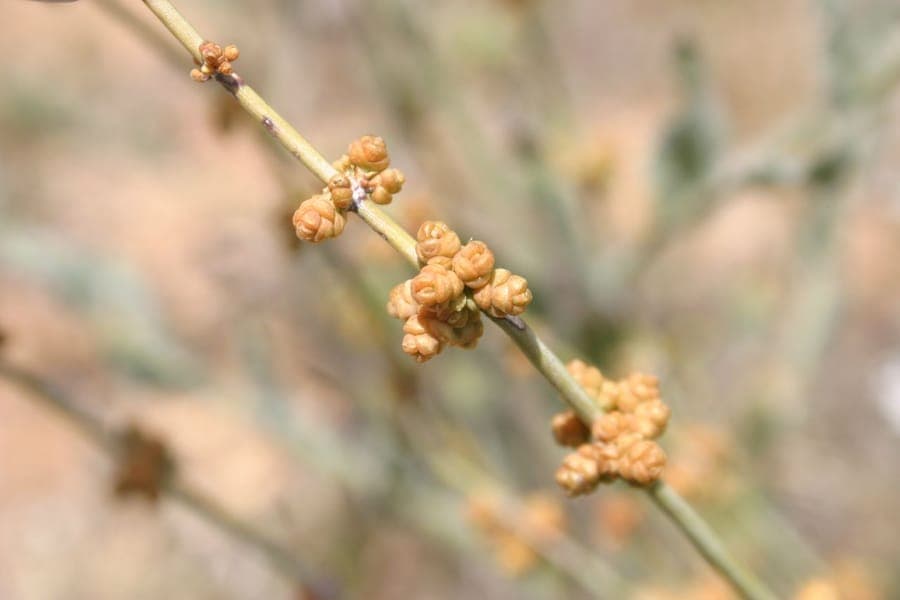
Joe Decruyenaere / CC BY-SA 2.0, via Wikimedia Commons
Nevada jointfir: complete guide to this desert shrub
Ephedra nevadensis
Want to see Nevada jointfir: complete guide to this desert shrub in your garden?
1 minute, no credit card
Overview
Ephedra nevadensis, commonly called Nevada jointfir, Nevada ephedra, or Mormon tea, is one of the most ancient plant lineages still found in today's gardens. The genus Ephedra represents a lineage stretching back over 300 million years, making these plants among the oldest surviving seed plants on Earth. Ephedra nevadensis grows natively across the American Southwest - Oregon, Nevada, California, Utah, Arizona, and into northwest Mexico - where it colonises rocky slopes, dry desert flats, and gravelly washes with remarkable tenacity. For gardeners seeking truly drought-resistant, structural plants with year-round interest, this is a plant worth knowing well. Explore how plants like Nevada jointfir can transform a dry garden at gardenworld.app.
The plant is immediately distinctive: instead of conventional leaves it carries slender, jointed, blue-green stems that perform photosynthesis directly. The true leaves are reduced to tiny scale-like sheaths at each stem node - an evolutionary adaptation that minimises water loss with extraordinary efficiency. The result is a plant with an almost prehistoric appearance that sits beautifully in gravel gardens, rock gardens, and contemporary dry-garden schemes.
Appearance and bloom cycle
Ephedra nevadensis forms a multi-stemmed, broadly spreading shrub, typically 60 to 120 cm tall and up to 150 cm wide. The stems emerge in graceful, arching clumps from the base, giving the plant a flowing, fountain-like silhouette. The colour of the stems shifts subtly through the seasons: bright fresh green in spring and summer, becoming slightly more grey-blue in winter. Unlike deciduous shrubs, Ephedra nevadensis retains its green stems through winter, providing valuable structure and colour in a dormant border.
Flowering occurs in early spring (March to April). The blooms are small and inconspicuous - pale yellow-green cones clustered at the stem nodes. The plant is dioecious, meaning male and female flowers occur on separate individuals. Female plants that have been pollinated by nearby males develop small, brown, seed-bearing cones in late spring. These attract bees and other pollinators but are not showy in the conventional sense. The ornamental appeal of Nevada jointfir lies firmly in its year-round stem structure and overall form.
Ideal location
Full sun is essential. In its natural habitat Ephedra nevadensis grows on exposed slopes and open plains with no overhead canopy - it is a plant shaped entirely by intense, unrelenting sunlight. In the garden, choose a position with at least six hours of direct sun daily. In partial shade the plant becomes loose and open in structure and grows more slowly.
Nevada jointfir is well suited to rock gardens, gravel gardens, and Mediterranean or desert-inspired borders. It also works well as a standalone specimen in a large container on a sunny terrace. Its wind tolerance and resistance to salt-laden air make it an excellent candidate for coastal gardens. The year-round structural interest means it holds its place in a planting scheme even when neighbouring plants are dormant or have been cut back.
Soil
The overriding requirement is drainage. Ephedra nevadensis cannot tolerate heavy, waterlogged clay or persistently moist soil. In the wild it thrives on poor, sandy, and gravelly soils - often calcareous - with a pH between 7.0 and 8.5. In the garden, work generous quantities of coarse horticultural sand and fine gravel into the planting area. A 5 cm layer of gravel as a top dressing around the base helps keep the root crown dry and suppresses moisture-retaining weeds.
For container growing, use a cactus and succulent compost mixed with extra perlite or pumice to ensure rapid drainage. Avoid fertilisers: excess nutrients produce lush, soft growth that is less cold-tolerant and less visually attractive. This plant performs best on lean, mineral soil.
Free design
Want to see Nevada jointfir: complete guide to this desert shrub in your garden? Make a free design now.
Watering
Once established, Ephedra nevadensis is among the most drought-resistant shrubs available to gardeners in temperate climates. In its native range it survives months-long dry seasons without any supplemental water. In a garden setting, water every two to three weeks during the growing season, always waiting until the soil around the roots has dried completely. During summer heat, weekly watering at most is sufficient and only in the most extreme conditions.
In winter the plant is largely dormant and needs minimal water - none at all if the ground receives occasional rainfall. Container-grown plants need careful attention: ensure drainage holes are fully functional and never allow water to pool in the saucer beneath the pot. Yellowing or browning of stems - particularly at the base - is a reliable indicator of root rot caused by overwatering.
Pruning
Ephedra nevadensis requires very little pruning and tolerates it well when needed. The most useful time to prune is early spring, just before new growth begins. At this point you can remove any dead, damaged, or frost-affected stems cleanly at their base. If the plant has grown larger than desired, you can reduce it by cutting back individual stems to a lower joint - the plant will re-sprout from the cut point.
A light summer trim can keep outward-reaching stems in check. Avoid heavy pruning in late autumn or winter, as fresh cuts during cold weather can be entry points for fungal disease. The stems are architecturally attractive on their own and benefit from selective rather than wholesale removal.
Maintenance calendar
January - February: Little action needed; ensure container plants are in a well-lit position. Water rarely. March - April: Flowering and new stem growth begins; prune lightly if needed. Begin watering every two weeks. May - June: Full growth underway; water every two weeks. Remove any weak or damaged stems. July - August: Peak summer heat; water weekly in extreme drought, otherwise every two weeks. September - October: Growth slows; reduce watering progressively. November - December: Winter rest; minimal watering. Protect container-grown plants from prolonged hard frost.
Winter hardiness
Ephedra nevadensis is impressively cold-hardy for a desert plant. It tolerates temperatures down to approximately -15 degrees Celsius, placing it in USDA zones 5 to 6. This makes it suitable as a permanent outdoor plant throughout most of northwestern Europe, including the UK, the Netherlands, Belgium, and Germany. In normal winters it requires no protection. Only during prolonged extreme cold - combined with freeze-thaw cycles and frozen ground - is it worth mulching the root zone with a layer of gravel or bark.
Container-grown specimens are slightly less cold-tolerant because the roots have less soil insulation. In severe winters, move large containers to an unheated but frost-free shed or garage, or wrap the pot in insulating material.
Companion plants
The year-round blue-green stems of Ephedra nevadensis make it a natural structural anchor in a dry or Mediterranean garden. It combines well with other drought-tolerant plants including Artemisia species, lavender (Lavandula angustifolia), rosemary (Salvia rosmarinus), Yucca, Agave, and various Festuca cultivars. In a rock garden, low-growing Sedums and ornamental Alliums make good companions. For colour contrast, the golden flowers of Encelia farinosa or the red-pink blooms of Salvia greggii complement the cool tones of the Ephedra stems beautifully.
Visit gardenworld.app to discover how Nevada jointfir and similar structural plants can be combined into a cohesive, water-wise garden design.
Closing
Ephedra nevadensis is a plant with genuine depth of character: ancient in origin, sculptural in form, and superbly adapted to the conditions that defeat most ornamental plants. Whether you are drawn to it for its year-round stem colour, its extreme drought tolerance, or its botanical curiosity, Nevada jointfir repays your attention with minimal demands in return. A well-chosen specimen will provide decades of low-maintenance structure in a dry or Mediterranean garden.
Want to see Nevada jointfir: complete guide to this desert shrub in your garden? Make a free design now.
Upload a photo, pick a style, and get a photorealistic design with plant list in under a minute.
10,000+ gardens designed already
No credit card required


Similar plants
Brittlebush: complete guide to this silver desert shrub
Encelia farinosa
Full growing guide for Brittlebush (Encelia farinosa): a drought-tolerant desert shrub with silver leaves and golden flowers for sunny gardens.
Longleaf jointfir: complete guide to Ephedra trifurca
Ephedra trifurca
Full growing guide for Ephedra trifurca (longleaf jointfir / longleaf Mormon tea): a resilient desert shrub with long jointed stems for dry, sunny gardens.