
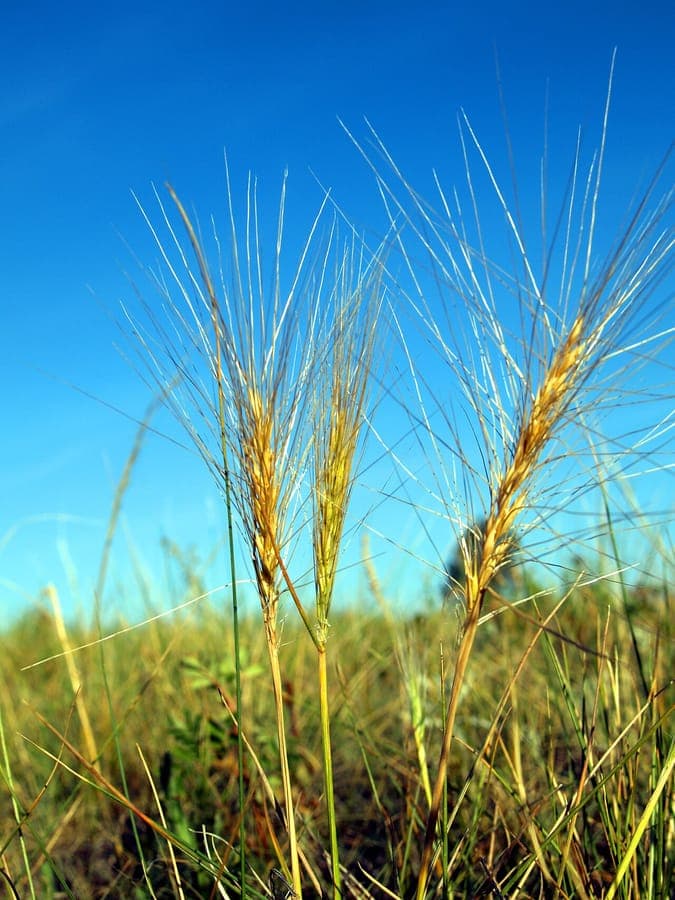
Jim Pisarowicz / Public domain, via Wikimedia Commons
Squirreltail grass (Elymus elymoides): complete guide
Elymus elymoides
Want to see Squirreltail grass (Elymus elymoides): complete guide in your garden?
1 minute, no credit card
Overview
Elymus elymoides, known in North America as bottlebrush squirreltail or simply squirreltail grass, is a tufted, ornamental grass in the family Poaceae. Native across a vast sweep of western Canada and the United States - from Alberta and British Columbia through the Great Plains states down to Arizona, New Mexico and the Mexican state of Coahuila - it grows on open prairies, rocky slopes and dry road verges where most plants struggle to survive. The species was formerly placed in the genus Sitanion before being reclassified as Elymus.
The plant's outstanding feature is the seed head: each spike carries long, stiff, spreading awns that can reach 10 cm in length, creating a structure that resembles a bottlebrush or, as the common name suggests, the bushy tail of a squirrel. These feathery spikes catch the light brilliantly and tremble in the slightest breeze, bringing movement and texture to garden compositions long after the main flowering season ends. gardenworld.app showcases numerous planting designs where grasses like this take centre stage in naturalistic and drought-resilient schemes.
Appearance and bloom cycle
Elymus elymoides forms dense, compact tufts of fine, blue-green to grey-green leaves. The foliage is narrow, linear and has the fine texture typical of grasses adapted to dry environments. Leaf colour shifts in autumn from blue-green to golden yellow or bronze-straw, adding a second season of interest.
The flower spikes appear from late spring into early summer, generally between May and July. They are the plant's main attraction: each spike consists of loosely spaced spikelets from which the characteristic long, straight-to-slightly-curved awns project in all directions. As the awns mature and the seeds ripen, the spikes dry to a warm straw-gold colour that persists attractively through winter. Once seeds are fully ripe, the awns become more flexible and the plant may self-seed on open, well-drained ground nearby.
Ideal location
Squirreltail grass is a full-sun plant. It performs best in a position receiving direct sunlight for most of the day; part shade is tolerated but results in looser clumps and fewer flower spikes. In its natural range it occupies open, exposed positions - flat plains, stony hillsides and dry verges - where competition from taller plants is minimal.
In garden settings, it is an excellent choice for gravel gardens, xeriscape plantings, green roofs, rock gardens and prairie-style borders. The grass works particularly well as a textural foil to broad-leaved perennials and sub-shrubs in a dry mixed border. Planted at the edge of a path or alongside a gravel drive, it provides a relaxed, contemporary look with virtually no maintenance.
Soil
Elymus elymoides is adaptable to a wide range of soil types as long as drainage is good. It grows naturally on sandy, stony, gravelly or even clay-based soils, tolerating a pH from 6.0 up to 8.4. This alkaline tolerance sets it apart from many ornamental grasses and makes it an option for gardens on chalky or limestone-based substrates.
On heavy clay, improve drainage by working in coarse grit or gravel before planting. On light sandy soils, no amendment is necessary. Avoid enriching the soil with heavy applications of fertiliser; fertile conditions encourage lush, floppy foliage at the expense of the upright, compact habit that makes the plant attractive.
Free design
Want to see Squirreltail grass (Elymus elymoides): complete guide in your garden? Make a free design now.
Watering
Once established - typically after one full growing season - squirreltail grass needs little to no supplemental water in average temperate conditions. During the establishment year, water regularly to encourage root development, but thereafter rely on natural rainfall except during prolonged drought. A deep, occasional soak is more beneficial than frequent shallow applications.
The grass is genuinely drought-tolerant and is increasingly valued in low-water garden designs. Overwatering or poorly drained positions are the primary cause of failure; consistently wet soil around the crown leads to rot and decline. Choose the planting site with this in mind.
Pruning
Elymus elymoides requires minimal cutting. The grass is semi-evergreen to evergreen depending on winter severity. In mild winters the foliage remains largely intact; after a cold winter it browns off and collapses.
The best time to cut back is in early spring, during February or March, before new growth emerges. Cut the clump down to around 10 to 15 cm above ground level. Avoid cutting in late summer or autumn so that the ornamental seed heads remain on the plant through winter - the dried spikes are genuinely attractive and provide seeds for birds. Every three to four years, if the centre of the clump becomes sparse, lift, divide and replant the outer sections in spring.
Maintenance calendar
January-February: Dried seed heads remain decorative. Check that clumps are not sitting in standing water.
March: Cut back old foliage to 10-15 cm. No fertiliser needed unless soil is extremely poor.
April-May: New leaves emerge. Divide and replant overcrowded clumps. Planting from pot is ideal at this time.
May-July: Flowering and spike season. Enjoy the ornamental effect. No watering needed unless severe drought.
August-September: Seeds ripen. Leave spikes standing for winter effect and wildlife.
October-December: Dormant period. Dried spikes continue to ornament the garden. No action needed.
Winter hardiness
Squirreltail grass is highly cold-hardy. Native to regions that experience harsh continental winters, the species is reliably hardy to USDA zone 4 and below, tolerating temperatures down to -35 degrees Celsius and beyond. In northern and central Europe, including the UK, the Netherlands and Germany, it overwinters in the open ground without any protection in all but the most exposed upland sites.
The only significant winter risk is prolonged waterlogging combined with frost on poorly drained soils. On a freely draining site, no winter protection is needed or warranted.
Companion plants
Elymus elymoides combines naturally with other drought-tolerant, sun-loving plants. Lavender (Lavandula angustifolia), catmint (Nepeta) and ornamental sage (Salvia nemorosa) provide complementary flower colour alongside the structural seed heads. Echinacea, Rudbeckia and Penstemon bring summer and late-summer colour to the same sunny, dry border.
In a gravel or xeriscape planting, partners such as Sedum, Festuca glauca, Stipa tenuissima and Artemisia share identical site and soil preferences. gardenworld.app provides a range of planting designs for dry, sunny borders where grasses like squirreltail are used alongside flowering perennials and low sub-shrubs.
For prairie-inspired schemes, combine with Agastache, Achillea and Oenothera to create a pollinator-friendly planting with a long season of interest.
Closing
Elymus elymoides is a grass that earns its place in any dry, sunny garden with the minimum of fuss. The extraordinary seed heads - those brushy, bristling spikes that sway and glitter in the wind - are among the most distinctive structural features any grass can offer. Plant it in good light and well-drained soil, water sparingly after establishment, and cut back once a year in early spring. In return, it will deliver movement, texture and seasonal interest from May through to the following February with almost no demands on your time or water supply.
Want to see Squirreltail grass (Elymus elymoides): complete guide in your garden? Make a free design now.
Upload a photo, pick a style, and get a photorealistic design with plant list in under a minute.
10,000+ gardens designed already
No credit card required


Similar plants
Sporobolus pungens: complete guide
Sporobolus pungens
Sporobolus pungens is a stoloniferous Mediterranean coastal grass with outstanding salt and drought tolerance, perfect for seaside and dry gardens.
Mediterranean aegilops: complete guide
Aegilops biuncialis
Everything about Aegilops biuncialis, a Mediterranean annual grass with ornamental spikes and outstanding drought tolerance for dry gardens.
Silver bluestem: complete guide
Bothriochloa saccharoides
Full guide to Bothriochloa saccharoides (silver bluestem): site, soil, watering, winter hardiness, pruning, and garden companions.