
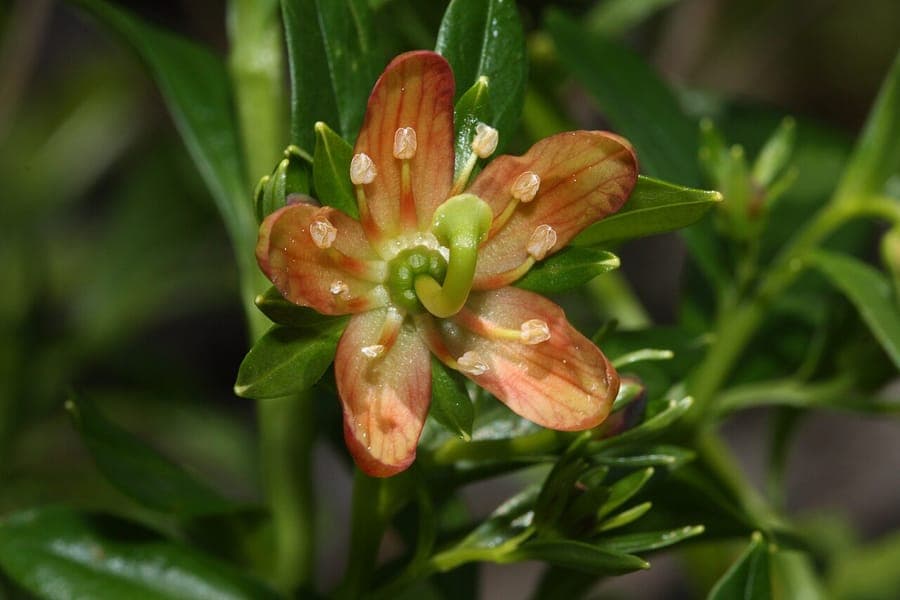
Walter Siegmund (talk) / CC BY-SA 3.0, via Wikimedia Commons
Copperbush: complete guide
Elliottia pyroliflora
Want to see Copperbush: complete guide in your garden?
1 minute, no credit card
Overview
Elliottia pyroliflora, commonly known as copperbush or copperflower, is a distinctive shrub in the family Ericaceae native to the moist, montane forests of Alaska, British Columbia, Washington and Oregon. The common name perfectly captures the plant's most striking feature: the copper-toned to salmon-orange flowers that emerge in summer and glow warmly against the fine, dark-green foliage. Once classified under the synonym Cladothamnus pyroliflorus, the species was reassigned to Elliottia in 1978.
In European gardens the copperbush remains a specialist's plant, sought after by woodland-garden enthusiasts who value unusual shrubs with natural character. The plant forms thicket-like colonies in the wild, making it useful as a larger-scale ground cover or habitat plant in the right setting. gardenworld.app features a number of designs combining copperbush with complementary woodland companions, giving you ready-made inspiration for recreating this Pacific Northwest atmosphere closer to home.
Appearance and bloom cycle
Copperbush is an upright to slightly spreading shrub with finely branched stems. Its leaves are narrow, elliptical and leathery, bearing a resemblance to those of pyrola (wintergreen) - hence the species epithet pyroliflora, meaning "pyrola-flowered". Foliage colour is medium green throughout the growing season, and the plant tends to hold its leaves well into autumn.
The flowers are the standout attraction. They appear from June through August, carried singly or in small clusters along the tips of the current year's growth. Each flower has reflexed petals in copper-red, salmon or orange-bronze tones - colours you rarely see in shrubs of comparable size and hardiness. The exposed stamens and pistil give the flowers an open, star-like appearance typical of the heath family. After blooming, small red to brownish fruits develop and add further seasonal interest.
Ideal location
Copperbush thrives in conditions that mimic the understorey of a Pacific coastal conifer forest: part shade to light dappled shade, sheltered from desiccating winds, with consistently moist, humus-rich soil. Full sun exposure is possible but demands excellent moisture retention to prevent stress.
The most successful placements in garden settings are at the edge of a woodland planting, alongside a pond or stream, or as part of a mixed ericaceous bed together with rhododendrons and pieris. The plant's loose, arching habit means it looks best in informal, naturalistic designs rather than clipped formal borders. Avoid hot, south-facing walls or positions in strong, drying wind.
Soil
As a member of the Ericaceae, copperbush requires acidic soil. The optimum pH range is 5.0 to 6.0 - the same bracket as rhododendrons, blueberries and leucothoe. Alkaline or chalk-based soils will cause chlorosis (yellowing leaves) and poor growth.
The soil must be free-draining yet moisture-retentive. Amend heavy clay by incorporating generous quantities of composted bark, peat or leaf mould before planting. Light sandy soils benefit from added organic matter to improve water-holding capacity. A permanent mulch of conifer needles, shredded bark or chopped oak leaves acidifies the surface gradually and maintains an even soil temperature around the roots. Specialist ericaceous composts and fertilisers are widely available at garden centres across the UK and Ireland.
Watering
Regular watering throughout the growing season is essential, particularly during dry spells in June and July. Copperbush dislikes drought but is equally intolerant of waterlogging; the goal is a consistently moist root zone without standing water.
Rainwater or soft water is strongly preferable to hard tap water, which raises soil pH over time. In regions with neutral to alkaline mains supply, collecting rainwater in a butt is the most practical long-term solution. A deep mulch layer of 8 to 10 cm applied in late April helps lock in soil moisture through summer. Container-grown specimens will need watering more frequently than border-planted ones, potentially every other day during hot, dry weather.
Free design
Want to see Copperbush: complete guide in your garden? Make a free design now.
Pruning
Copperbush requires minimal pruning. The natural form is graceful and well-proportioned, so hard cutting is rarely needed. Each spring, in February or March, remove any winter-damaged stems cleanly at the base. A light shaping to contain spread is acceptable, but avoid cutting back into old, bare wood since the plant regenerates slowly.
Spent flowers do not need to be deadheaded; the small fruits that follow contribute ornamental value and provide food for birds and small mammals. If a mature plant becomes leggy or unbalanced, selective removal of the oldest stems in early spring stimulates new growth from the base and restores a compact outline without the risks of a full cut-back.
Maintenance calendar
January-February: Protect young plants with horticultural fleece during hard frost. Check mulch is intact over the root zone.
March: Remove dead and damaged wood. Apply an ericaceous fertiliser. Light shaping if needed.
April-May: New planting is ideal. Monitor soil moisture; start watering regularly if dry spells extend beyond one week.
June-August: Main flowering period. Water deeply during drought. Keep root area weed-free.
September-October: Autumn colour develops. Top up mulch with fresh conifer needles or bark.
November-December: Dormant period. Insulate container specimens in a sheltered, frost-free location if temperatures fall below -15 degrees Celsius.
Winter hardiness
Elliottia pyroliflora is native to areas with cold, snowy winters and proves reliably hardy to USDA zone 5, tolerating temperatures down to approximately -20 degrees Celsius. In the UK and the low-lying areas of northwest Europe (zones 7-8), it overwinters without protection once established.
In the first two winters after planting, a protective mulch and occasional wrapping with fleece during severe cold snaps will improve survival. The greatest risk in mild maritime climates is not extreme cold but the repeated freeze-thaw cycles of a typical wet winter - good drainage and a thick mulch layer are the most effective safeguards against root damage.
Companion plants
Copperbush partners naturally with other acid-loving woodland plants. Rhododendrons and deciduous azaleas share the same soil and light requirements and bloom at overlapping times, creating a sustained spring-to-summer floral display. Ferns - particularly Dryopteris, Osmunda and Athyrium - provide architectural foliage contrast through the growing season.
Other ericaceous companions worth considering include Kalmia latifolia, Leucothoe fontanesiana and Pieris japonica. For ground cover beneath the canopy, Gaultheria procumbens and Pachysandra terminalis fill in bare soil without competing aggressively. Vaccinium (blueberries and bilberries) serve dual purpose as both ornamental and edible partners on the same acid soil.
gardenworld.app offers a library of planting plans specifically designed around woodland and naturalistic settings, including combinations that feature copperbush alongside its ideal companions.
Closing
Elliottia pyroliflora is one of those plants that rewards patience and the right conditions with something genuinely unusual: a naturally elegant shrub, warm copper flowers in midsummer, and year-round structural interest with minimal fuss. It is not the easiest plant to source - specialist nurseries and mail-order ericaceous plant specialists are the most reliable outlets - but the search is worthwhile. Plant it in the right spot, give it an acid, moist, humus-rich soil and reasonable shelter, and the copperbush will establish quietly and then surprise you with its beauty every summer for decades.
Want to see Copperbush: complete guide in your garden? Make a free design now.
Upload a photo, pick a style, and get a photorealistic design with plant list in under a minute.
10,000+ gardens designed already
No credit card required


Similar plants
Zenobia pulverulenta: complete guide
Zenobia pulverulenta
Everything about Zenobia pulverulenta (honeycup): siting, acid soil, pruning and the fragrant white bells, in this complete care guide.
Dwarf huckleberry: complete guide
Gaylussacia dumosa
Everything about dwarf huckleberry (Gaylussacia dumosa): acidic soil, partial shade, pruning and care for this compact North American berry shrub.
Drooping leucothoe: complete guide
Leucothoe fontanesiana
Everything about drooping leucothoe (Leucothoe fontanesiana): shade tolerance, soil, watering, pruning, hardiness and companion plants.