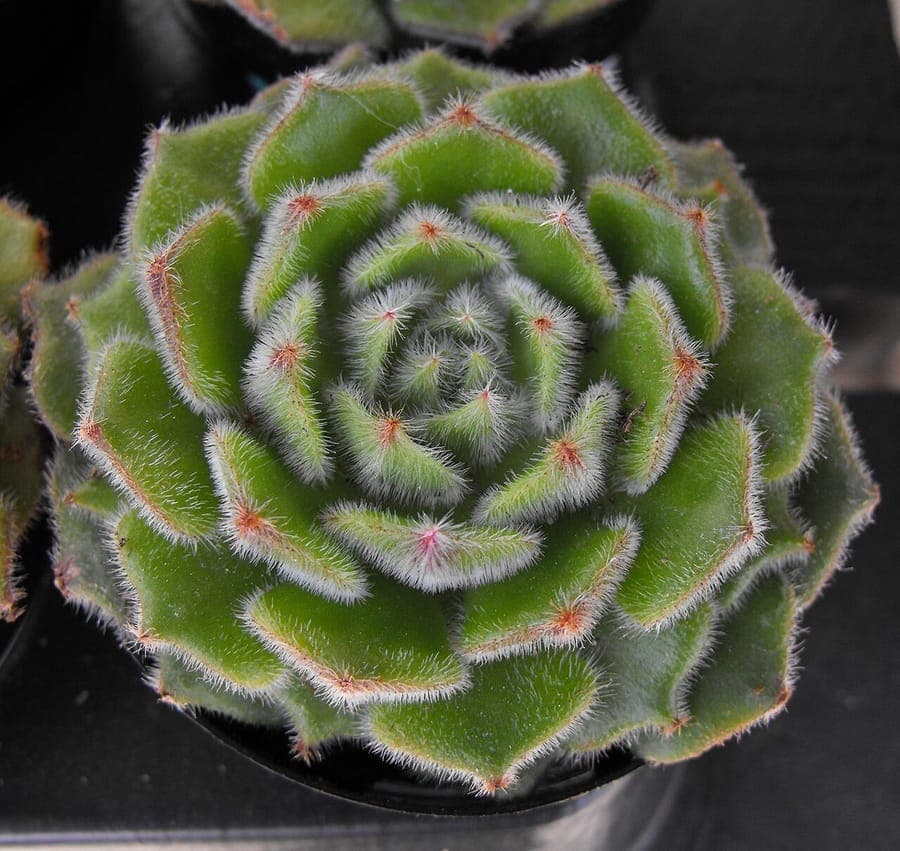
Stickpen / Public domain, via Wikimedia Commons
Mexican firecracker (Echeveria setosa): complete guide
Echeveria setosa
Want to see Mexican firecracker (Echeveria setosa): complete guide in your garden?
Full design in HD: €7.99
Look after your Mexican firecracker with the GardenWorld app
Identify plants with your camera and get a care calendar with reminders for this plant.


Overview
Echeveria setosa is the echeveria you cannot resist touching. Its fleshy green leaves are covered in fine white hairs, most visible along the edges and at the tips, which give the whole rosette a soft, silvery sheen. Setosa simply means "bristly". In English it goes by the name Mexican firecracker, after its fiery red flowers tipped with yellow.
It comes from semi-arid parts of Mexico, especially the state of Puebla, where it grows in rocky spots with strong light, dry air and a pronounced dry season. Several varieties have been described, including var. ciliata, var. deminuta, var. minor and var. oteroi, which differ in size and in how densely hairy they are. The photo at the top of this page shows var. ciliata, with its hairs concentrated along the leaf margins.
If you already grow Echeveria secunda or another blue echeveria, you will soon notice that setosa has a very different personality. It stays flat and compact, produces far fewer offsets and is more sensitive to damp and cold. It is a plant for a sunny windowsill or a bright conservatory rather than an outdoor trough. If you want your indoor and patio plants to work together as a whole, you can have a garden design made on gardenworld.app that takes your containers into account as well.
Appearance and flowering
A mature rosette is low, usually only a few centimetres tall, and around 10 to 15 cm across. After a few years some plants form a small cluster of rosettes. The leaves are spoon-shaped, thick and fresh green, ending in a blunt point, and the tips blush reddish in strong light. The hairs are the most striking feature: in the typical form white hairs cover the whole leaf, while in var. ciliata they sit mainly along the edges.
In spring, flower stems up to about 30 cm rise above the rosette. They carry short clusters of tubular flowers, red with yellow tips, like tiny fireworks. The stems and sepals are lightly hairy too. Flowering lasts a few weeks and, outdoors, attracts bees.
Light and position
Give Echeveria setosa a very bright spot with a few hours of direct sun, ideally morning or evening sun. An east-, west- or south-facing window suits it. Behind south-facing glass, fierce midday sun in summer can be too much: the hairs offer some protection, but a plant moved suddenly into blazing light still scorches. In too little light the rosette stretches and loses its compact shape.
In summer it can go outside, but only under cover or somewhere it will not be rained on for hours. The hairs hold on to water droplets, and leaves that stay wet invite rot and mould. A windowsill, a bright porch or a cool greenhouse is therefore its best home.
Watering and rest
Watering takes a little more care than with smooth-leaved echeverias. Never pour water over the rosette: it lingers among the hairs and can rot the heart. Water around the edge of the pot onto the compost, or stand the pot in a tray of water for a quarter of an hour and then let it drain thoroughly. Bottom-watering suits this plant particularly well.
From April to September, water as soon as the compost is completely dry, which in a warm room is roughly every ten days to two weeks. In winter it barely grows. Keep it almost dry then: a little water once a month, and less if it is kept cool. It dislikes high humidity, so do not put it in a steamy bathroom or among tropical houseplants that get misted regularly.
Free preview
Want to see Mexican firecracker (Echeveria setosa): complete guide in your garden? Make a free preview of your design.
Potting mix and repotting
Use a very open mix: about half cactus compost and half pumice, lava rock or coarse sand. A terracotta pot that is not too large keeps the roots dry. Top-dress with a centimetre of fine grit so the hairy lower leaves never rest on damp compost.
Repot only when the plant has outgrown its pot, usually every two to three years in spring. Handle the leaves gently: they snap off fairly easily, and touched hairs become flattened and grubby. Wait a week before watering after repotting. Feed no more than twice per growing season with half-strength cactus fertiliser.
Grooming
No pruning is needed. Cut spent flower stems low down and remove dead lower leaves with tweezers, as mealybugs and moulds settle easily among the hairs. Remove dust with a soft paintbrush, never a damp cloth or a mister. Check between the leaves regularly: mealybugs are harder to spot on a hairy plant than on a smooth one.
Propagation
The simplest way to propagate Echeveria setosa is from the offsets older plants sometimes produce. Cut them off in spring, let them dry for a few days and set them on a dry mix of sand and cactus compost. Only start watering, carefully, after a week or two.
Leaf cuttings are possible but slower than with smooth echeverias. Twist off a healthy leaf with its base intact, let it dry for a few days and lay it on dry compost in good light, without misting. After a few weeks, roots and a tiny rosette may appear. Be patient: it takes years for such a cutting to become a full-sized rosette.
Care calendar
March: gradually increase watering; repot if needed.
April to May: flowering time. Take offsets or leaf cuttings.
June to August: bright light with some shelter from fierce midday sun; bottom-water when the compost is dry.
September: last feed; start reducing water.
October: bring indoors before nights fall below 10 °C.
November to February: bright, cool to moderately warm and almost dry.
The plant calendar on gardenworld.app can remind you when it is time to water or repot.
Winter hardiness
Echeveria setosa is clearly frost-tender, more so than Echeveria secunda. Keep it above about 7 °C in winter, ideally between 8 and 15 °C in very good light. A cool, bright bedroom or a heated greenhouse is ideal; a warm living room works too, but the plant will stretch more quickly. Cold and damp together are the real danger: in a chilly, humid spot the hairy rosettes rot fast.
Toxicity for pets
The ASPCA lists echeverias as non-toxic to cats and dogs, and that includes Echeveria setosa. The fine hairs may mildly irritate the skin or mouth of some people and animals, but no serious problems are known. It is still wise to keep it out of reach: a cat that chews it will ruin the rosette, and eating a lot of leaves can cause a mildly upset stomach.
Companion plants
A group of hairy succulents on a windowsill is a joy to touch. Echeveria pulvinata, with velvety leaves on short stems, has the same needs. Kalanchoe tomentosa adds a felted shape with brown-edged leaves. A trailing Sedum morganianum in a taller pot brings movement, and a Crassula ovata gives height at the back. Ideally choose plants that also do without misting, so you can water the whole group the same way.
Final thoughts
Echeveria setosa is a small, soft presence among succulents, with a surprisingly fiery display every spring. It asks for just a little more care than its smooth relatives: water on the compost rather than the leaves, dry air, plenty of light and a frost-free winter above 7 °C. Respect that rhythm and this unusual Mexican rosette will give you years of pleasure.
Frequently asked questions about Mexican firecracker
Is Mexican firecracker winter hardy?
Echeveria setosa is clearly frost-tender, more so than Echeveria secunda. Keep it above about 7 °C in winter, ideally between 8 and 15 °C in very good light.
How much water does Mexican firecracker need?
Watering takes a little more care than with smooth-leaved echeverias. Never pour water over the rosette: it lingers among the hairs and can rot the heart.

See it in your garden
See Mexican firecracker in your garden
One photo of your garden and a few questions. You see the result in about a minute.
Try it with a photoIdentify this plant in your own garden. Identify a plant
Similar plants
Echeveria pulvinata: complete guide
Echeveria pulvinata Rose
Discover Echeveria pulvinata, an exotic succulent with velvety blue-green leaves. Perfect houseplant and garden plant. Growing tips, propagation and care advice.
Kalanchoe tomentosa: complete guide
Kalanchoe tomentosa Baker
Panda plant (Kalanchoe tomentosa) is a fuzzy-leaved succulent from Madagascar with woolly foliage and purple flowers. Perfect for living rooms, windowsills, and dry zones.
Sedum morganianum: complete guide
Sedum morganianum
Burro's-tail succulent from Mexico: elegant trailing plant with watery-green, bead-like foliage. Perfect for hanging baskets and living walls.
