
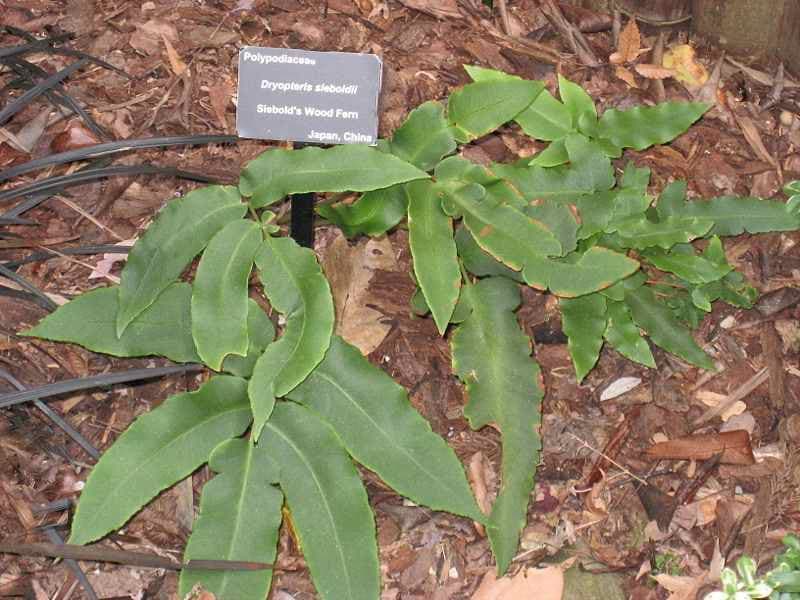
--FinitoR originally uploaded as Daderot / CC BY-SA 3.0, via Wikimedia Commons
Dryopteris sieboldii: complete guide
Dryopteris sieboldii
Want to see Dryopteris sieboldii: complete guide in your garden?
1 minute, no credit card
Overview
Dryopteris sieboldii, also known as Siebold's Buckler Fern or Siebold's Swordfern, is a graceful and persistent fern species from East Asia. This plant naturally grows in the mountainous regions of South China, Central China, and Japan. It is a member of the Polypodiaceae family, along with many other beautiful ferns.
In gardens, this fern becomes increasingly popular for its elegant architecture, persistent foliage, and low-maintenance nature. The plant is hardy in temperate zones and creates beautiful structure in partial shade and shade gardens.
Appearance and growth
Dryopteris sieboldii forms beautiful, clustered fronds with dark green color. The frond division is doubly pinnate (pinnate-pinnulate), giving a fine, almost lace-like texture.
The height typically reaches 45-75 centimeters, depending on growing conditions. The plant grows relatively slowly and forms a dense, conical silhouette. The plant remains winter-persistent in most climates, providing value throughout all seasons.
Ideal location
Dryopteris sieboldii prefers partial to full shade. It grows best in a protected location with indirect bright light. Avoid direct sun, which can damage fronds.
Use this fern in shaded borders, under trees, in rock gardens, or against walls. It combines well with other shade-lovers. The plant also lends itself to container growing in pots in protected locations.
Soil
Dryopteris sieboldii grows best in moist, nutrient-rich soil. A pH range of neutral to slightly acidic (5.5 to 7.0) is ideal. The plant prefers soil with plenty of organic matter (humus).
Improve poor soil with plenty of compost or leaf mold. Ensure good drainage to prevent waterlogging. Mulching around the base helps retain moisture.
Watering
Dryopteris sieboldii requires regular water during the growing season. Keep the soil moist but not soggy. Water when the top inch feels dry.
Water during dry periods. Once established, the plant is fairly drought-tolerant, though regular watering stimulates better growth. Moisture retention is important, so mulching helps.
Free design
Want to see Dryopteris sieboldii: complete guide in your garden? Make a free design now.
Pruning
Dryopteris sieboldii requires minimal pruning. Remove dead or damaged fronds in spring. In very cold zones, all fronds may be damaged by frost, but the plant returns from the rhizome.
If the plant grows in containers, remove dead fronds as needed. Established plants don't need fertilizing, but annual compost dressing helps growth.
Maintenance calendar
Spring (March-May): New growth appears. Clean off dead material from last year. Begin watering. Summer (June-August): Keep watering regular. Plant is in full growth. Add mulch as needed. Fall (September-November): Maintain watering. Plant prepares for winter. Protect from extreme wind. Winter (December-February): Plant is semi-dormant in cold zones. Minimal watering. In very cold zones protect with extra mulch.
Winter hardiness
Dryopteris sieboldii is hardy in zones 6-9 (minimum temps to about -18 degrees C). In zone 5 protect plant with extra mulch in severe winters. In zone 10+ grow in partial shade in somewhat more humid locations.
The plant is semi-evergreen in mild zones, so it can remain vibrant and year-round green through much of winter.
Companion plants
Dryopteris sieboldii combines well with:
- Other ferns: Polystichum, Dryopteris erythrosora, Athyrium
- Shade-lovers: Heuchera, Carex, Hosta
- Bloomers: Helleborus, Lamium, Epimedium
- Low shrubs: Sarcococca, Daphne, Euonymus
The plant brings elegant green structure to shady planting needs.
Closing
Dryopteris sieboldii is an essential fern for shaded environments. With its elegant form, persistent foliage, and low-maintenance nature, it brings year-round beauty and structure. Plant in moist, nutrient-rich soil and enjoy this Asian jewel for decades. Find seeds or plant material at specialized garden centers. More ideas for shade gardens await at gardenworld.app.
Want to see Dryopteris sieboldii: complete guide in your garden? Make a free design now.
Upload a photo, pick a style, and get a photorealistic design with plant list in under a minute.
No credit card required


Similar plants
Dryopteris tyrrhena: complete guide
Dryopteris tyrrhena
Discover Dryopteris tyrrhena (Mediterranean Buckler-fern), a rare and exquisite fern species. Growing tips, care, and shade garden design.
Dryopteris villarii: complete guide
Dryopteris villarii
Dryopteris villarii, known as rigid buckler fern, is a shade-loving fern form from the Alps. Discover how to grow and maintain this elegant alpine fern in your garden.
Polystichum dudleyi: complete guide
Polystichum dudleyi
Dudley's swordfern: a California native fern for shady gardens. Cultivation, moisture management, and natural garden design tips.