
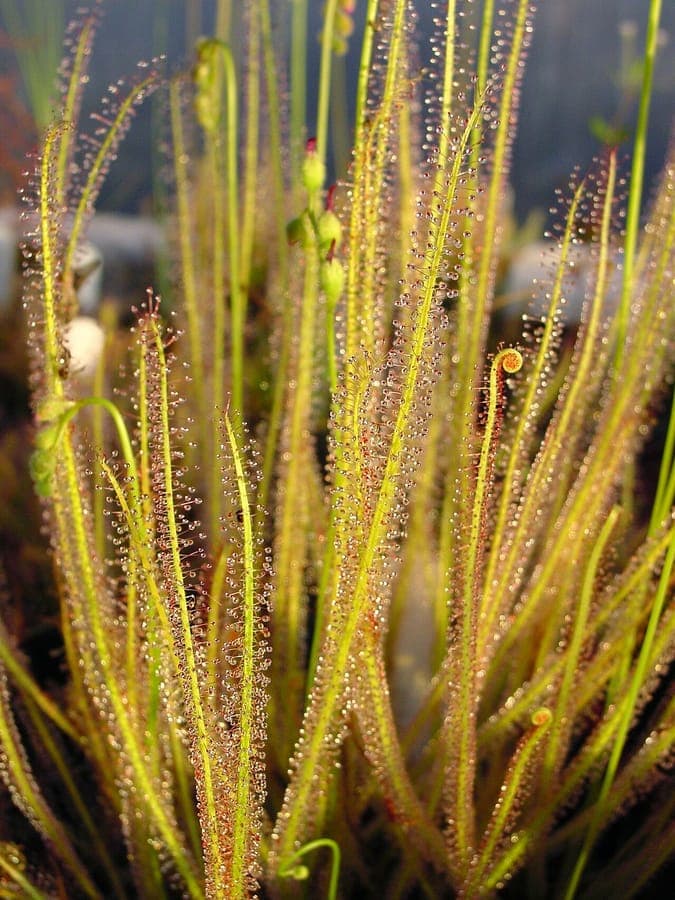
NoahElhardt / CC BY-SA 3.0, via Wikimedia Commons
Threadleaf sundew: complete guide
Drosera filiformis
Want to see Threadleaf sundew: complete guide in your garden?
1 minute, no credit card
Overview
Drosera filiformis, known as the threadleaf sundew or thread-leaved sundew, is one of the most elegant members of the Drosera genus. Native to the eastern coast of North America - from Nova Scotia in Canada south through Massachusetts, New Jersey, and the Carolinas to Florida - it grows in nutrient-poor, wet peat bogs and coastal plain wetlands. The species gets its name from the thread-like, cylindrical leaves covered with gland-tipped hairs that secrete a sticky mucilage to trap insects.
Sundews are among the oldest carnivorous plant families on earth. They capture insects using their sticky leaves, digest them through enzymatic breakdown, and absorb the resulting nitrogen and minerals to supplement the nutrient-deficient peat soils they inhabit. Anyone interested in creating a bog garden or biotope planting featuring carnivorous plants will find outstanding design inspiration at gardenworld.app.
Appearance and bloom cycle
Drosera filiformis forms a rosette of upright leaves that can reach thirty to forty centimetres in length - exceptionally long for a sundew species. The leaves are cylindrical and extremely narrow, thinner than a pencil. Along their full length they are densely covered with long, red to deep purple glandular hairs, each tipped with a glistening sticky droplet. In sunlight these droplets sparkle like dew - hence the name 'sundew'.
Flowers appear from June through August on a tall, upright flowering stem. They are pink to purple in colour, with five petals, and open one by one from the base upward. Each flowering stem can carry five to twenty blooms. The fruits are small capsules containing numerous seeds. After the blooming season, the plant forms a tight winter bud (hibernaculum) close to the ground, protecting it through the cold months.
Ideal location
Drosera filiformis requires full sun for optimal growth and the deepest colouration of its glandular hairs. At least six hours of direct sunlight per day is ideal. In partial shade the leaves grow longer and pale green, and the plant's trapping performance declines. It thrives in an open, unshaded bog setting or at the edge of a pond without tree cover.
Indoors, the plant can be kept under a strong fluorescent lamp or LED grow light, positioned fifteen to twenty centimetres from the light source. Outdoors it looks wonderful in a clay pot sitting in a saucer filled with rainwater - the classic tray method that keeps the roots continuously moist without waterlogging.
Soil
This is perhaps the most critical aspect of growing Drosera filiformis: the growing medium must be nutrient-poor and acidic. Never use ordinary potting compost, fertilisers, or lime. The standard mix for carnivorous plants is one part sphagnum moss to one part perlite or horticultural sand. A pH of 4.0 to 5.0 is optimal.
Live sphagnum moss as a top dressing keeps the medium moist and acidic, and gradually replenishes the substrate from the inside. Avoid any potting medium that contains added nutrients, as mineral salts are lethal to carnivorous plants. Most specialist garden centres stock ready-made carnivorous plant substrates if you prefer not to mix your own.
Watering
Drosera filiformis demands low-mineral water - rainwater is by far the best option. Tap water contains too much lime and mineral salts that will damage the plant over time. Reverse osmosis water or distilled water are acceptable alternatives.
The most recommended method is the tray technique: stand the pot in a saucer or tray filled to a depth of two to four centimetres with water. The roots absorb moisture continuously through capillary action. Never let the tray dry out during the growing season. In winter, when the plant forms its hibernaculum, reduce the water level to just barely moist - roots must not dry out completely, but should not sit in stagnant water.
Free design
Want to see Threadleaf sundew: complete guide in your garden? Make a free design now.
Pruning
Drosera filiformis requires no pruning in the traditional sense. Do remove dead leaves promptly, as rotting plant material can attract fungal infections that spread to healthy parts of the plant. Use clean scissors or tweezers to remove dead leaves close to the base.
After winter, when the plant emerges from its hibernaculum, removing the dried leaves from the previous season allows the new rosette to develop unobstructed. This is also a good time to divide congested clumps if the pot has become overcrowded.
Maintenance calendar
January-February: Plant in winter dormancy (hibernaculum). Keep cool at two to ten degrees Celsius. Substrate barely moist. March-April: First green shoots break from the hibernaculum. Gradually raise water level. Move to brighter position. May-June: Full growth resumes. Move outdoors to a sunny location. Apply tray watering method. July-August: Flowering period. Insects are caught and digested. Refill tray with rainwater regularly. September-October: Growth slows. Leaves begin dying back. Hibernaculum begins forming. November-December: Overwinter in a sheltered, cool location. Minimal water.
Winter hardiness
Drosera filiformis is considerably hardier than most other sundew species. It tolerates temperatures down to approximately -15 degrees Celsius and is suited to USDA hardiness zones 6 through 9. In the Netherlands, Belgium, and the UK it can overwinter outdoors in an unheated glasshouse, a cold frame, or at the base of a sheltered wall, provided it is not surrounded by frozen standing water.
The key to successful overwintering is a lightly moist substrate - not too wet, not too dry - and a temperature low enough to keep the plant dormant. In a heated space it overwinters poorly because it breaks dormancy too early. An unheated greenhouse or cool cellar is ideal.
Companion plants
Carnivorous plants do best in company with similar specialists. Drosera filiformis combines beautifully with other sundews such as Drosera rotundifolia (round-leaved sundew) or Drosera anglica (great sundew). Bog orchids like Calopogon tuberosus bloom in the same biotope and add vibrant colour to a peat garden composition.
Sarracenia pitcher plants are classic companions - they grow under identical conditions and complement the planting visually with their striking hooded pitchers. Pinguicula (butterwort) and Utricularia (bladderwort) are further carnivorous companions suited to the wet peat edge. For a fully designed bog garden, gardenworld.app offers planning tools and plant combination ideas to get the layout just right.
Closing thoughts
Drosera filiformis is one of the most refined carnivorous plants available to the home grower: elegant in form, fascinating in function, and surprisingly frost-tolerant for such an exotic-looking subject. Given low-mineral water, a nutrient-free substrate, and plenty of sun, it reveals its true beauty - glistening threads crowned with dewdrop-like mucilage that sparkle in sunlight like tiny jewels. Once drawn into the world of carnivorous plants, many growers find that Drosera filiformis becomes a permanent fixture in every specialised garden or glasshouse collection.
Want to see Threadleaf sundew: complete guide in your garden? Make a free design now.
Upload a photo, pick a style, and get a photorealistic design with plant list in under a minute.
10,000+ gardens designed already
No credit card required


Similar plants
Cape Sundew: complete guide
Drosera capensis
The fascinating Cape Sundew is a carnivorous plant with sticky leaves. Learn how to grow this unique plant successfully and watch it thrive.
Waterwheel plant: complete guide
Aldrovanda vesiculosa
A detailed guide to growing Aldrovanda vesiculosa: light, water, pH and dormancy. Perfect for ponds and aquatic setups.
Great sundew: complete guide
Drosera anglica
How to grow Drosera anglica in acidic, wet soil with full sun. Perfect for bog gardens and natural wetland plantings in temperate climates.