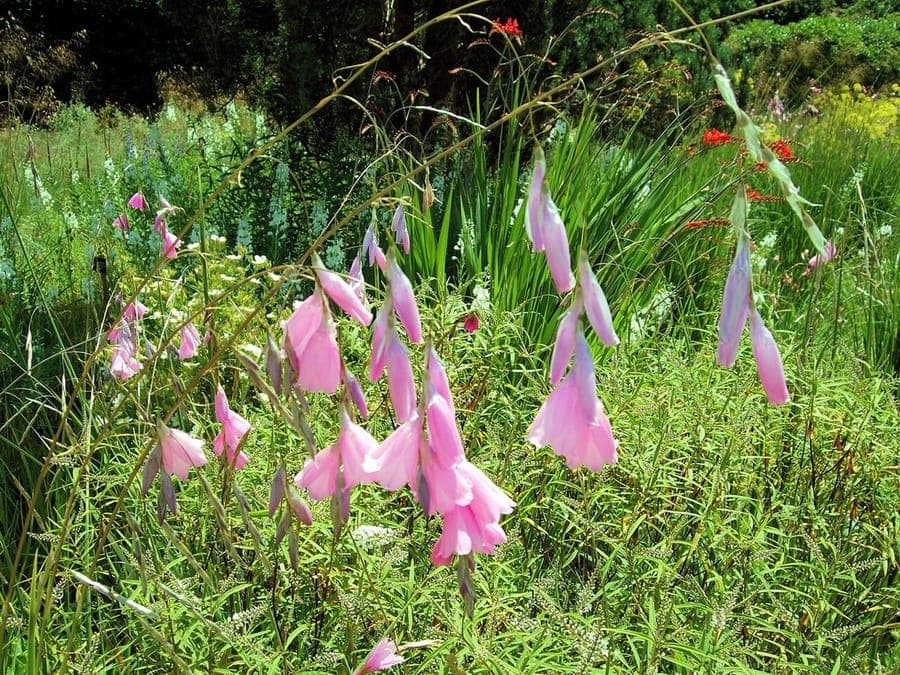
Jim Linwood from London / CC BY 2.0, via Wikimedia Commons
Dierama pulcherrimum: growing angel's fishing rod
Dierama pulcherrimum
Want to see Dierama pulcherrimum: growing angel's fishing rod in your garden?
Full design in HD: €7.99
Look after your Dierama pulcherrimum with the GardenWorld app
Identify plants with your camera and get a care calendar with reminders for this plant.


Overview
Dierama pulcherrimum is one of the most graceful perennials you can grow. From a clump of narrow, grassy leaves, long wiry stems arch outwards in summer. At their tips hang pink, magenta or white bells that sway at the slightest breeze. That is where its common names come from: angel's fishing rod, wandflower and fairy wand. The species name pulcherrimum means "the most beautiful", and anyone who has seen it in flower will understand why.
It belongs to the iris family (Iridaceae) and comes from eastern South Africa, where it grows on moist grassy slopes and along streams in full sun, with summer rain and a drier, cool winter. Below ground it forms corms that stack up year after year, so old clumps develop a solid mass. It reached British gardens in the 1860s and has been especially popular ever since in the mild, moist climate of Ireland, western Scotland and Cornwall.
As far as is known, Dierama pulcherrimum is not toxic; there are no reports of poisoning in people or pets. It is not considered invasive in Europe. It has escaped from gardens in parts of Australia, but in a north-west European climate it self-seeds only modestly. If you are unsure where such a tall, arching plant would fit, gardenworld.app can create a garden design for you that allows for the space its arches need.
Appearance and bloom cycle
The foliage is evergreen, narrow and tough, 60 to 90 cm long, and looks like a large ornamental grass. From July the flower stems appear: 1.2 to 1.5 metres long, sometimes more, as thin as a knitting needle and yet surprisingly strong. They arch outwards, so a mature plant easily spreads a metre or more.
The flowers are bell-shaped, 3 to 5 cm long, hanging in clusters from short, hair-fine stalks. In the species they are usually pink to deep magenta, but white forms exist, as do pale pink and almost purple selections such as 'Blackbird'. The buds are held in silvery, papery bracts that shimmer in the light. Flowering runs from July into September, followed by round seed capsules that dangle decoratively for weeks.
Ideal location
Angel's fishing rod needs full sun. In shade it hardly flowers and the stems hang limply. Choose a warm, sheltered spot where it has room to display its arches. It looks most beautiful beside a pond, where the flowers are reflected in the water, or above low ground cover, along a path or on a slope where you can look up into the bells.
Crucially, it hates being moved. Once established it resents transplanting and can take a year to recover, so choose the right place from the start. Buy pot-grown plants if you can and plant them out in spring, in April or May. Dry corms sold loose establish far less reliably. Allow at least 60 cm between it and its neighbours so the base of the clump is not smothered.
Soil requirements
The ideal soil is fertile, rich in organic matter and moisture-retentive in summer, but free-draining in winter. Cold, wet ground in winter rots the corms. On heavy clay, work plenty of grit and compost into the top 30 cm, or plant on a slight mound. On light sandy soil, add generous amounts of compost so the ground does not dry out in summer.
A neutral to slightly acid soil is ideal. Plant the clump at the same depth as it sat in its pot, with the corms about 5 to 8 cm below the surface. A layer of compost in spring is all the feeding it needs.
Free preview
Want to see Dierama pulcherrimum: growing angel's fishing rod in your garden? Make a free preview of your design.
Watering
In the first year after planting, angel's fishing rod needs regular water, especially in dry spells in May and June. Give 5 to 10 litres per plant each week then. Even established plants produce fewer and shorter flower stems after a dry early summer, so water during prolonged drought and mulch with compost or leaf mould.
In autumn and winter the plant needs little water; it matters more that excess rain drains away quickly. A container is not a good long-term choice, because the corms grow deep and the clumps become large.
Pruning
There is little pruning to do. Cut spent flower stems back to the base if you do not want seed. If you leave them, the capsules stay decorative into autumn and the plant will self-seed here and there. Seedlings take two to three years to flower and are often slightly different in colour from the parent.
Do not cut the evergreen foliage short. In March or April, simply remove brown, damaged or dead leaves by gently pulling them away or cutting them at the base. Divide only when it is really necessary, in spring, using a sharp spade and keeping as much soil around the corms as possible.
Maintenance calendar
January to February: dormant. In hard frost, protect the base with straw or leaf mould.
March to April: remove brown leaves and apply a layer of compost.
April to May: best time to plant new pot-grown plants.
May to June: water in dry weather while the flower stems grow.
July to September: flowering. Enjoy it, and cut a few stems for the vase if you like.
October to November: cut spent stems or leave the seed heads. Spread a thin mulch around the clump.
December: check that no water lies around the base.
You will find a handy overview of all these tasks in the planting calendar on gardenworld.app, tailored to the plants in your own garden.
Winter hardiness
Dierama pulcherrimum is moderately hardy (RHS H4) and tolerates frost down to about -8 to -10 °C, provided the soil drains well. In most of the UK it survives normal winters in a sunny, sheltered spot. In colder areas or during long, severe frosts the foliage may be damaged, but the corms usually shoot again in spring.
Protect young plants for their first two winters with straw, leaf mould or conifer branches around the base. Avoid a thick, wet layer over the heart of the clump, as this can cause rot. Wet feet in winter are a greater enemy than cold.
Companion plants
Angel's fishing rod needs low or airy neighbours so the arching stems can hang freely. Geranium sanguineum forms a low, flowering mat at its feet and enjoys the same sunny spot. Eryngium bourgatii, with its silvery-blue spiky flowers, makes an exciting contrast with the soft bells.
Ornamental grasses such as Stipa gigantea suit it well, sharing its airy, transparent character. Agapanthus africanus, also of South African origin, flowers at the same time with blue globes. Verbena bonariensis floats purple tufts between the stems and draws in butterflies.
Final thoughts
Dierama pulcherrimum is not a plant for just anywhere, but in the right spot it becomes a showstopper that visitors always ask about. Give it full sun, soil that stays moist in summer and drains well in winter, and above all peace and quiet. Plant a young pot-grown specimen in spring, leave it undisturbed, and after two or three years dozens of pink bells will sway above your border every summer.
Frequently asked questions about Dierama pulcherrimum
Is Dierama pulcherrimum winter hardy?
Dierama pulcherrimum is moderately hardy (RHS H4) and tolerates frost down to about -8 to -10 °C, provided the soil drains well. In most of the UK it survives normal winters in a sunny, sheltered spot.
When and how do you prune Dierama pulcherrimum?
There is little pruning to do. Cut spent flower stems back to the base if you do not want seed.
How much water does Dierama pulcherrimum need?
In the first year after planting, angel's fishing rod needs regular water, especially in dry spells in May and June. Give 5 to 10 litres per plant each week then.
Where does Dierama pulcherrimum grow best?
Angel's fishing rod needs full sun. In shade it hardly flowers and the stems hang limply.
What soil does Dierama pulcherrimum need?
The ideal soil is fertile, rich in organic matter and moisture-retentive in summer, but free-draining in winter. Cold, wet ground in winter rots the corms.

See it in your garden
See Dierama pulcherrimum in your garden
One photo of your garden and a few questions. You see the result in about a minute.
Try it with a photoIdentify this plant in your own garden. Identify a plant
Similar plants
Bloody cranesbill: complete guide
Geranium sanguineum
Bloody cranesbill offers intense magenta-pink flowers and fall color. This hardy plant blooms tirelessly from May through October.
Eryngium bourgatii: complete guide
Eryngium bourgatii
The Pyrenean eryngo (Eryngium bourgatii) is a striking ornamental plant with metallic blue flowers. Explore our full guide to cultivation, location, and care.
Stipa gigantea: complete guide
Stipa gigantea
Giant feather-grass is a striking ornamental grass with feathery seed heads and golden shimmer. Learn how to grow this monumental grass successfully in your garden design.
