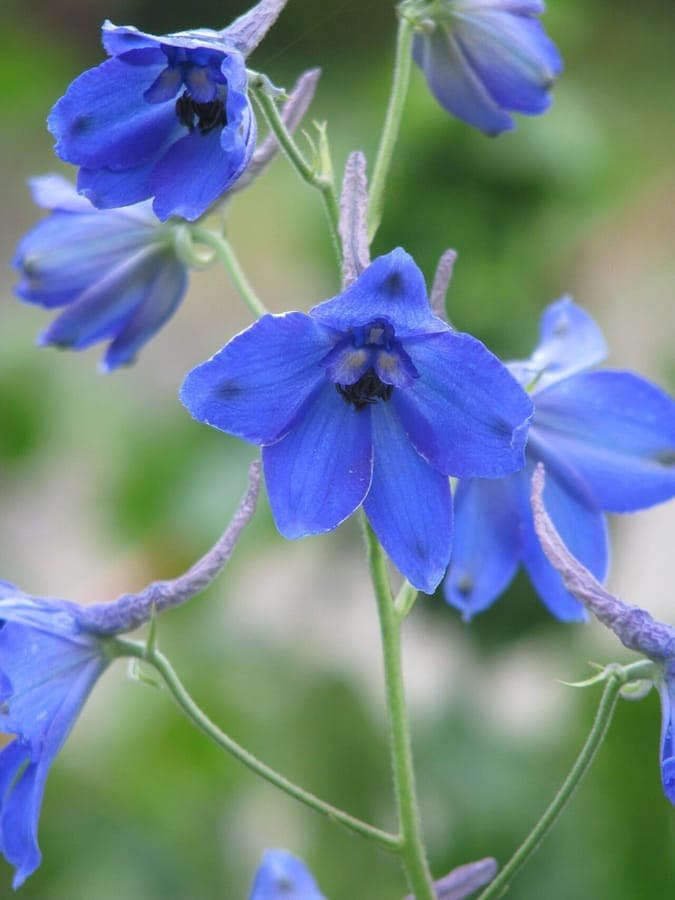
peganum from Small Dole, England / CC BY-SA 2.0, via Wikimedia Commons
Belladonna delphinium (Delphinium × belladonna): growing guide
Delphinium × belladonna
Want to see Belladonna delphinium (Delphinium × belladonna): growing guide in your garden?
Full design in HD: €7.99
Look after your Belladonna delphinium with the GardenWorld app
Identify plants with your camera and get a care calendar with reminders for this plant.


Overview
Mention delphiniums and most gardeners picture towering, ramrod-straight spires that need staking from May onwards. The Belladonna Group is the lighter, more relaxed side of the family. Delphinium × belladonna usually reaches 90 to 120 cm, branches from low down and carries loose sprays of open, single flowers.
The group arose in the nineteenth century from crosses between the tall Delphinium elatum and the low, finely branched Delphinium grandiflorum. From the first parent came the blue colouring and sturdiness; from the second came the branching habit, the more finely cut leaves and a willingness to flower again after cutting back. Like monkshood and columbine it belongs to the buttercup family, Ranunculaceae, and like those relatives every part of it is poisonous. There is a separate section on that further down.
Well-known cultivars include 'Völkerfrieden' (gentian blue, the plant in the photograph), 'Piccolo' (bright azure, compact), 'Casa Blanca' (pure white), 'Cliveden Beauty' (sky blue), 'Atlantis' (deep violet-blue) and 'Bellamosum' (very dark blue). If you would like to see where these plants would work best in your own plot, you can have a garden design made on gardenworld.app that takes your light, soil and existing planting into account.
Appearance and bloom cycle
The foliage forms a loose clump of palmate, deeply divided leaves, a little finer than those of the big border delphiniums. In May numerous stems rise from the clump and branch about halfway up. Each side shoot ends in a short, open spray of five to fifteen flowers.
Individual flowers are 3 to 5 cm across and single: five coloured sepals spread like a star, with the characteristic spur at the top that gives the genus its common names. At the centre sits a small 'bee' of narrow petals, blue edged with dark on 'Völkerfrieden', white or almost black on other cultivars.
The first flush runs from mid-June to late July. Cut the faded stems back promptly and a second, slightly smaller flush follows in August and September. That repeat flowering is what makes the Belladonna Group so rewarding. The branched stems are lovely in loose arrangements; plunge them into cold water as soon as you cut them.
Ideal location
Delphinium × belladonna wants full sun or very light shade. Six hours of direct sun a day is a sensible minimum; with less light the stems grow lax and flowering falls off. An open spot with some air movement helps keep powdery mildew at bay, but avoid a windswept corner: even though these stems are shorter and tougher than those of tall delphiniums, a summer gale can still flatten them.
At roughly a metre tall they sit well in the middle of a border, in front of tall grasses or shrubs and behind lower perennials. Plant in groups of three, 40 to 50 cm apart. They also grow in large containers, provided the pot holds at least 30 litres and never dries out in summer.
Soil requirements
The ideal soil is fertile, rich in organic matter and deeply dug, moisture-retentive in summer but free-draining in winter. Neutral to slightly alkaline ground with a pH of 6.5 to 7.5 suits them best. On heavy clay, work compost and some coarse grit into the top 30 cm; on poor sandy soil add plenty of compost or well-rotted manure.
Set the crown so that it sits level with the soil surface, never deeper. A crown sitting in wet soil will rot quickly in winter.
Watering
Delphiniums need water most while the flower stems are growing, from May to July. In dry spells give each plant a generous 10 litres once or twice a week, preferably in the morning and at the base. Wet foliage in the evening encourages mildew. A mulch of compost or leaf mould keeps the soil moist for longer, but keep it clear of the crown itself.
After the first flush and the cut back, the plant needs water again to build its second round of stems. In winter you give nothing at all: excess moisture is the danger then.
Free preview
Want to see Belladonna delphinium (Delphinium × belladonna): growing guide in your garden? Make a free preview of your design.
Pruning
Pruning is the key to repeat flowering. As soon as most flowers on a stem have faded, usually in late July, cut the whole flowering stem down to just above the young leaves at the base. Leave healthy foliage in place, because the plant needs it to produce new shoots. Give a handful of organic flower feed and a good watering at the same time, and within a few weeks fresh stems appear that flower in August and September.
After the second flush cut back again, and in late autumn take everything down to 10 to 15 cm above ground. Some gardeners leave the hollow stems standing over winter, but rain can run down inside them to the crown and cause rot, so cutting short is the safer choice. Always wear gloves when pruning.
The Belladonna Group rarely needs staking. On an exposed site a few twiggy pea sticks or a round grow-through support placed over the clump in May is enough.
Maintenance calendar
March-April: Clear old stem stubs. Scatter a handful of organic fertiliser around each plant and protect the young shoots from slugs. This is also the time to divide old clumps.
May: Stems grow fast. Put supports in place if needed and water in dry weather.
June-July: First flush. Cut stems for the house and keep an eye out for slugs and mildew.
Late July-August: Cut faded stems back to the fresh foliage, feed lightly and water to encourage repeat flowering.
September: Second flush. Last chance to plant new delphiniums this year.
October-November: Cut everything down to 10 to 15 cm. Keep wet fallen leaves away from the crown.
December-February: Dormant. Nothing to do apart from making sure water does not pool around the plant.
Winter hardiness
Delphinium × belladonna is fully hardy in Britain and north-west Europe and copes with frost down to about -25 °C. Cold is not the problem; cold, wet soil is. On free-draining ground the plants come through winter without any protection. On heavy clay a slightly raised planting position or a collar of coarse grit around the crown makes a real difference.
The biggest threat comes in early spring, when slugs can strip the soft young shoots in a single night.
Toxicity to people and pets
Delphiniums are among the most poisonous plants commonly grown in gardens, and the Belladonna Group is no exception. All parts contain diterpenoid alkaloids, with the highest concentrations in the seeds and in young growth. These compounds block the signal between nerve and muscle.
In people, eating any part causes a burning sensation in the mouth, nausea, vomiting and muscle weakness, and in serious cases a slow or irregular heartbeat and breathing difficulties. The sap can irritate skin, so wear gloves when cutting back or dividing and wash your hands afterwards. The plant is also toxic to dogs and cats, and for horses and cattle even a small amount can be fatal. Never tip prunings into a paddock or over a fence into grazing land.
Where young children play, place delphiniums towards the back of the border and teach them that flowers and seeds never go in the mouth. If you think someone has eaten part of the plant, contact your doctor, NHS 111 or the emergency services straight away, and for a pet ring your vet at once.
Companion plants
The airy blue of Belladonna delphiniums looks best among soft colours and contrasting shapes. Lady's mantle (Alchemilla mollis) makes a fresh green and lime-yellow edge at their feet. Cranesbill 'Rozanne' (Geranium 'Rozanne') flowers all summer and fills the gap between the two flushes. Woodland sage (Salvia nemorosa) and catmint (Nepeta racemosa) repeat the blues and purples at a lower level.
Roses are the classic partner. An old rose such as Rosa gallica adds pink and crimson next to the blue and flowers at roughly the same time as the first delphinium flush.
Final thoughts
Belladonna delphiniums give you the blue of the classic border delphinium with far less work: no canes, no snapped spires and a second flowering as a bonus. Full sun, rich but well-drained soil, a cut back after the first flush and vigilance against slugs in spring are all they need. Just remember that this is a highly poisonous plant and choose its position with children and animals in mind.
To keep track of when to cut back for repeat bloom and when slugs become active, use the plant calendar on gardenworld.app.
Frequently asked questions about Belladonna delphinium
Is Belladonna delphinium winter hardy?
Delphinium × belladonna is fully hardy in Britain and north-west Europe and copes with frost down to about -25 °C. Cold is not the problem; cold, wet soil is.
When and how do you prune Belladonna delphinium?
Pruning is the key to repeat flowering. As soon as most flowers on a stem have faded, usually in late July, cut the whole flowering stem down to just above the young leaves at the base.
How much water does Belladonna delphinium need?
Delphiniums need water most while the flower stems are growing, from May to July. In dry spells give each plant a generous 10 litres once or twice a week, preferably in the morning and at the base.
Where does Belladonna delphinium grow best?
Delphinium × belladonna wants full sun or very light shade. Six hours of direct sun a day is a sensible minimum; with less light the stems grow lax and flowering falls off.
What soil does Belladonna delphinium need?
The ideal soil is fertile, rich in organic matter and deeply dug, moisture-retentive in summer but free-draining in winter. Neutral to slightly alkaline ground with a pH of 6.5 to 7.5 suits them best.

See it in your garden
See Belladonna delphinium in your garden
One photo of your garden and a few questions. You see the result in about a minute.
Try it with a photoIdentify this plant in your own garden. Identify a plant
Similar plants
Geranium 'Rozanne': complete guide
Geranium 'Rozanne'
Everything about Geranium 'Rozanne' (Rozanne cranesbill): planting, care, bloom time and combinations. Practical tips for the longest-flowering perennial.
Garden lady's-mantle: complete guide
Alchemilla mollis
Alchemilla mollis, or garden lady's-mantle, is a graceful perennial perfect for borders, shade gardens, and low-maintenance landscapes. Grows 15–30 cm tall, blooms June–August.
Hungarian rose: complete guide
Rosa gallica
Discover Rosa gallica: growth habits, care tips, bloom season and ideal planting conditions. A hardy, fragrant rose for classic and cottage gardens.
