
Antepenultimate / CC BY-SA 4.0, via Wikimedia Commons
Swamp loosestrife: complete guide
Decodon verticillatus
Want to see Swamp loosestrife: complete guide in your garden?
1 minute, no credit card
Overview
Decodon verticillatus, commonly known as swamp loosestrife or water-willow, is a native North American semi-woody perennial belonging to the loosestrife family, Lythraceae - the same family as purple loosestrife (Lythrum salicaria). It inhabits the shallow margins of ponds, lakes, bogs, swamps and slow-moving streams across eastern North America, from Quebec and Nova Scotia in the north to Florida and Texas in the south. Though still uncommon in European gardens, it deserves far wider cultivation among pond enthusiasts who value a plant that combines bold summer flowers, vivid autumn colour, outstanding ecological value and reliable hardiness in a single package.
The species was formally described in 1821 by Stephen Elliott in his Sketch of the Botany of South Carolina and Georgia. The genus name Decodon refers to the ten stamens characteristic of the flowers, while the epithet verticillatus describes the whorled arrangement of the flowers in the leaf axils. Botanically it is related to the invasive purple loosestrife of European waterways, but unlike its relative it behaves responsibly in cultivation and does not spread aggressively beyond its planting position.
Gardeners looking to create a naturalistic pond margin will find Decodon verticillatus rewarding both visually and ecologically. It provides food for specialist bees and long-tongued bumblebees during a period - mid-July to September - when many garden plants have already finished flowering. Seed-eating birds visit the dry capsules in autumn and winter. Visit gardenworld.app to explore planting plans that incorporate marginal aquatics like swamp loosestrife into cohesive, wildlife-friendly garden designs.
Appearance and bloom cycle
Decodon verticillatus forms an arching, multi-stemmed clump typically reaching 100–200 cm in height and 120–180 cm in width. The hollow, angled stems are softly hairy and develop a spectacular red-bronze to deep burgundy colouring in autumn. Leaves are lance-shaped, arranged in opposite pairs or whorls of three, measuring 5–15 cm in length. They are dark green above with a slightly paler, finely hairy underside, and colour orange-red in autumn, extending the ornamental season well beyond the flowering period.
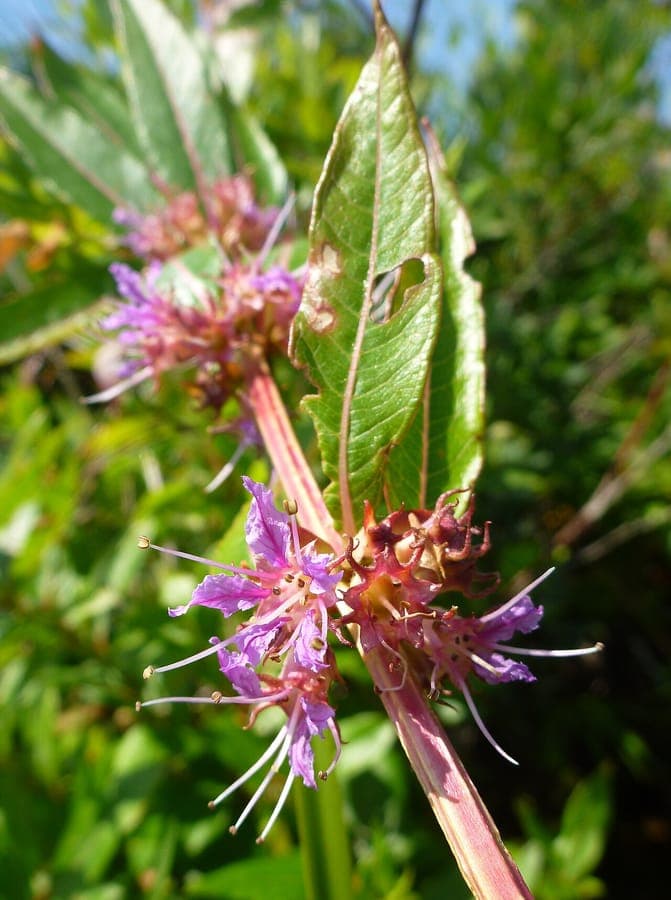
The vivid pink to magenta-red flowers appear from mid-July through September, crowded in dense whorls at the middle internodes of the stems - a highly distinctive feature that sets this plant apart from most other marginals. Each flower is 1–1.5 cm across with five to seven crinkled petals. The flowers produce abundant nectar and are visited by honeybees, bumblebees, butterflies and other long-tongued insects. The small, inconspicuous brown seed capsules that follow provide food for finches and other seed-eating birds in autumn. The stems often arch over the water, and when the stem tips touch the substrate they root readily, forming new plants - a fascinating propagation mechanism.
Ideal location
Swamp loosestrife thrives in a sunny to lightly shaded position with at least four to five hours of direct sunlight per day. In nature it colonises the shallowest margins of water bodies - standing in 0–30 cm of water or in permanently waterlogged mud at the water's edge. In the garden, it is most at home in the shallow zone of a large pond or natural pool, but it also thrives in a wet bog garden, a rain garden that remains reliably moist, or a wet depression in the landscape.
The plant tolerates both standing and slowly moving water. Full sun encourages the most prolific flowering and the most compact, sturdy stems. Partial shade is acceptable but results in fewer flowers and slightly taller, more lax growth. Deep shade is not suitable. Avoid any position where the roots might dry out, even briefly - this plant demands permanently moist to wet conditions and will not compromise on this requirement.
Soil requirements
Decodon verticillatus prefers acidic to slightly acidic soils with a pH between 4.9 and 6.5. In practice, the ideal growing medium is a heavy, humus-rich, poorly drained loam or clay-loam - exactly the kind of waterlogged soil found naturally at pond margins. Peaty loam works excellently. Sandy, free-draining soils are wholly unsuitable unless permanently submerged.
The plant does not require high fertility: in nature it thrives in relatively nutrient-poor peaty substrates. Excess nitrogen encourages leafy, rank growth at the expense of flowering. For planting in an aquatic basket, use a specialist aquatic compost or a low-nutrient loam mix, avoiding any added fertiliser. Position the basket at a depth of 0–20 cm below the water surface for optimal results.
Free design
Want to see Swamp loosestrife: complete guide in your garden? Make a free design now.
Watering
As a true wetland plant, Decodon verticillatus demands permanently wet roots. Even brief periods of drying out - a few days in warm summer weather - can cause leaf yellowing, stem die-back and a significant reduction in flowering. Plants growing directly in pond margins where water levels remain stable require no supplementary irrigation. Plants in a wet border or rain garden should be kept consistently moist throughout the growing season, particularly during hot dry spells.
Stable water levels suit this plant best. Ponds that experience significant fluctuation of more than 30 cm between seasons are less ideal, though the plant can tolerate short periods of lower water if the rootstock remains moist. Position it on the most reliably wet section of the pond margin - often the north or north-east side where evaporation is lowest.
Pruning
Decodon verticillatus needs very little maintenance pruning. The most beneficial intervention is a single hard cut-back in early spring - March to April - before the new shoots emerge. Cut all stems back to 15–20 cm above the ground. This encourages the formation of multiple vigorous new stems and promotes a more floriferous display than would result from leaving old stems in place. At the same time, remove any dead or damaged stems cleanly at the base.
In autumn, once the stems have died back, leave the dead structure standing through winter. The hollow stems provide overwintering sites for solitary bees and other beneficial insects, and the seed heads feed birds. Remove the dead material only in late winter or early spring. If the plant spreads too extensively by rooting stem tips, simply detach or sever the rooted stems from the mother plant; these can be replanted elsewhere as new divisions.
Maintenance calendar
January–February: The plant is dormant. No action required. Check that the pond has not frozen solid at the planting depth.
March–April: Cut back all old stems to 15–20 cm. Remove any stems that have rooted and spread beyond the desired area. Divide established clumps if required. This is the best time to plant new specimens purchased from garden centres.
May–June: New stems emerge and extend rapidly. Ensure consistent moisture. No feeding is needed or recommended.
July–September: Full bloom. The dense whorls of pink-red flowers are at their most spectacular. Avoid cutting or disturbing the plant during this period.
October–November: Foliage colours orange-red. Stems die back gradually. Leave all dead material standing for wildlife benefit.
December: Full dormancy. The rootstock is safely underground.
Winter hardiness
Decodon verticillatus is fully winter-hardy to at least -25 °C, corresponding to USDA hardiness zone 4. It is reliably hardy throughout the British Isles, the Netherlands, Belgium and most of central Europe. The above-ground stems die back completely in winter, but the underground rootstock survives unharmed and produces vigorous new growth in spring. In garden ponds, ensure that the water at the planting depth is at least 30 cm deep so that the rootstock does not freeze solid during severe winters. The hollow, buoyant stems are a useful adaptation: they allow floating shoots to reach new colonisation sites and help the plant survive temporarily elevated water levels. No winter protection is required in temperate European climates. For inspiring examples of winter-resilient pond planting, gardenworld.app offers a wide range of design ideas.
Companion plants
Swamp loosestrife combines handsomely with other marginal and bog plants. Particularly effective companions include:
- Iris pseudacorus (yellow flag iris): flowers earlier in the season, providing complementary yellow tones; plant at 20–30 cm spacing.
- Pontederia cordata (pickerelweed): the blue flower spikes provide a striking contrast with the pink Decodon flowers; both prefer the same shallow water depth.
- Carex pseudocyperus (cyperus sedge): a native sedge offering elegant pendulous spikes and structural contrast.
- Lycopus europaeus (gypsywort): a smaller marginal that increases wildlife value without competing aggressively.
- Filipendula ulmaria (meadowsweet): the creamy white plumes flower simultaneously and soften the composition.
- Lythrum salicaria (purple loosestrife): a bold companion that shares the same flowering season and ecological niche.
Garden centres specialising in aquatic plants typically stock a good range of compatible companions in spring. Plant at intervals of 40–60 cm between Decodon and its neighbours to allow each plant sufficient space to develop its natural form.
Closing
Decodon verticillatus is a remarkable but underused plant for wet gardens and pond margins in Europe. Its combination of showy midsummer to early autumn flowering, handsome autumn colour, outstanding wildlife value and reliable hardiness makes it a worthy addition to any water feature that can accommodate its needs. Once established in a suitable position, it requires little more than an annual spring cut-back and will reward the gardener with decades of reliable performance and ecological generosity.
Want to see Swamp loosestrife: complete guide in your garden? Make a free design now.
Upload a photo, pick a style, and get a photorealistic design with plant list in under a minute.
10,000+ gardens designed already
No credit card required


Similar plants
Winged loosestrife: complete guide
Lythrum alatum
Everything about Lythrum alatum, the winged loosestrife. Care, location, pruning and garden pairings for this native North American wetland perennial.
Dnieper loosestrife: complete guide
Lythrum borysthenicum
Everything about Lythrum borysthenicum, the Dnieper loosestrife: location, bloom season, care in pond margins and bog gardens. Full growing guide included.
Grand redstem: complete guide
Ammannia robusta
Everything about Ammannia robusta: pond margins, bog gardens, soil, care and propagation. Practical advice for water garden enthusiasts in temperate climates.