
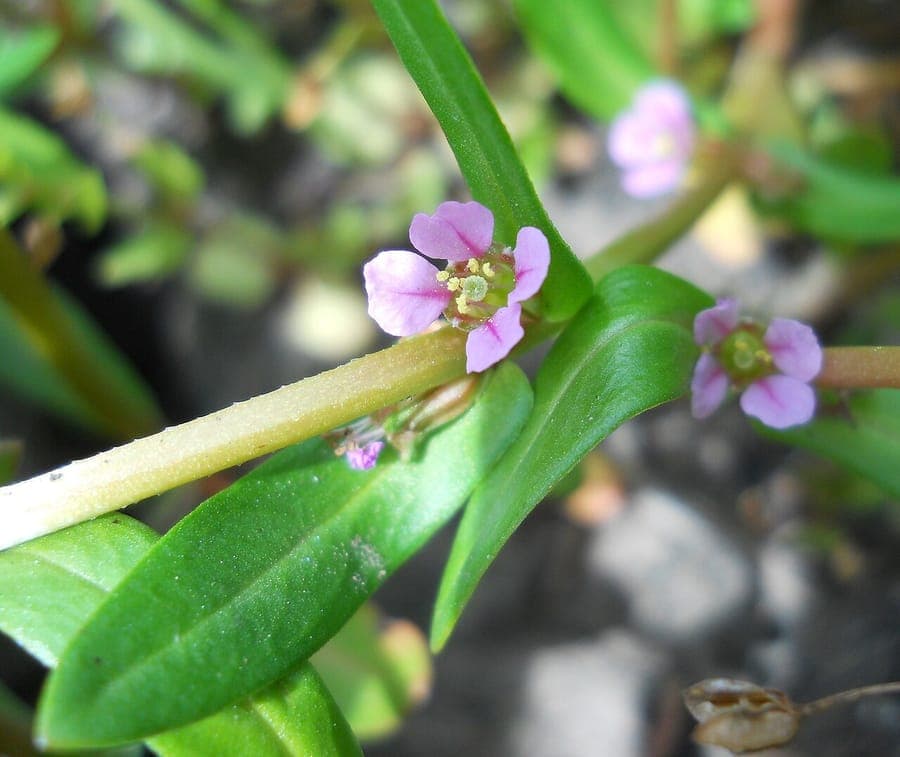
John Scholze / CC BY 2.0, via Wikimedia Commons
Grand redstem: complete guide
Ammannia robusta
Want to see Grand redstem: complete guide in your garden?
1 minute, no credit card
Overview
Ammannia robusta - known in English as grand redstem, scarlet ammannia or longleaf ammannia - is a little-known but botanically interesting aquatic marginal plant from the family Lythraceae, the loosestrife family. The species was described in 1842 by botanists Heer and Regel from North American material, and its epithet 'robusta' refers to its relatively sturdy build compared with other members of the genus Ammannia. The genus Ammannia comprises roughly 25–30 species worldwide, all characterised by a strong preference for wet and marshy habitats and a delicate but colourful flowering display.
The native range of Ammannia robusta is impressive: the species is indigenous from southern Canada down to Guatemala, with strongholds in the American Midwest, the western Great Plains and the Mexican Highlands. It has also been introduced to parts of South America (Argentina, Brazil), the Mariana Islands, Spain and the Windward Islands - a clear sign of its capacity to colonise wet, disturbed ground. As a garden plant, grand redstem is a niche subject: not stocked in mainstream garden centres, but available through specialist pond and bog plant nurseries.
The species is ideally suited to the shallow margin zone of a pond or water feature, a bog garden, or a seasonally wet depression in an ecological garden. Gardeners planning a naturalistic water garden or a pond-edge planting scheme can find inspiration for cohesive designs that incorporate aquatic plants and marginals at gardenworld.app.
Appearance and bloom cycle
Ammannia robusta is an annual to short-lived perennial with a single crown, though in milder climates it can persist as a subshrub. The stems are erect and can reach 30 to 80 cm in height depending on water depth, soil fertility and the length of the growing season. The most striking feature is the stem colour itself: under good growing conditions the stems turn a conspicuous red to deep purplish-red, earning the plant its common name 'redstem'. In shadier or less fertile positions, stems remain green and the plant is less ornamental.
The leaves are oblong to lanceolate, 2 to 8 cm long, arranged in opposite pairs and clasping the stem directly (sessile). They are glossy, dark green to reddish-green, and taper to a point at both ends. Leaf texture is medium.
The flowers are small but produced in large numbers, clustered in the leaf axils. They are pink to reddish-purple, four-petalled, and only 3–5 mm in diameter. Despite their modest size, they create a fine, colourful effect along the full length of the stems during the flowering period. In Western Europe, bloom typically runs from July to September. After flowering, the plant sets small, capsule-like fruits containing numerous tiny seeds, which are dispersed by water.
The species is sometimes confused with the closely related Ammannia coccinea, but grand redstem is generally more robust with broader leaves.
Ideal location
Ammannia robusta is a true marginal and bog plant. In nature it grows on wet, silty banks of rivers, ditches and ponds, in wet rice fields, in marsh grasslands and along brackish creeks. It thrives best in shallow water depths of 0 to 10 cm, but can survive on periodically drying margins as long as it remains close to the waterline.
In the garden, the ideal position is in the shallow margin zone of a pond or water feature, in a spot receiving full sun to light semi-shade. Full sun encourages the characteristic red stem colouring and promotes a more floriferous display. In heavy shade, stems lose their red colour and the plant becomes taller and less decorative.
Plant grand redstem in groups of three to five specimens spaced 20–30 cm apart to create a full marginal effect. In a pond basket or water container, the plant can be grown in an aquatic planting basket at a water depth of 0 to 5 cm above the top of the basket. Planting directly into the wet, clayey soil of a natural pond margin is the most natural approach for established water gardens.
Soil requirements
Ammannia robusta has a clear preference for acid to moderately acid substrates, with a pH range of 4.0 to 5.9. This makes it particularly well suited to the silty margins of peat ponds, heathland pools and acid bogs - habitats common in northern Europe and the British Isles. That said, the species has been recorded in less acidic conditions, indicating some flexibility.
In terms of texture, the plant thrives best on fine-grained, silty or clay-rich substrates that are high in organic matter. Coarse sandy substrates are less suitable as nutrients leach too rapidly. When establishing the plant in a margin zone, filling the planting pockets with a mix of aquatic clay and peat or specialist bog compost (available from specialist pond nurseries) provides ideal starting conditions.
The soil does not need to be fertilised separately: the rich sediment layer of a natural pond margin provides sufficient nutrients. Excess fertilisation produces over-vigorous leaf development at the expense of stem colour and flowering, and can disturb the balance of the marginal vegetation.
Free design
Want to see Grand redstem: complete guide in your garden? Make a free design now.
Watering
As a marginal and bog plant, Ammannia robusta requires a constant supply of water by nature. In a pond system or alongside a stream, this is provided automatically. In an isolated bog bed or water trough, it is essential that the substrate remains wet at all times - drying out for just 24 to 48 hours can cause serious damage, particularly in warm summer weather.
For pond basket culture: top up the water level daily. In a bog garden with a clay liner below the planting, connecting a water inlet pipe or linking to the overflow of a nearby pond is the most reliable way to keep moisture levels constant.
For container growing - for those wishing to cultivate the plant indoors in a terrarium or living biotope - daily topping up with soft, low-lime water is necessary. Tap water with a high calcium content raises the substrate pH and is less suitable; rainwater or demineralised water is preferable.
Pruning
Ammannia robusta requires virtually no pruning in the traditional sense. Since the species is typically treated as an annual in temperate Western European gardens, the only management needed is removal of the dead stems in autumn, after the first frosts have killed the above-ground parts. Cut the stems down to 5 cm above the water surface or soil level.
In mild winters or in a heated glasshouse, the plant may persist as a short-lived perennial. In that case, remove dead or damaged stems in early spring and allow the plant to regrow from the rootstock or from self-sown seedlings that germinate in the wet margin soil.
Leaving seed-bearing stems standing through autumn and winter provides ecological benefits: small birds such as reed tits and siskins readily eat the tiny seeds, and the dead stems offer shelter for overwintering insects.
Maintenance calendar
January – February: The plant is dormant or has died back. No action needed in frost periods. Protect container-grown specimens by moving them to a frost-free space if persistent hard frost is expected.
March – April: Start of the growing season. Sow fresh seed on a moist, warm substrate (peat and clay mix, temperature 18–22 °C). Remove any dead stems from the previous year. Press fresh aquatic clay around the roots in the margin zone.
May: Seedlings of 3–5 cm can be planted out into the margin zone or into pond baskets. Keep them well moistened at all times.
June: The plant grows rapidly. Red stem colouring becomes visible with sufficient light. For inspiration on pond garden designs that combine marginal plants like Ammannia robusta with water lilies and other aquatic plants, visit gardenworld.app.
July – September: Flowering period. Enjoy the small, pink blossoms. Maintain water levels. Remove competing aquatic plants that may encroach on the position.
October – November: After the first frosts the plant dies back. Leave seed-bearing stems standing for seed dispersal and bird food.
December: Dormancy. No further action required.
Winter hardiness
In temperate Western European conditions, Ammannia robusta is predominantly an annual. As a marginal plant native to continental North America, it is adapted to cold winters, but its overwintering strategy relies on seed production and dispersal rather than the survival of above-ground parts. In mild winters - as occur regularly along the coasts of the Netherlands and Belgium - the rootstock may survive and resprout in spring.
In USDA hardiness zones 5 to 9 the species can overwinter as a perennial; in zone 4 and colder it behaves as an annual. The seeds themselves are exceptionally frost-resistant and germinate in spring once the water temperature rises above 15 °C.
For overwintering in colder areas: move the plant in October to an unheated greenhouse or cold frame (minimum temperature -2 °C). Keep the substrate wet but ensure some air circulation to prevent fungal problems. Return outdoors in spring once night temperatures consistently remain above 5 °C. Gardenworld.app is a useful resource for planning a complete water garden scheme around plants with varying hardiness requirements.
Companion plants
In a pond or marginal garden, Ammannia robusta combines beautifully with other wet-habitat plants. Colour contrasts with yellow-flowering species are particularly effective: yellow flag (Iris pseudacorus, blooming May–June), marsh marigold (Caltha palustris, blooming April–May) and butterbur (Petasites hybridus) provide bright yellow tones that contrast attractively with the red stems of the ammannia.
For structural variety, broad-leaved marginals such as bulrush (Typha latifolia) and common club-rush (Schoenoplectus lacustris) are good neighbours in larger planting schemes. On narrower margins, finer-textured species such as water cress (Nasturtium officinale) or water forget-me-not (Myosotis scorpioides) are better suited.
For a more ecologically diverse margin zone, the addition of frogbit (Hydrocharis morsus-ranae) as a floating cover plant and stonewort (Chara spp.) as a submerged oxygenating plant is recommended. A well-composed marginal planting creates a habitat for frogs, dragonflies, water spiders and numerous insects, turning the pond edge into a thriving miniature ecosystem.
Closing thoughts
Ammannia robusta is a distinctive and underrated marginal plant that, in the right context - a wet pond edge, a bog garden or an ecological margin zone - produces a striking visual effect thanks to its vividly coloured red stems and delicate pink floral display. It has specific requirements for soil moisture and pH, but with a correctly prepared planting position it is straightforward to cultivate. Any naturalistic water garden or pond-side planting scheme benefits from the inclusion of this modest but botanically fascinating plant.
Want to see Grand redstem: complete guide in your garden? Make a free design now.
Upload a photo, pick a style, and get a photorealistic design with plant list in under a minute.
10,000+ gardens designed already
No credit card required


Similar plants
Winged loosestrife: complete guide
Lythrum alatum
Everything about Lythrum alatum, the winged loosestrife. Care, location, pruning and garden pairings for this native North American wetland perennial.
Dnieper loosestrife: complete guide
Lythrum borysthenicum
Everything about Lythrum borysthenicum, the Dnieper loosestrife: location, bloom season, care in pond margins and bog gardens. Full growing guide included.
Swamp loosestrife: complete guide
Decodon verticillatus
Full growing guide for Decodon verticillatus: location, soil, watering, pruning, winter hardiness and companion plants for pond margins.