
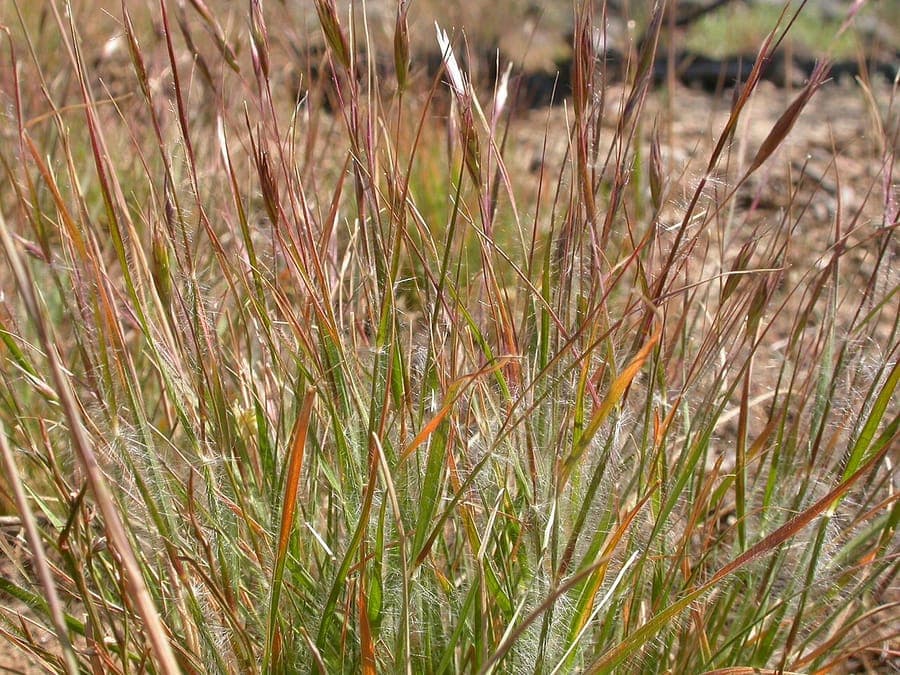
Matt Lavin from Bozeman, Montana, USA / CC BY-SA 2.0, via Wikimedia Commons
Onespike oatgrass (Danthonia unispicata): complete guide
Danthonia unispicata
Want to see Onespike oatgrass (Danthonia unispicata): complete guide in your garden?
1 minute, no credit card
Overview
Danthonia unispicata, commonly called onespike oatgrass or few-flowered oatgrass, is a small, fine-textured native bunchgrass in the family Poaceae. The species was described originally by Thurber as a variety of Danthonia californica, and later elevated to full species status by Munro and Macoun in 1888. Its name is unmistakably descriptive: unispicata means "single-spiked" in Latin, referring to the plant's characteristic of bearing just one - occasionally two - spikelets per flowering stem.
The native range covers western Canada (Alberta and British Columbia) and the western United States, including Montana, Idaho, Wyoming, Colorado, Utah, Nevada, Oregon, Washington, California, and South Dakota. Across these regions the plant inhabits dry, open slopes, rocky prairies, and arid grasslands on gravelly or sandy soils.
For gardeners who want a compact, drought-adapted bunchgrass for lean conditions, Danthonia unispicata is an excellent choice. At gardenworld.app you will find design examples where small native bunchgrasses like this one are used as textural accents in dry garden schemes.
Appearance and bloom cycle
Onespike oatgrass is the most fine-textured of the three Danthonia species covered here. It forms a tight, well-defined clump typically 20 to 40 cm tall. The leaves are narrow, fine in texture, and green - noticeably finer than those of Danthonia compressa or D. intermedia. The species specification lists its foliage texture as "fine" and its fruit as "conspicuous", which distinguishes it in the field.
Flowering culms are slender and rise above the foliage. Each culm carries just one, occasionally two, spikelets - the feature that gives the plant its name. Flower colour is described as green, unlike the yellowish flowers of the other two species. Bloom time runs from June through August. Seeds ripen to conspicuous brown fruit in late summer and disperse in autumn.
After the growing season the clump retains its shape through autumn and winter. The foliage turns golden to straw-yellow in autumn. The slender culms and minimal seed heads give the plant a light, airy silhouette that contrasts attractively with broader-leaved perennials. As a cool-season species it grows most actively in spring and early autumn, slowing during the hottest weeks.
Ideal location
In the wild Danthonia unispicata occupies dry, sun-exposed habitats - open rocky slopes, dry prairies, and gravelly grasslands. In the garden it thrives in full sun and tolerates light shade. Aim for at least five to six hours of direct sunlight per day for best flowering and compact growth.
The plant's compact size makes it ideal for rock gardens, gravel gardens, sloping borders, trough gardens, and dry wildflower areas. It performs well in containers (minimum 25 cm diameter) with very free-draining compost. In a front garden it makes a refined accent plant between boulders or low shrubs. Garden centres stocking native western prairie plants occasionally carry this species.
Soil
Danthonia unispicata performs best in well-drained, poor to moderately fertile soils. Its native range data indicate a pH tolerance of 6.0 to 8.0, making it adaptable to neutral, slightly acid, and even slightly alkaline conditions - a wider range than many bunchgrasses. This makes it useful across a range of garden settings including limestone rock gardens.
Avoid heavy, poorly drained clay. Root rot in wet conditions is the primary cause of plant failure. On clay-heavy soils, work in generous quantities of coarse grit or fine gravel before planting. Sandy, gravelly, and stony soils need no amendment and are in fact optimal.
Do not fertilise. Even moderate nitrogen input causes floppy, untidy growth that destroys the plant's characteristic compact, well-defined form.
Free design
Want to see Onespike oatgrass (Danthonia unispicata): complete guide in your garden? Make a free design now.
Watering
Once established, Danthonia unispicata is one of the most drought-tolerant species in the genus. In a temperate climate with average rainfall, no supplemental watering is needed after the first season.
During establishment - the first four to six weeks after planting - consistent moisture is important. Keep the root ball from drying out completely. Once rooted in, progressively reduce watering. In a dry summer, one deep soak every two to three weeks is sufficient. Frequent light watering encourages shallow roots and reduces the plant's natural resilience. Standing water at the crown must be avoided at all times.
Pruning
As a cool-season bunchgrass, Danthonia unispicata should be cut back in late winter before new growth begins - late February or early March is ideal. Cut the clump back to 8 to 12 cm above ground using clean, sharp secateurs. The small clump size means this is quick work. Remove any dead foliage at the same time.
Do not cut back in autumn or during the growing season. The standing culms and seed heads provide food for finches and other seed-eaters and shelter for overwintering invertebrates. The fine-textured dormant clump also has a quiet winter beauty of its own.
Maintenance calendar
February-March: cut back to 8-12 cm before new shoots emerge; remove dead foliage; check drainage after snow melt.
April-May: new foliage emerges; water once if the soil is bone dry; check that the clump is firmly anchored after any hard frosts.
June-August: flowering period; allow spikelets to develop and set seed; no fertilising; no pruning.
September-October: seeds ripen; leave culms standing for birds and for the autumn display; collect seeds if propagation is planned.
November-January: dormant period; no maintenance required; the fine clump remains decorative through the winter.
Winter hardiness
Danthonia unispicata is solidly cold-hardy. It is native to regions with continental winters, including the high Rocky Mountain states and the Canadian prairies. In USDA hardiness zone 4 and above it overwinters without any protection.
In gardens across northern Europe (zones 7 to 8), the plant is fully winter-proof. Temperatures down to -15 degrees Celsius present no problem provided drainage is good. Mulching is not needed. On very exposed, light soils in windy coastal locations, a thin layer of leaf mulch can provide extra insulation, though it is rarely necessary.
Companion plants
Onespike oatgrass is at its best in combinations with other small, dry-tolerant plants that share its preference for lean, well-drained conditions. Strong partners include creeping thyme (Thymus praecox), sun rose (Helianthemum nummularium), maiden pink (Dianthus deltoides), sheep fescue (Festuca ovina), and rock cress (Arabis alpina). Early-flowering bulbs such as species crocuses and snowflakes (Leucojum vernum) add colour in early spring before the grass enters its growth phase.
In a formal rock garden the plant sits naturally among low sedums and cushion-forming alpine plants. Avoid placing it next to vigorous spreading ground covers that may overwhelm the small clump over time.
At gardenworld.app, explore design inspiration for compact dry borders and rock gardens in which small bunchgrasses like Danthonia unispicata provide fine-textured structure among flowering perennials.
Closing
Danthonia unispicata is a refined, undemanding little bunchgrass with a great deal to offer in the right setting. Its delicate leaf texture, distinctive single-spiked flowers, outstanding drought tolerance, and compact growth habit make it a practical and visually appealing choice for rock gardens, gravel borders, alpine troughs, and dry prairie plantings. Visit gardenworld.app for tailored garden design advice and planting inspiration to make the most of species like this in your own outdoor space.
Want to see Onespike oatgrass (Danthonia unispicata): complete guide in your garden? Make a free design now.
Upload a photo, pick a style, and get a photorealistic design with plant list in under a minute.
10,000+ gardens designed already
No credit card required


Similar plants
Mountain oat grass (Danthonia compressa): complete guide
Danthonia compressa
Full guide to Danthonia compressa, mountain oat grass: ideal site, soil, watering, pruning, winter hardiness and companion plants.
Intermediate oat grass (Danthonia intermedia): complete guide
Danthonia intermedia
Full guide to Danthonia intermedia, intermediate oat grass: ideal site, soil, care, winter hardiness and companion planting advice.