
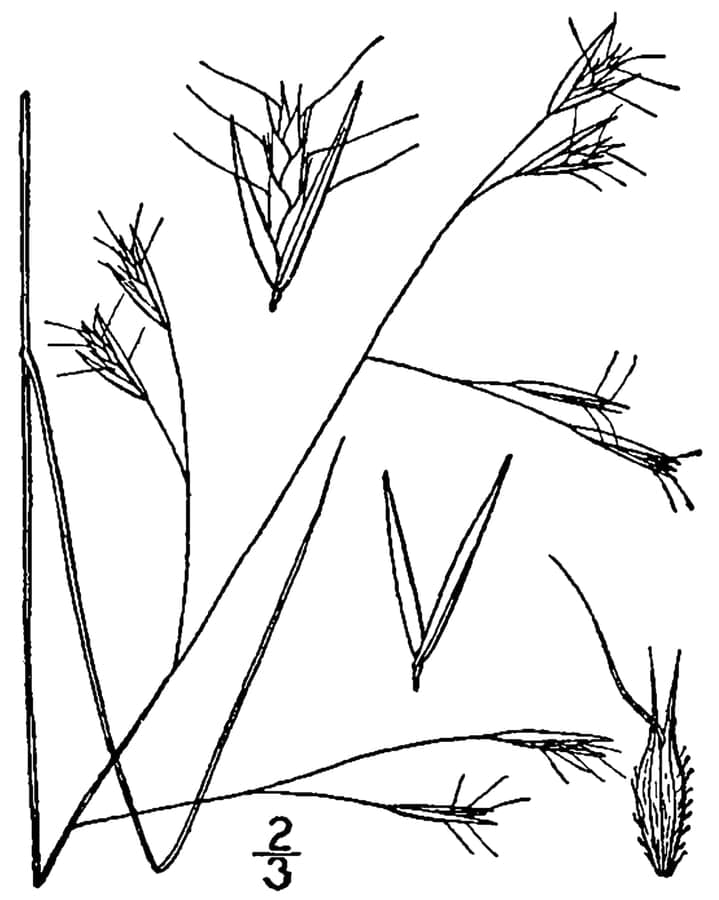
Britton, N.L., and A. Brown. 1913. An illustrated flora of the northern United States, Canada and the British Possessions. 3 vols. Charles Scribner's Sons, New York. Vol. 1: 221. Courtesy of Kentucky Native Plant Society. Scanned by Omnitek Inc. / Public domain, via Wikimedia Commons
Mountain oat grass (Danthonia compressa): complete guide
Danthonia compressa
Want to see Mountain oat grass (Danthonia compressa): complete guide in your garden?
1 minute, no credit card
Overview
Danthonia compressa, commonly known as mountain oat grass or flattened oat grass, is a native cool-season bunchgrass belonging to the family Poaceae. First described by Austin in 1869, the species is native to eastern North America, ranging from Alabama and Georgia northward through the Appalachians into the northeastern states, the Great Lakes region, and the Canadian provinces of Ontario, Quebec, Nova Scotia, and Prince Edward Island.
The species epithet compressa refers to the distinctively flattened stems, a feature that sets it apart from closely related species such as Danthonia spicata. It grows in open to partially shaded habitats - woodland edges, rocky slopes, dry meadows, and clearings - and tolerates a wide range of soil conditions provided drainage is adequate.
For gardeners seeking low-maintenance, habitat-friendly ornamental grasses, Danthonia compressa offers considerable appeal. At gardenworld.app, you can explore design ideas that incorporate native grasses like this one into naturalistic planting schemes.
Appearance and bloom cycle
Mountain oat grass forms neat, rounded clumps typically 30 to 60 cm tall. The foliage is medium in texture, green, and remains low-growing relative to the flowering culms. Leaf sheaths are glabrous to slightly hairy, and the leaf tips taper to a slender point.
Flowering culms rise above the basal foliage, bearing an open, airy panicle with yellowish spikelets. Bloom time runs from June through August. Each spikelet contains multiple florets and carries a twisted awn that curves gracefully after seed set - a distinctive feature of the Danthonia genus. Seeds ripen to brown in late summer and disperse naturally in autumn, providing a modest self-seeding effect.
After flowering, the clump retains its structure well into autumn and winter. In autumn, the foliage takes on warm golden-yellow to light-brown tones. The characteristic flattened culms, which give the species its name, become most apparent on close inspection. As a cool-season grass, the plant shows its most active growth in spring and again in early autumn, going semi-dormant during the hottest weeks of summer.
Ideal location
In the wild, Danthonia compressa occupies open to lightly shaded spots - woodland edges, rocky outcrops, dry grasslands, and forest clearings. In the garden it performs best in a position with at least four to six hours of direct sunlight per day.
In warmer continental climates, some afternoon shade helps prevent the upper root zone from drying out excessively during heat waves. In coastal and maritime climates with moderate summer temperatures, the plant thrives in full sun without any protection. It is well suited to sloping borders, dry stone gardens, gravel gardens, and naturalistic wildflower meadows.
Container growing is possible in large pots (at least 30 cm diameter) with very free-draining compost, but the plant genuinely thrives when planted in the open ground where its roots can reach deeper moisture. Garden centres in the UK and North America occasionally stock this species alongside other native bunchgrasses.
Soil
Danthonia compressa is adaptable but prefers well-drained, moderately infertile soil. Its native range data suggest a pH tolerance between 4.8 and 7.0, meaning it grows comfortably on moderately acidic to neutral substrates.
Heavy, water-retentive clay is unsuitable - waterlogging is the most common cause of plant failure. If your soil is clay-heavy, incorporate coarse grit and organic matter at planting time to improve permeability. Sandy and loamy soils require little or no amendment.
Avoid overly rich, nitrogen-heavy soils. Excess fertility encourages lush, floppy growth at the expense of the plant's characteristic compact, well-defined clump shape. Lean soil, as in gravel borders or unimproved garden beds, consistently produces the best results.
Free design
Want to see Mountain oat grass (Danthonia compressa): complete guide in your garden? Make a free design now.
Watering
Once established - generally after the first growing season - mountain oat grass is reliably drought-tolerant and rarely needs supplemental watering in temperate climates. Average rainfall in most of northern Europe is sufficient to maintain healthy growth through the season.
During the planting phase and the first weeks after transplanting, consistent moisture is important. Never let the root ball dry out completely during establishment. Once the plant has anchored itself, watering frequency can be reduced significantly. In dry summers, a deep soak once every two weeks is far preferable to frequent shallow watering, which encourages roots to remain at the surface.
Avoid standing water around the crown, especially during winter. Good drainage is the single most important factor for long-term plant health.
Pruning
As a cool-season grass, Danthonia compressa makes most of its growth during the cooler parts of the year - spring and autumn. This influences the timing of pruning compared to warm-season grasses.
The best time to cut back the clump is in late winter or very early spring, before new growth begins - typically February or early March. Cut the clump back to approximately 10 to 15 cm above the ground using sharp shears or hedge trimmers for larger clumps. At the same time, remove any dead leaf material and old culms that might obstruct new shoots.
Do not cut back in autumn or midsummer. The old flowering stems and seed heads provide food and shelter for insects and birds throughout the winter months, and the natural structure is part of the plant's seasonal appeal.
Maintenance calendar
February-March: cut back clumps before new growth emerges; remove dead foliage and any outlying shoots beyond the clump margin.
April-May: new leaves emerge; water once if conditions are dry; check that the plant is firmly rooted after a frosty winter.
June-August: flowering season; allow panicles to develop fully for best effect; no fertilising needed; no pruning.
September-October: seeds ripen; leave seed heads in place for birds and for the autumn visual effect; collect seeds if propagation is desired.
November-January: the clump is dormant; no maintenance needed; avoid walking on frozen foliage.
Winter hardiness
Danthonia compressa is robustly cold-hardy. Its native range extends from Alabama in the south to Alaska in the north, indicating that the species tolerates an exceptionally wide climate spectrum. In USDA hardiness zones 4 and above, the plant overwinters without difficulty.
In gardens across northern Europe, which generally correspond to USDA zones 7 to 8, the plant presents no winter concerns. Temperatures down to -15 degrees Celsius are handled without damage, provided soil drainage is adequate. Mulching is generally unnecessary but may be beneficial on very light, exposed sandy soils in areas prone to hard frost.
Companion plants
Mountain oat grass pairs naturally with other low-maintenance perennials that share its preference for lean, well-drained conditions. Good combinations include wild bergamot (Monarda fistulosa), self-heal (Prunella grandiflora), blue fescue (Festuca glauca), and salad burnet (Sanguisorba minor). For a varied spring palette, combine with early bulbs such as Siberian squill (Scilla siberica) or species crocuses.
In more formal settings, the grass works well alongside low-growing sedums or thyme, which share the same drought tolerance. Avoid aggressive ground-covering plants that may swamp the clump over time.
At gardenworld.app, you can find expert design guidance for dry, naturalistic borders in which native grasses like Danthonia compressa play a structural role.
Closing
Danthonia compressa is an understated but characterful grass that adds real value to a thoughtfully designed garden. Its compact form, graceful flowering stems, and wide adaptability make it a reliable choice for lean, naturalistic planting. Whether you are establishing a wildflower meadow, a gravel border, or a woodland edge planting, this native bunchgrass deserves a place in your plan. Explore further at gardenworld.app for tailored design inspiration and practical planting advice.
Want to see Mountain oat grass (Danthonia compressa): complete guide in your garden? Make a free design now.
Upload a photo, pick a style, and get a photorealistic design with plant list in under a minute.
10,000+ gardens designed already
No credit card required


Similar plants
Intermediate oat grass (Danthonia intermedia): complete guide
Danthonia intermedia
Full guide to Danthonia intermedia, intermediate oat grass: ideal site, soil, care, winter hardiness and companion planting advice.
Onespike oatgrass (Danthonia unispicata): complete guide
Danthonia unispicata
Complete guide to Danthonia unispicata, onespike oatgrass: site requirements, soil, watering, pruning, winter hardiness and companions.