
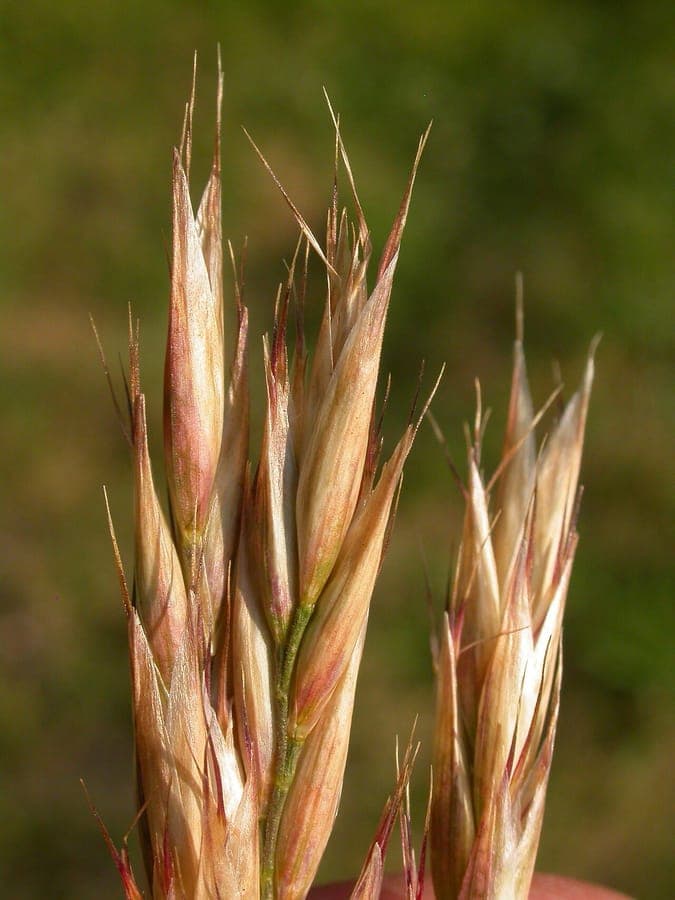
Matt Lavin / CC BY-SA 2.0, via Wikimedia Commons
Intermediate oat grass (Danthonia intermedia): complete guide
Danthonia intermedia
Want to see Intermediate oat grass (Danthonia intermedia): complete guide in your garden?
1 minute, no credit card
Overview
Danthonia intermedia, commonly called intermediate oat grass or timber oat grass, is a native cool-season bunchgrass in the family Poaceae. It was described in 1883 by George Vasey, the same botanist for whom the informal name Vasey's oatgrass is used. The species epithet intermedia refers to its morphological position between other species in the genus.
The native range of Danthonia intermedia is remarkably broad, spanning western and central North America from British Columbia and Alberta south through the Rocky Mountain states to Arizona and New Mexico, and east through the Great Plains to Michigan. It also occurs in the Russian Far East - Kamchatka, Khabarovsk, and Magadan - suggesting a circumpolar distribution likely facilitated by ancient land connections. In its native habitat the plant colonises open slopes, subalpine meadows, woodland edges, and dry grasslands.
For gardeners seeking tough, low-maintenance bunchgrasses that thrive in lean conditions, Danthonia intermedia is a highly rewarding choice. At gardenworld.app, you can explore planting schemes that feature native bunchgrasses as structural elements in naturalistic garden design.
Appearance and bloom cycle
Intermediate oat grass forms neat, rounded clumps typically 30 to 60 cm in height. The foliage is medium in texture, green, and compact relative to the flowering culms. Leaf sheaths are glabrous to slightly hairy, and the leaf blades taper gradually to a point. The clump is well-defined and holds its shape year-round, which is part of its structural appeal.
Flowering culms rise above the basal foliage and carry an open, loose panicle with yellowish spikelets. Bloom time runs from June through August. Each spikelet bears multiple florets and carries a twisted awn that curves gracefully after seed set - a hallmark feature of the Danthonia genus. Seeds ripen to brown in late summer and disperse naturally in autumn.
In autumn the foliage turns golden-yellow to warm brown, giving the clump continued ornamental value through the cooler months. The seed heads remain attractive well after seed dispersal. As a cool-season species, its most vigorous growth occurs in spring and in early autumn; it slows noticeably during the hottest weeks of summer.
Ideal location
In the wild Danthonia intermedia inhabits open, well-drained slopes and subalpine meadows across a wide altitude range. In the garden it thrives in a sunny to lightly shaded position with at least four to six hours of direct sunlight per day.
In warmer, continental climates, some afternoon shade reduces heat stress on the shallower root zone. In cooler maritime climates the plant is equally happy in full sun. It is an excellent choice for sloping borders, dry stone walls, gravel gardens, rock gardens, and naturalistic wildflower areas. Garden centres specialising in native plants in the UK, Canada, and the United States increasingly stock species like this alongside other bunchgrasses.
Soil
Danthonia intermedia performs best in well-drained, moderately infertile soil. Its native range data indicate a pH tolerance of 6.0 to 7.8 - somewhat higher than many native bunchgrasses - so it adapts well to neutral and even slightly alkaline soils as well as near-neutral ones.
Heavy clay that retains water is unsuitable. Waterlogging, especially combined with winter frost, readily causes root rot. Where soil is clay-heavy, work in coarse grit and composted bark at planting time to improve drainage. Sandy, gravelly, or well-structured loam soils require little or no amendment.
Avoid enriching the soil with nitrogen-heavy fertilisers. Rich soil produces lush but structurally weak growth, and the characteristic compact clump form is lost. The leanest soils, such as those in gravel borders or unimproved hillside beds, consistently give the best results.
Free design
Want to see Intermediate oat grass (Danthonia intermedia): complete guide in your garden? Make a free design now.
Watering
Once established after the first growing season, Danthonia intermedia is reliably drought-tolerant and needs no supplemental watering in most temperate climates. Rainfall alone is sufficient under ordinary conditions.
At planting and for the first four to six weeks after transplanting, regular watering is important - never let the root ball dry out completely during establishment. Once anchored, gradually reduce watering frequency. In dry summers, one thorough deep soak every two weeks is ideal. Surface watering encourages shallow rooting and reduces long-term resilience.
Avoid standing water at the crown at all times. The plant's deep-rooting habit makes it well suited to sloping beds where surface water drains away naturally.
Pruning
As a cool-season bunchgrass, Danthonia intermedia completes most of its growth in spring and early autumn. The correct pruning window is late winter to early spring, before new growth emerges - typically late February to early March.
Cut the entire clump back to approximately 10 to 15 cm above ground level. Use sharp, clean shears or secateurs. At the same time, remove any dead leaf material that might obstruct the emerging shoots. Do not cut back in autumn or summer: the standing culms and seed heads supply food and shelter for invertebrates and seed-eating birds, and are part of the plant's winter aesthetic.
Maintenance calendar
February-March: cut back to 10-15 cm before new shoots emerge; remove dead foliage.
April-May: new leaves push through; water once if there has been no rain for two or more weeks; check that the root ball is firmly anchored after any hard frosts.
June-August: flowering period; allow panicles to develop fully; no fertilising required; minimal intervention needed.
September-October: seeds ripen; leave seed heads for birds and for the decorative autumn effect; collect a few seeds for propagation if desired.
November-January: dormant period; no maintenance needed; avoid crushing the clump under heavy snow loads where possible.
Winter hardiness
Danthonia intermedia is outstandingly cold-hardy. It is naturally adapted to harsh subalpine and montane climates with severe frost, deep snow, and short growing seasons. In USDA hardiness zone 3 and above it overwinters without any protection.
In gardens across northern Europe, corresponding to zones 7 to 8, the plant is entirely winter-proof. Temperatures down to -20 degrees Celsius cause no damage provided drainage is adequate. No mulching is necessary. On very exposed, light sandy soils a thin layer of bark mulch or chopped leaf litter may be applied as extra insurance, but this is rarely needed.
Companion plants
Intermediate oat grass combines well with other dry-tolerant perennials sharing a preference for lean, open conditions. Strong combinations include mountain avens (Dryas octopetala), blue fescue (Festuca glauca), salad burnet (Sanguisorba minor), prairie clover (Dalea purpurea), and wild bergamot (Monarda fistulosa). Early bulbs such as Siberian squill (Scilla siberica) or pasque flower (Pulsatilla vulgaris) extend the seasonal interest from early spring.
In a rock garden or gravel planting, the compact clumps sit naturally among low sedums and creeping thyme. Avoid vigorous spreading ground covers that may smother the clumps over time.
At gardenworld.app, design ideas for dry, naturalistic borders showcase native bunchgrasses like Danthonia intermedia as key structural plants within wildlife-friendly garden schemes.
Closing
Danthonia intermedia is a tough, graceful bunchgrass that asks for very little and delivers a great deal in return. Its compact form, elegant flowering panicles, and outstanding cold-hardiness make it an excellent choice for gravel gardens, hillside plantings, rock gardens, and naturalistic meadow areas. Whether your climate is alpine-cold or temperate-maritime, this species adapts readily. Visit gardenworld.app for tailored design inspiration that puts plants like this to work in a garden you will enjoy season after season.
Want to see Intermediate oat grass (Danthonia intermedia): complete guide in your garden? Make a free design now.
Upload a photo, pick a style, and get a photorealistic design with plant list in under a minute.
10,000+ gardens designed already
No credit card required


Similar plants
Mountain oat grass (Danthonia compressa): complete guide
Danthonia compressa
Full guide to Danthonia compressa, mountain oat grass: ideal site, soil, watering, pruning, winter hardiness and companion plants.
Onespike oatgrass (Danthonia unispicata): complete guide
Danthonia unispicata
Complete guide to Danthonia unispicata, onespike oatgrass: site requirements, soil, watering, pruning, winter hardiness and companions.