
Ivar Leidus / CC BY-SA 4.0, via Wikimedia Commons
Kiwano: complete guide
Cucumis metuliferus
Want to see Kiwano: complete guide in your garden?
1 minute, no credit card
Overview
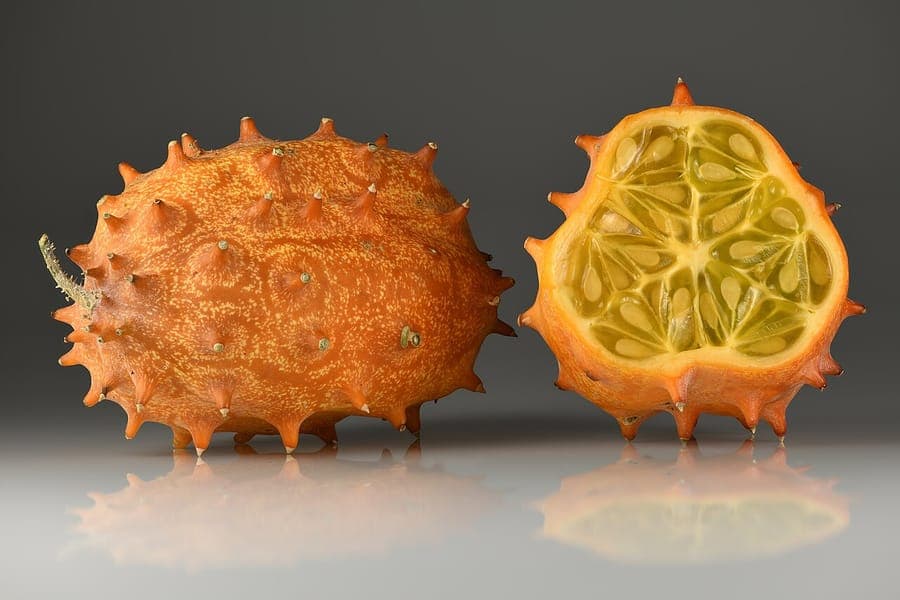
The kiwano (Cucumis metuliferus) is one of the most visually striking plants a gardener can grow. Also known as the African horned cucumber, horned melon, jelly melon, or blowfish fruit, this annual climbing vine produces vivid orange fruits covered in prominent spines. It belongs to the cucumber family (Cucurbitaceae), making it a relative of cucumber, melon, and courgette.
Native to tropical and southern Africa - Angola, Kenya, Tanzania, Zimbabwe and beyond - the kiwano has been a food source for local communities for centuries. The flesh is bright green and gelatinous, with a mild flavour reminiscent of cucumber with hints of lime and banana. Today, it is commercially cultivated in New Zealand, Australia, and southern Europe, and is increasingly appearing in supermarkets across northern Europe.
For hobbyist gardeners in the UK, Netherlands, Belgium, and northern France, the kiwano is a rewarding summer crop. The vine grows rapidly up a trellis or fence, reaching 150 to 300 cm, and produces fruits that are genuine conversation pieces. Cultivation requires a warm, sunny season and protection from frost, but is otherwise straightforward.
At gardenworld.app you can find design inspiration for gardens featuring exotic edible plants like the kiwano, combining ornamental value with edibility for a tropical touch.
Appearance & bloom cycle
The kiwano is a vigorous annual vine. Its stems are hairy and attach to any support with curling tendrils. Leaves are heart-shaped to lobed, deep green, 8 to 15 cm across - resembling cucumber leaves but with a somewhat rougher texture.
Flowers are small and yellow, 1 to 2 cm across. Male flowers appear first, followed by female flowers with a small embryonic fruit at the base. Pollination is carried out mainly by bees. Flowering begins in June and continues through August, depending on the sowing date and weather.
The fruits are the plant's defining feature. When young they are bright green with pale yellow markings and short spines. As they ripen, they turn deep orange with long pointed spines of 1 to 2 cm. A mature fruit weighs 200 to 400 g and measures 10 to 15 cm in length. Inside, the green gelatinous pulp surrounds emerald-green seeds. Ripening occurs from August through October.
While no widely recognised named cultivars exist, selections with larger fruits or more intensely coloured skin are available from specialist seed suppliers. The decorative quality of the mature fruit persists for months after harvest, making it popular as an ornamental table fruit.
Ideal location
Kiwano demands a warm, fully sunny position. Choose a spot receiving at least six to eight hours of direct sun daily. In cooler climates, a south-facing wall or fence is ideal; the reflected warmth significantly boosts fruit set. Sheltered, warm corners in the garden work well.
A vertical support is essential. The vine climbs with strong tendrils up to 2 to 3 metres. Use a sturdy metal trellis, wooden framework, or tensioned wire with 10 to 15 cm mesh. The heavy fruits benefit from additional support - net each large fruit to the trellis to prevent the stems from snapping under weight.
Container cultivation is possible in pots of at least 30 litres, placed in a sunny, sheltered position on a patio or terrace. Note that containers dry out faster than open ground; daily watering may be necessary in hot spells. Starting plants under glass or in an unheated greenhouse allows the harvest to begin two to three weeks earlier.
Soil requirements
Kiwano performs best in light, free-draining soil with a pH of 6.0 to 7.0. Heavy clay inhibits growth; improve it by working in coarse sand and mature compost. Sandy soil dries out too rapidly; incorporate 5 to 8 cm of garden compost or well-rotted manure to improve moisture retention and nutrient supply.
The plant is a heavy feeder and demands fertile soil. Before planting, work in 5 litres of mature compost and 50 g of slow-release nitrogen fertiliser (such as horn meal) per square metre. During the growing season, apply a potassium-rich liquid feed monthly to support fruit development. High potassium levels improve fruit colour and shelf life.
Good drainage is critical. Kiwano will not tolerate waterlogged roots; standing water quickly causes root rot. Plant on slightly raised beds or include a 10 cm layer of coarse gravel at the base of containers. The soil should be moist but never saturated.
Watering
Kiwano has a moderate but consistent water requirement and is more drought-tolerant than cucumber or courgette. During germination and the first weeks after planting out, keep the soil evenly moist. Once the plant is established and begins to climb, switch to deep, infrequent watering: soaking the root zone to a depth of 20 to 30 cm once per week is more effective than shallow daily watering.
Consistent moisture is critical during flowering and fruit set from June through August. Drought stress at this stage causes flower and fruit drop. Mulching around the plant base with 5 cm of straw or chopped leaf reduces watering frequency by half and keeps roots cool.
Avoid overhead watering; wet foliage in warm nights promotes powdery mildew. Drip irrigation at the root zone is the ideal method. Water in the early morning so foliage dries during the day.
In September and October, as fruits ripen, reduce watering. Restricting moisture at this stage intensifies flavour and improves fruit colour.
Free design
Want to see Kiwano: complete guide in your garden? Make a free design now.
Pruning
Kiwano requires minimal pruning but benefits from light guidance. Pinch out the growing tip of the main stem once it reaches the desired height to encourage lateral shoots, which bear the majority of the fruit. Do not remove too many lateral shoots.
Remove any diseased, damaged, or ground-trailing shoots. Strip the lower leaves up to 30 cm height regularly to improve air circulation and reduce fungal disease risk. In productive summers, thin fruits to five to eight per plant, removing the smallest or most misshapen to allow the remainder to develop fully.
Remove spent flowers and deformed fruits promptly. After the harvest in October, pull out the entire plant including roots - kiwano is an annual and will not overwinter. Save seeds from fully ripe fruits: rinse, dry on kitchen paper for two weeks, then store in a paper envelope in a cool, dry place. Seed viability lasts two to three years.
Maintenance calendar
February to March: Sow seeds indoors on a warm windowsill or in a heated propagator at 22 to 25 °C. Use small peat pots or modules with seed compost. Sow two seeds per pot and remove the weaker seedling after germination.
April: Begin hardening off after the last frost risk passes. Stand pots outside during the day and bring in at night. Prepare the garden bed with mature compost.
May (after 15 May in the UK/Netherlands): Plant out at final spacing of 60 to 90 cm. Fix to supports immediately and water in well.
June to July: Regular watering, monthly liquid feed (potassium-rich), train lateral shoots along supports. Flowering begins in June.
August: Fruits begin to colour. Reduce watering slightly. Watch for powdery mildew and treat preventively with a sodium bicarbonate solution (1 tablespoon per litre of water).
September to October: Harvest period. Fruits are ripe when the skin is fully orange and spines feel firm. Store harvested fruits at room temperature for four to eight weeks.
October to November: Remove plants after the first frost. Save seed for next year.
Winter hardiness
Kiwano is a tropical annual with no frost hardiness whatsoever. Growth stops at temperatures below 5 °C. Even a light frost of -1 °C causes irreversible leaf damage and kills young plants. In the UK, Netherlands, Belgium, and northern France, it is strictly a summer crop from May through October.
The plant is optimised for USDA hardiness zones 10 to 12. In our latitudes (zones 7 to 8), protection is needed. A fleece cover during an unexpected cold night in May or September can save plants. Growing in a cold greenhouse or polytunnel extends the season by three to four weeks at both ends.
Seeds do not survive outdoors in the ground over winter; always store them dry and frost-free indoors. Stored seed retains viability for two to three years at 5 to 10 °C and below 50 percent relative humidity.
Companion plants
Kiwano suits a tropically inspired summer garden or productive kitchen border. Combine it with:
- Courgette or squash as ground-covering plants at the base of the trellis. They share the same rich, warm soil requirements.
- Sunflowers (Helianthus annuus) as a backdrop. Tall stems act as wind buffers and yellow flowers complement the kiwano's fruit colour.
- Runner beans (Phaseolus vulgaris) alongside the trellis. They fix nitrogen, enriching the soil for the kiwano.
- French marigolds (Tagetes) as border edging. They deter nematodes and aphids while adding colour.
- Basil and dill as a low herb border. Both repel thrips and whitefly to some degree.
Avoid growing kiwano in the same spot as other cucurbits in successive years. Rotate growing positions annually to prevent fungal buildup and soil fatigue.
Conclusion
Kiwano is one of those remarkable plants that combines ornamental drama with genuine edibility - exotic in appearance yet surprisingly manageable in a European summer garden. With the right sunny location, fertile free-draining soil, and consistent watering, it delivers an eye-catching harvest of spiny orange fruits that are as beautiful on the table as they are in the kitchen. The main requirement is early planning: seeds must be started indoors in February or March.
For ideas on integrating kiwano and other unusual edibles into a coherent garden design, visit gardenworld.app for inspiration. Seeds are available at garden centres with a broad vegetable range or via specialist online seed suppliers.
Want to see Kiwano: complete guide in your garden? Make a free design now.
Upload a photo, pick a style, and get a photorealistic design with plant list in under a minute.
10,000+ gardens designed already
No credit card required


Similar plants
Sponge gourd: complete guide
Luffa aegyptiaca
Full guide to growing sponge gourd (Luffa aegyptiaca): sowing, care, harvesting edible fruits and drying natural loofah sponges in your garden.
Cucumis prophetarum: complete guide
Cucumis prophetarum
Wild cucumber is a fascinating climbing plant with remarkable spiky fruits. Learn how to grow this exotic annual from seed to harvest for decorative interest.
Momordica dioica: complete guide
Momordica dioica
Spine gourd: vigorous climbing vegetable with edible spiky fruits. Perfect growing conditions and harvest instructions.