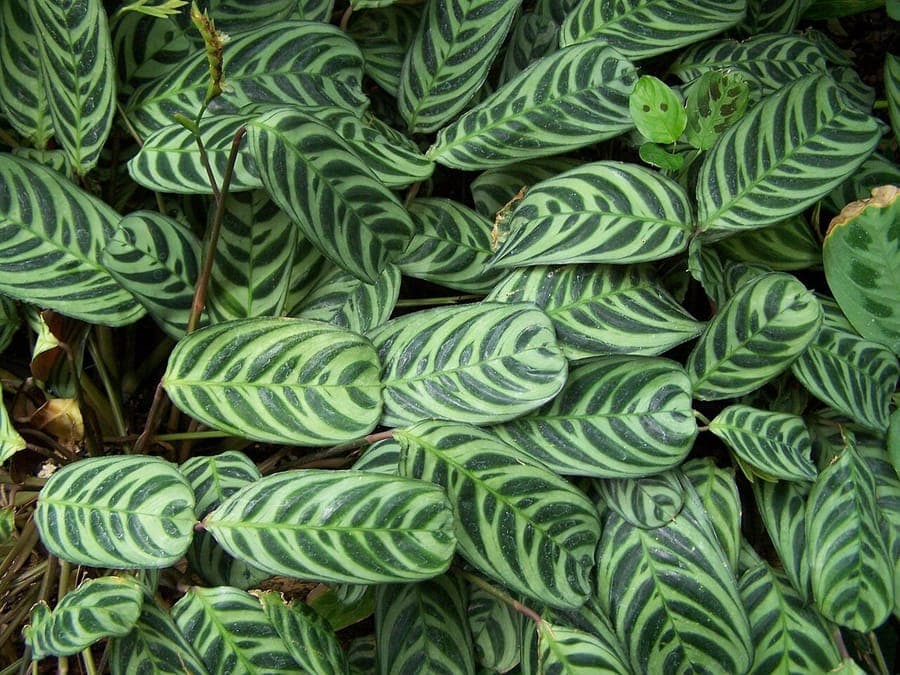
Benutzer:Callipides / CC BY-SA 2.0 de, via Wikimedia Commons
Fishbone prayer plant (Ctenanthe burle-marxii): care guide
Ctenanthe burle-marxii
Want to see Fishbone prayer plant (Ctenanthe burle-marxii): care guide in your garden?
Full design in HD: €7.99
Look after your Fishbone prayer plant with the GardenWorld app
Identify plants with your camera and get a care calendar with reminders for this plant.


Overview
Ctenanthe burle-marxii is one of the smallest and most graphic members of the arrowroot family. Across a pale grey-green leaf, dark green bars run diagonally from the midrib to the edge, like the bones of a fish, which is why it is sold as the fishbone prayer plant. Some garden centres simply label it Ctenanthe, and a form with almost silver-grey leaves goes by the cultivar name 'Amagris'.
The species is named after Roberto Burle Marx, the Brazilian landscape architect who collected countless plants on his expeditions through the country and used them in his gardens. It grows wild in eastern Brazil in the shade of the forest and belongs to the Marantaceae, along with calatheas, marantas and stromanthes. The genus name comes from the Greek word for comb, a reference to the comb-like arrangement of bracts around the flowers.
What makes this plant so appealing is its size. Where a stromanthe soon spreads a metre wide, Ctenanthe burle-marxii stays a low, neat clump. It fits on a desk, a sideboard or a windowsill out of full sun.
Appearance and growth
The plant grows 20 to 40 cm tall and slightly wider. The leaves are elongated ovals, 10 to 15 cm long, carried on slender, upright stalks. The upper surface is a soft grey-green with those striking dark bars; the underside is purplish red. The overall effect is fresh yet calm, which suits a modern interior with lots of white, wood or concrete.
It grows from short rhizomes and gradually forms a dense mat. In tropical gardens it is even used as shade ground cover. Indoors it grows at a moderate pace: during the growing season a new, rolled leaf regularly pushes up from the centre.
In the evening the leaves lift and fold halfway, then lower again in the morning. That movement is typical of the family and a sign of a healthy plant. Now and then small white flowers appear among greenish bracts on a short spike. They are more a curiosity than an ornament.
Position in the home
Thanks to its compact size, this ctenanthe fits in all sorts of places. A side table in a bright living room, a desk near a window or a bathroom with frosted glass all work well. It is also at home in a large, open glass plant cabinet, where the air stays humid.
Avoid draughts and sudden temperature changes. A windowsill above a radiator, a spot next to the front door or in the path of an air conditioner leads to brown edges and rolled leaves. In winter, do not push the pot against a cold windowpane either: leaves that touch the glass soon become marked.
Light
Ctenanthe burle-marxii likes bright, indirect light but tolerates partial shade rather better than most calatheas. A spot by a north or east-facing window is ideal, or a few metres from a south-facing one. Direct sunlight, especially at midday, bleaches the grey-green and dulls the bars; worse scorching leaves dry brown patches.
In a gloomy corner the plant will survive, but it grows slowly, the stalks stretch and the contrast between the bars and the background fades. If you notice it stalling in winter, move it a little closer to the window.
Watering
Keep the compost evenly moist. Water when the top 2 cm are dry: on average once a week in summer and every ten to fourteen days in winter. Because the pot is small, it dries out faster in a warm room than you might expect, so check with a finger rather than watering on a fixed day.
Never leave the plant standing in water. Use rainwater, filtered water or tap water that has stood overnight. Like its relatives, it develops brown tips if the water is hard. Use water at room temperature; cold water straight from the tap shocks the roots.
Free preview
Want to see Fishbone prayer plant (Ctenanthe burle-marxii): care guide in your garden? Make a free preview of your design.
Humidity
Humidity of around 50 % is enough, though more is welcome. That makes this species a little easier than the fussiest calatheas. In a dry, heated home the leaves will still curl quickly. A saucer of wet clay pebbles under the pot works well for such a small plant, and so does a cluster of houseplants or a small humidifier nearby.
Compost and repotting
Choose an open, humus-rich compost. A mix of houseplant compost with a third perlite and a little fine bark holds enough moisture while letting the roots breathe. A pot with a drainage hole is essential.
Repot every two years in spring. The roots are shallow, so a wide, low pot is better than a deep one. Go up 2 to 3 cm in size. A full clump can be split into two or three pieces when you repot, each with its own roots and a few leaves. Keep the divisions extra warm and humid for a few weeks.
Care and pruning
From April to September, feed every four weeks with half-strength liquid houseplant fertiliser. More is not needed; this compact plant uses very little.
Cut yellowing or damaged leaves away at the base. Wipe the leaves with a damp cloth now and then, as the matt surface catches dust that dulls the pattern. Watch for spider mite under the leaves, especially in winter, and for mealybug in the leaf joints. A lukewarm shower and higher humidity are the first measures.
Care calendar
January to February: Less water, no feeding. Check for spider mite because of the dry air.
March to April: Start feeding. Repot or divide if needed.
May to August: Full growth. Water regularly and keep out of harsh sun.
September to October: Stop feeding. Return the plant to its winter spot if you moved it.
November to December: Watch out for heating, draughts and cold windows.
On gardenworld.app you will find a plant calendar showing, month by month, the jobs to do for your houseplants and in the garden.
Temperature and overwintering
The ideal temperature is between 18 and 25 °C. Below 15 °C growth stops, and prolonged cold damages the leaves. In our climate it is strictly a houseplant and can never overwinter outdoors. Even in summer there is little point in putting it outside, where it is usually too sunny by day or too cold at night.
Toxicity to pets
The ASPCA, the American animal welfare charity that runs its own poison control centre, has no separate entry for Ctenanthe. It does list the closely related genera Calathea and Maranta, from the same family, as non-toxic to dogs and cats. No toxic compounds are known in Ctenanthe burle-marxii, and it is widely regarded as safe for people and pets. A cat that chews a lot of the leaves may at most get a mild stomach upset, as with any plant material.
Companion plants
Because it grows low, this ctenanthe makes a lovely foreground in a group of houseplants. The Chinese money plant (Pilea peperomioides), with its round leaves, is a playful contrast to the crisp bars. A bird's nest fern (Asplenium nidus) adds height and bright green. The peace lily (Spathiphyllum wallisii) and an Aglaonema share the same rhythm of light and water. Let an Epipremnum pinnatum trail down from a shelf above, and you have a complete green corner.
Final thoughts
Ctenanthe burle-marxii is the ideal introduction to the world of prayer plants: compact, graphic and a little less demanding than many calatheas. Give it bright light without sun, even moisture, soft water and a spot away from draughts, and it will stay fresh for years. If you would like your garden to look as cared for as your houseplant corner, you can have a garden design made on gardenworld.app.

See it in your garden
See Fishbone prayer plant in your garden
One photo of your garden and a few questions. You see the result in about a minute.
Try it with a photoIdentify this plant in your own garden. Identify a plant
Similar plants
Chinese Money Plant: complete guide
Pilea peperomioides
Chinese Money Plant (Pilea peperomioides) is a trendy houseplant from China featuring distinctive round, mint-green leaves. This Instagram-famous plant has become a favorite for modern homes with its elegant appearance and easy-care nature.
Asplenium nidus: complete guide
Asplenium nidus
Learn all about the Bird's Nest Fern (Asplenium nidus), a stunning tropical houseplant with glossy green fronds. Expert care tips, light requirements and optimal growing conditions.
Peace lily: complete guide
Spathiphyllum wallisii
How to grow a peace lily (Spathiphyllum wallisii): light, watering, repotting, getting it to flower again, and why it is toxic to cats and dogs.
