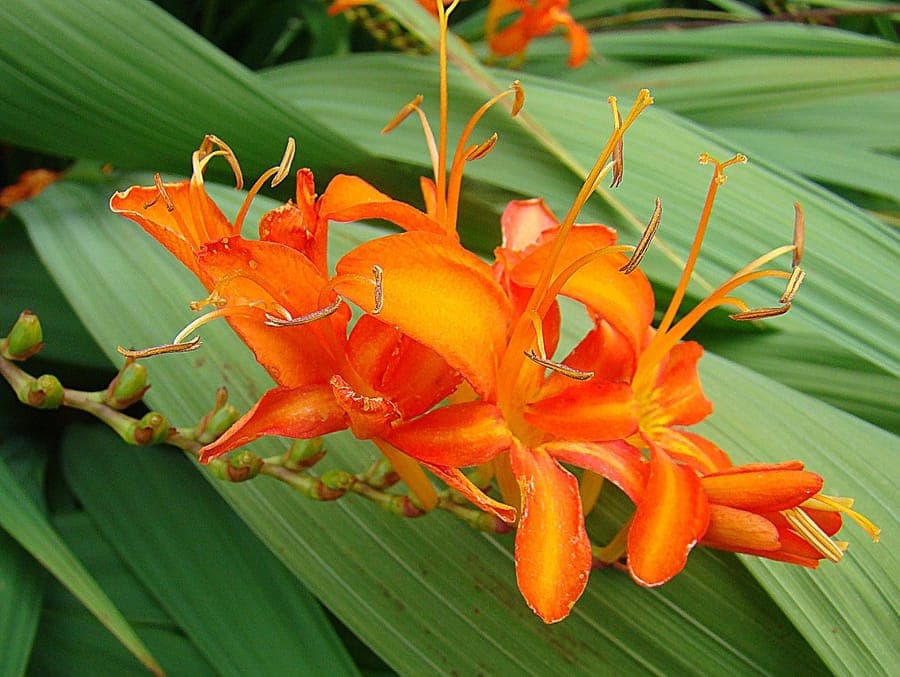
Dick Culbert from Gibsons, B.C., Canada / CC BY 2.0, via Wikimedia Commons
Giant montbretia (Crocosmia masoniorum): growing guide
Crocosmia masoniorum
Want to see Giant montbretia (Crocosmia masoniorum): growing guide in your garden?
Full design in HD: €7.99
Look after your Giant montbretia with the GardenWorld app
Identify plants with your camera and get a care calendar with reminders for this plant.


Overview
Crocosmia masoniorum, the giant montbretia, is the boldest and most architectural crocosmia you can grow. It comes from South Africa's Eastern Cape, where it grows on damp slopes, along streams and at the foot of cliffs in a region of summer rainfall. In the garden it builds sturdy clumps of broad, pleated leaves, and in summer it sends out arching spikes packed with orange-red flowers that point upwards like small flames.
The plant belongs to the iris family (Iridaceae) and grows from corms that form chains: each year a new corm develops on top of the old one, so a clump spreads steadily. Garden centres often sell it simply as montbretia, a name that really covers the whole genus and above all the familiar hybrid Crocosmia × crocosmiiflora. Crocosmia masoniorum is also one of the parents of the famous 'Lucifer', which Alan Bloom raised in England by crossing it with Crocosmia paniculata.
At 90 to 120 cm tall and 50 to 60 cm across, this is a mid-border plant with a slightly tropical feel. On gardenworld.app you can have a garden design created that gives warm colours like these a place alongside ornamental grasses and late perennials, so the border keeps glowing well into September.
Appearance and flowering season
The foliage is the first thing you notice: sword-shaped, fresh green, deeply pleated lengthways and up to 5 cm wide. It stands upright at first and later arches gracefully, giving strong vertical structure from May onwards.
Flowering runs through July and August, sometimes into September. The flower stems rise above the leaves and bend almost horizontally near the top. Along that arching spike the flowers face upwards, which sets this species apart from most other crocosmias, whose flowers look sideways or downwards. Each flower is 3 to 4 cm long, tubular with spreading lobes, in bright orange to orange-red, with long stamens protruding. The buds sit along the stem like a row of green beads and open from the base upwards.
After flowering, rounded seed capsules follow and stay decorative into autumn. Bumblebees and other insects visit the flowers; in their homeland they are pollinated mainly by sunbirds.
Ideal position
Give Crocosmia masoniorum a sunny spot. Full sun produces the most flowers and the sturdiest stems. Light partial shade works too, especially in a warm garden, but in real shade you mostly get leaves. A sheltered border against a south- or west-facing wall or hedge is ideal, as this species is a little less hardy than common montbretia.
Place clumps in the middle of a border with lower plants in front. Allow 40 to 50 cm between corms or pot-grown plants. On a windy site the heavy flower stems may flop, so shelter pays off.
Soil requirements
This crocosmia likes humus-rich, fertile soil that stays moist in summer but drains well in winter. Ordinary garden soil improved with compost usually suits it. On heavy clay that stays wet in winter, corms may rot: work in grit and organic matter, or plant slightly raised. On dry sand, a generous amount of compost helps hold moisture. Slightly acid to neutral soil is fine.
Planting
Plant dry corms in March and April, about 8 to 10 cm deep, in groups of five to seven for an instant clump. Pot-grown plants can go out from spring to early summer. Avoid planting in late autumn: young corms that have not rooted cope poorly with a wet winter.
Water in after planting and keep the soil lightly moist for the first few weeks. Flowering can be modest in the first year; from the second year the clump fills out.
Free preview
Want to see Giant montbretia (Crocosmia masoniorum): growing guide in your garden? Make a free preview of your design.
Watering
During the growing season, from May to September, the plant likes steady moisture. In most British summers rainfall is enough, but during a prolonged dry spell give a thorough soak at the base once a week. Drought in July leads to brown leaf tips, fewer flowers and a greater risk of red spider mite. No extra water is needed in winter, when wet soil is the main risk.
In containers the compost dries out much faster. Check every few days in summer and water as soon as the top few centimetres feel dry.
Pruning
Cut faded flower stems if you do not want seed, or leave them for the seed heads. Leave the foliage standing in autumn. It turns straw-coloured and protects the corms from frost and wet over winter. Cut everything back to just above ground level in February or early March, before new growth appears.
Every few years clumps become so congested that flowering declines. Lift them in spring, separate the corm chains and replant the youngest, plumpest corms.
Maintenance calendar
February to March: Cut back old leaves and stems. Divide congested clumps.
March to April: Plant new corms 8 to 10 cm deep. Spread a little compost around existing clumps.
May to June: Leaves grow quickly. Keep the soil moist in dry spells.
July to August: Peak flowering. Water during drought and remove spent stems if you like.
September to October: Last flowers and seed heads. Leave the foliage in place.
November to January: Mulch the base with 5 to 10 cm of leaf mould or bark, especially in cold areas and around young plants.
Winter hardiness
Crocosmia masoniorum is reasonably hardy. The RHS rates it H4, which means it tolerates frost down to about -10 °C. In most of Britain and the Low Countries it survives in the ground, particularly in a sheltered spot with good drainage. In severe winters or on waterlogged soil some corms may be lost.
Protect clumps with a layer of mulch, leaf mould or straw, and leave old foliage in place until spring. Container plants are more vulnerable: move pots somewhere frost-free and dry over winter, or plunge them into the ground. In cold, wet areas you can also lift the corms in autumn and store them cool and frost-free in barely moist sand.
Toxicity and spread
Crocosmia masoniorum is not known to be seriously toxic to people or pets. It is not an edible plant, though, so discourage children and animals from chewing the corms.
Keep an eye on spread. Its relative Crocosmia × crocosmiiflora has escaped into the wild in Ireland, Britain and parts of western Europe and is regarded as invasive there. Crocosmia masoniorum grows more slowly, but it also forms corm chains. Never dump lifted corms or garden waste in the countryside, and avoid planting it next to streams or nature reserves.
Companion plants
The orange-red flowers call for partners that either fan the flames or cool them down. Red hot pokers (Kniphofia uvaria) and sneezeweed (Helenium autumnale) share the same warm palette. Daylilies (Hemerocallis fulva) have similar strap-like foliage and flower a little earlier, extending the season. Blues and purples provide contrast: Agapanthus africanus and the airy Verbena bonariensis are classic companions for crocosmia.
Ornamental grasses such as Miscanthus sinensis and Panicum virgatum add movement and carry the display into autumn. The planting calendar on gardenworld.app helps you line up the flowering times of all these plants.
Final thoughts
Crocosmia masoniorum is a plant for gardeners who love colour and structure. Its broad, pleated leaves look good for months, and in summer the striking upward-facing orange flowers appear. Give it sun, moist but well-drained soil and a little winter protection, and it improves year after year. Keep an eye on its spread and divide clumps every few years, and it will flower generously while staying within the bounds of your border.
Frequently asked questions about Giant montbretia
Is Giant montbretia winter hardy?
Crocosmia masoniorum is reasonably hardy. The RHS rates it H4, which means it tolerates frost down to about -10 °C.
When and how do you prune Giant montbretia?
Cut faded flower stems if you do not want seed, or leave them for the seed heads. Leave the foliage standing in autumn.
How much water does Giant montbretia need?
During the growing season, from May to September, the plant likes steady moisture. In most British summers rainfall is enough, but during a prolonged dry spell give a thorough soak at the base once a week.
What soil does Giant montbretia need?
This crocosmia likes humus-rich, fertile soil that stays moist in summer but drains well in winter. Ordinary garden soil improved with compost usually suits it.

See it in your garden
See Giant montbretia in your garden
One photo of your garden and a few questions. You see the result in about a minute.
Try it with a photoIdentify this plant in your own garden. Identify a plant
Similar plants
Kniphofia uvaria: complete guide
Kniphofia uvaria
Learn about red-hot poker (pokerplant) - exotic summer bloomer, full sun requirements, drainage, frost protection, and vibrant color.
Fall Sneezeweed (Helenium autumnale): complete guide
Helenium autumnale L.
Discover Fall Sneezeweed, a stunning late-season bloomer with red, yellow, and copper flowers. Hardy perennial for borders and late-season color.
Fulvous day-lily: complete guide
Hemerocallis fulva
The fulvous day-lily (Hemerocallis fulva) is a hardy, clumping perennial that thrives in full sun to partial shade. Long blooming season from June to August, low maintenance.
