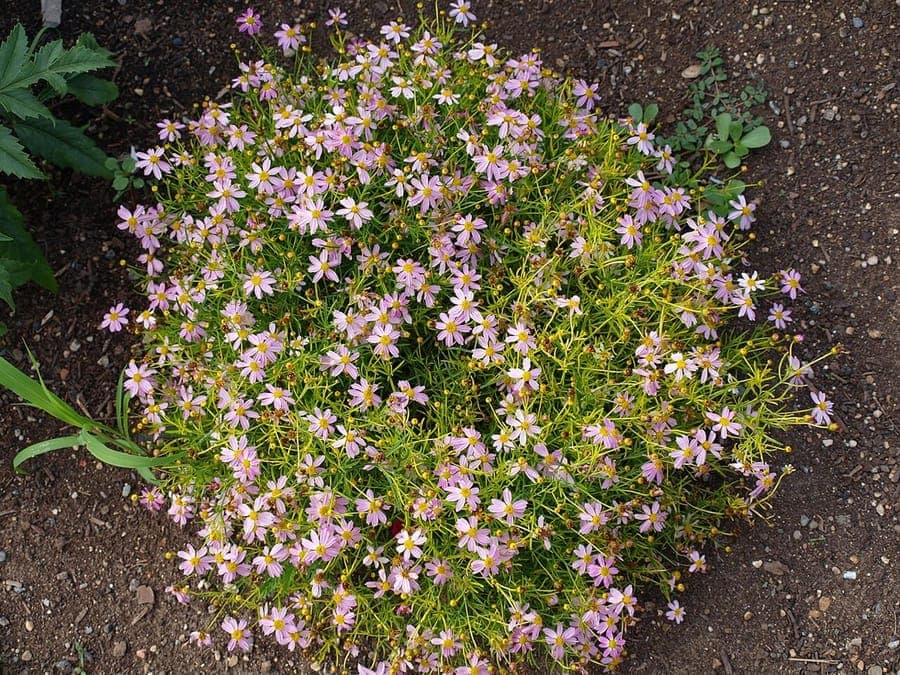
F. D. Richards from Clinton, MI / CC BY-SA 2.0, via Wikimedia Commons
Pink tickseed (Coreopsis rosea): complete guide
Coreopsis rosea
Want to see Pink tickseed (Coreopsis rosea): complete guide in your garden?
Full design in HD: €7.99
Look after your Pink tickseed with the GardenWorld app
Identify plants with your camera and get a care calendar with reminders for this plant.


Overview
Pink tickseed (Coreopsis rosea) is a dainty, low-growing perennial that spends the whole summer covered in small pink daisies with yellow centres. While most tickseeds flower bright yellow, this species brings a soft, romantic colour to the border. It forms an airy, rounded mound of needle-fine foliage that looks elegant even when it is not in flower.
The species comes from eastern North America, where it grows on sandy, damp shores of ponds and lakes, in wet grassland and near the coast, from Nova Scotia down to the south-eastern United States. In the wild it is even rare in places. In gardens it has become popular thanks to selections such as 'American Dream', which flowers a deeper pink and stays compact. On gardenworld.app you can have a garden design made that places pink tickseed at the front of a sunny border, as a soft edging along a path or among other low growers.
Coreopsis rosea grows 30 to 60 cm tall and spreads by underground runners to about 45 to 60 cm across. After a few years it forms a small mat. It is a faithful bloomer and attracts bees, hoverflies and small butterflies.
Appearance and bloom cycle
The leaves are linear, just 1 to 2 mm wide and 2 to 5 cm long, carried in pairs along thin, freely branching stems. This gives the plant a fine, almost grassy texture that contrasts nicely with the bolder foliage of other perennials. The foliage is fresh green and stays tidy until autumn.
Flowering starts in July and continues into September, with a second flush into October if you trim the plant lightly in midsummer. The flower heads are 1.5 to 2.5 cm across, with eight pale to mid-pink rays around a small golden-yellow centre. On some plants the flowers are almost white. They are scattered loosely above the foliage, so the mound looks like a soft pink cloud. The photo shows a rounded clump seen from above, full of pink stars and round yellow buds among the fine leaves.
Ideal location
Pink tickseed loves sun. Plant it where it gets at least six hours of direct light. It tolerates light shade in the afternoon, but then it flowers less freely and tends to flop. Ideal spots are the front of a border, a sunny edge along a patio or path, or a damp area beside a pond.
Space plants 30 to 40 cm apart. Thanks to the runners, they knit together into a continuous edging within a year or two. It also does well in a roomy pot or trough, as long as the compost does not dry out. A mixed container with grasses and other low plants makes a lovely summer display on a terrace.
Soil requirements
Unlike most tickseeds, Coreopsis rosea does not enjoy bone-dry soil. It wants moist but well-drained ground. Humus-rich sand, sandy loam or a light, improved clay are ideal. A slightly acid to neutral pH suits it; in the wild it often grows on acidic, sandy shores. On very chalky soil it is less vigorous.
On heavy, waterlogged clay the plant can rot over winter, so work in compost and some coarse grit to a depth of 20 cm. On poor, dry sand, add compost or leaf mould instead to help it hold moisture. Feeding is hardly necessary: a thin layer of compost in spring is plenty.
Free preview
Want to see Pink tickseed (Coreopsis rosea): complete guide in your garden? Make a free preview of your design.
Watering
This tickseed needs more water than its yellow-flowered relatives. Keep the soil evenly moist during the first year, watering twice a week in dry spells with about 3 to 5 litres per plant. Even later on, extra water is needed in hot, dry summers: if the soil gets too dry, flowering stops and parts of the clump may die back.
A mulch of compost or fine bark helps to retain moisture. In containers, check almost daily in summer. Never leave a pot standing in a saucer of water, though, because wet roots combined with cold can be fatal in winter.
Pruning
Around midsummer, usually in late July or early August, the first flush of flowers may start to look tired. Shear the whole clump back by about a third with shears. Within two to three weeks new buds appear and the plant flowers again into autumn. Deadheading individual flowers is neither practical nor necessary with so many tiny blooms.
Leave the foliage over winter, as it protects the crown. In March, cut everything back to a few centimetres above the ground. Every three years or so, divide the plant in spring to keep it vigorous, replanting the young outer pieces.
Maintenance calendar
March: Cut back the old foliage. Apply a thin layer of compost.
April to May: Plant new specimens or divide old clumps. Keep young plants moist.
June: The plant is growing strongly. Water in dry weather.
July: Flowering begins. Mulch the soil if it dries out quickly.
Late July to early August: Shear the clump back by a third for a second flush.
September to October: Repeat flowering. Water less as the weather cools.
November to February: Leave the foliage standing. Make sure water does not collect around the crown.
You can find these steps in the plant calendar on gardenworld.app, laid out month by month for the plants in your own garden.
Winter hardiness
Coreopsis rosea is hardy to about -30 °C (USDA zones 4 to 8) and needs no protection in the UK or the Low Countries. The main winter risk is cold, wet, poorly drained soil, which causes the roots to rot. In a good spot the plant lives for many years. If it starts to decline after a few seasons, dividing and replanting usually rejuvenates it.
The plant is not known to be toxic to people, dogs or cats. It suffers from few diseases; only the young shoots are sometimes nibbled by slugs in spring. It is not invasive in Europe.
Companion plants
The soft pink and fine foliage combine beautifully with blue, purple and silver plants. Balkan clary (Salvia nemorosa) and catmint (Nepeta × faassenii) offer blue and violet spikes that suit the pink flowers well, although these partners need a little less water. Bloody cranesbill (Geranium sanguineum) forms a low, magenta-pink carpet that weaves nicely in between.
For a touch of yellow, pair it with threadleaf tickseed (Coreopsis verticillata 'Moonbeam'), which has pale yellow flowers and the same fine foliage. If you plant pink tickseed beside a pond, combine it with great blue lobelia (Lobelia siphilitica). Low ornamental grasses such as Carex or Festuca add extra structure.
Final thoughts
Coreopsis rosea is a graceful, long-flowering perennial that adds a soft pink note to a sunny, moist border. Give it sun, moisture-retentive but well-drained soil and a trim in summer, and it will flower from July well into autumn. Plant a row along your path or at the front of the border and enjoy its little pink clouds for months.
Frequently asked questions about Pink tickseed
Is Pink tickseed winter hardy?
Coreopsis rosea is hardy to about -30 °C (USDA zones 4 to 8) and needs no protection in the UK or the Low Countries. The main winter risk is cold, wet, poorly drained soil, which causes the roots to rot.
When and how do you prune Pink tickseed?
Around midsummer, usually in late July or early August, the first flush of flowers may start to look tired. Shear the whole clump back by about a third with shears.
How much water does Pink tickseed need?
This tickseed needs more water than its yellow-flowered relatives. Keep the soil evenly moist during the first year, watering twice a week in dry spells with about 3 to 5 litres per plant.
Where does Pink tickseed grow best?
Pink tickseed loves sun. Plant it where it gets at least six hours of direct light.
What soil does Pink tickseed need?
Unlike most tickseeds, Coreopsis rosea does not enjoy bone-dry soil. It wants moist but well-drained ground.

See it in your garden
See Pink tickseed in your garden
One photo of your garden and a few questions. You see the result in about a minute.
Try it with a photoIdentify this plant in your own garden. Identify a plant
Similar plants
Whorled tickseed: complete guide
Coreopsis verticillata
Discover whorled tickseed, a long-blooming perennial with thread-like foliage. Comprehensive guide covering cultivation and garden applications.
Woodland sage: complete guide
Salvia nemorosa
Everything about Woodland Sage (Salvia nemorosa): planting, care, pruning and combinations. Expert tips for months of blue-violet flower spikes.
Catmint: complete guide
Nepeta faassenii
Everything about catmint (Nepeta faassenii): long-blooming blue flowers, drought-proof, ideal rose companion. Expert tips for a carefree, pollinator-rich border.
