
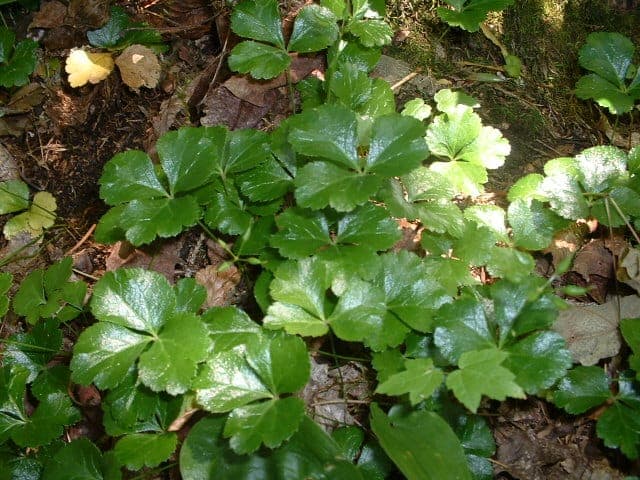
Fungus Guy / Public domain, via Wikimedia Commons
Coptis trifolia: complete guide for American goldthread in gardens
Coptis trifolia
Want to see Coptis trifolia: complete guide for American goldthread in gardens in your garden?
1 minute, no credit card
Overview
Coptis trifolia, commonly known as American goldthread, goldthread, or goldenroot, is a delicate woodland plant from the Ranunculaceae family. This North American groundcover is native from subarctic regions through the northeastern United States.
Gardeners prize it for its beautiful fine foliage, golden underground roots, and delicate white flowers. It represents a perfect choice for those seeking elegant, low-growing coverage in shaded gardens, particularly beneath trees.
Appearance and Bloom
Coptis trifolia grows only 10-15 cm tall, making it an ideal groundcover. Leaves are trifoliate (as the name suggests) and very finely textured, with a deep green gloss remaining attractive year-round in mild climates.
Flowers are small and white, appearing in late spring, typically April through May. Though subtle, they prove elegant, standing out against dark foliage. Various pollinators visit the flowers.
Most distinctive is the golden or orange-yellow underground root system (rhizome), providing the "thread" in the plant's common name. This becomes visible when plants are relocated. This rhizome has been traditionally used medicinally.
Ideal Location
Coptis trifolia performs best in shaded to half-shaded locations. It thrives beneath trees and in wooded conditions. Avoid full sun, especially in warm climates, as this causes leaf scorch.
The plant demands high humidity. It performs best in cool, moist conditions comparable to its natural mountain habitat. Growth naturally proceeds slowly and steadily.
It proves ideal for shaded pathways, beneath shrubs, or as understory planting beneath trees. It forms beautiful, natural groundcover carpets. Consult gardenworld.app for shade garden designs.
Soil
Coptis trifolia prefers acidic to neutral soil (pH 5.0 to 7.0) and thrives in humus-rich growing medium. Abundant composted forest soil or leaf mold proves ideal.
The plant demands excellent drainage; waterlogged conditions quickly kill it. Mix compost with sand or gravel for good drainage. Mulching around the plant with leaf mold helps maintain acidic, moist soil.
Free design
Want to see Coptis trifolia: complete guide for American goldthread in gardens in your garden? Make a free design now.
Watering
Coptis trifolia requires consistently moist soil, especially during growing seasons. However, drainage proves essential; waterlogged conditions prove fatal.
Watering becomes critical during dry periods, particularly in warm seasons. Regular misting helps maintain elevated humidity, which this plant greatly appreciates.
Winter watering should be reduced, though soil must never completely dry out.
Pruning and Maintenance
Coptis trifolia requires minimal pruning or maintenance. Remove only dead or damaged foliage as observed. The plant slowly spreads naturally via rhizomes.
You may carefully divide in early spring to encourage expansion or increase populations.
Maintenance Calendar
Spring: Plant begins leafing out. Water as needed. Plant blooms in late spring.
Summer: Keep consistently moist. Mist for humidity. Replenish mulch layers.
Autumn: Maintain consistent moisture. Plant continues slow growth.
Winter: Water carefully, reduce frequency but never allow complete drying. Foliage may recede in very cold regions.
Winter Hardiness
Coptis trifolia proves very hardy. Originating from arctic and subarctic regions, it tolerates cold well. It grows easily in zones 2-8.
In very warm regions it may struggle due to its requirements for humidity and cooler temperatures.
Companion Plants
Coptis trifolia combines beautifully with other shade plants:
- Other shade flowers like Trillium
- Various ferns
- Helleborus (Christmas rose)
- Asarum (ginger)
- Hosta cultivars for foliage contrast
These combinations create natural forest floor scenes. Explore additional pairings on gardenworld.app for shade garden ideas.
Closing
Coptis trifolia represents a subtle and elegant plant perfectly suited to shaded and wooded garden designs. Though slow-growing and requiring careful attention, it rewards patience with years of fine beauty and elegance. For gardeners seeking fine details and naturalism, this proves an exceptional plant.
Want to see Coptis trifolia: complete guide for American goldthread in gardens in your garden? Make a free design now.
Upload a photo, pick a style, and get a photorealistic design with plant list in under a minute.
No credit card required


Similar plants
Drummond's anemone: complete guide
Anemone drummondii
Discover Drummond's anemone (Anemone drummondii): a silvery-grey mountain plant for cool rock gardens and alpine troughs.
Korean clematis: complete guide
Clematis serratifolia
Clematis serratifolia is a hardy climber with fragrant yellow bell flowers in August-September. Pruning group 3, location and care tips.
Aquilegia brevistyla: complete guide
Aquilegia brevistyla
Discover Aquilegia brevistyla, the elegant North American columbine. Growing tips, shade tolerance, and design ideas for woodland and shadowed gardens.