
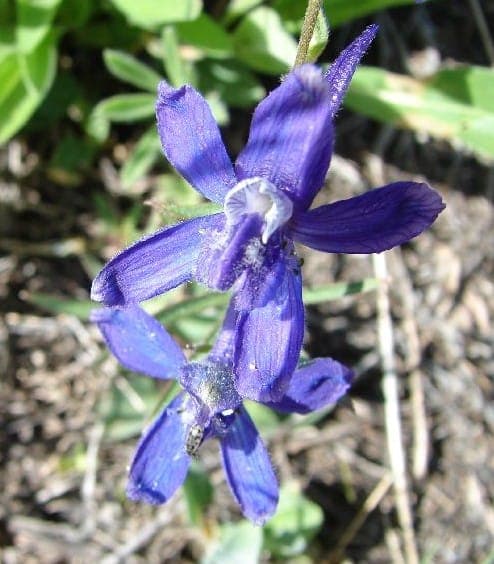
Cassondra Skinner / Public domain, via Wikimedia Commons
Anderson's larkspur: complete guide
Delphinium andersonii
Want to see Anderson's larkspur: complete guide in your garden?
1 minute, no credit card
Overview
Anderson's larkspur (Delphinium andersonii) is a perennial herb belonging to the buttercup family Ranunculaceae, native to the arid and semi-arid landscapes of the western United States. First described by the botanist A. Gray in 1887 and named in honour of Charles Lewis Anderson, an American explorer and naturalist, this species grows wild across California, Idaho, Montana, Nevada, Oregon and Utah. It thrives on dry, rocky hillsides and sagebrush plains at elevations ranging from a few hundred to over two thousand metres.
For gardeners who want something more unusual than the familiar tall garden larkspur (Delphinium elatum) or the annual larkspur (Consolida ajacis), this western native offers a genuinely compelling alternative. Its adaptations to drought, poor soils and fluctuating temperatures make it well suited to low-maintenance borders, rock gardens and prairie-inspired planting schemes that are increasingly popular across Europe. On gardenworld.app you can explore garden design ideas that incorporate drought-tolerant perennials like Anderson's larkspur into cohesive and beautiful planting plans.
Appearance and bloom cycle
The plant forms a single-crowned, upright herb with deeply divided, palmate leaves that give it a delicate, fern-like appearance when not in flower. The flowering stems rise cleanly from the basal rosette and can reach 50-80 cm in height under favourable conditions. The flowers are unmistakably larkspur-like: five sepals with a characteristic long backward spur, surrounding smaller inner petals. Colour ranges from pale blue to rich violet-blue, often with a white or paler central eye.
Blooming generally occurs in late spring to early summer, from May through to July depending on altitude and local conditions. In European gardens with a temperate climate, flowers typically appear in May and June. After flowering the plant sets small, pod-like follicles containing seeds that allow natural self-seeding. The above-ground parts die back after summer, and the plant overwinters as a perennial rootstock in the soil.
Note that all parts of the plant, especially the seeds and young shoots, contain toxic alkaloids (diterpenoid alkaloids) that are harmful to humans and animals if ingested. Always wear gloves when handling the plant and ensure it is kept away from children and pets.
Ideal location
As a native of dry slopes and open sagebrush plains, Delphinium andersonii performs best in a position receiving full sun to very light partial shade. It tolerates strong sun exposure well, provided the soil drains quickly and does not remain waterlogged. In European gardens, a south- or south-west facing border, a rock garden bed or a dedicated dry border is the most appropriate setting.
Avoid planting in damp, heavy or deeply shaded spots. The roots are particularly sensitive to standing water, especially in winter and early spring when low temperatures combine with excess moisture to cause root rot. A raised bed or a sloped site naturally improves drainage and replicates the plant's native hillside conditions.
Soil
The ideal soil for Anderson's larkspur is free-draining, sandy or gravelly with a neutral to slightly alkaline pH, ideally between 6.0 and 8.0. The plant is naturally adapted to nutrient-poor, calcareous substrates, so a lean, gritty mix is far preferable to a rich, fertile border soil. Adding excessive organic matter or fertiliser encourages lush leaf growth at the expense of flowering and can also increase susceptibility to fungal disease.
If your garden soil is heavy clay, improve drainage before planting by incorporating coarse sand, fine gravel and some horticultural grit into the top 30 cm. A topdressing of fine gravel or pea shingle around the plant's base helps regulate soil temperature, prevents splash-back of soil onto the lower leaves, and further improves drainage.
Free design
Want to see Anderson's larkspur: complete guide in your garden? Make a free design now.
Watering
Once established - usually after one full growing season - Anderson's larkspur is notably drought tolerant and requires very little supplemental watering. During dry summer spells, a thorough watering every two to three weeks is generally sufficient. Newly planted specimens need somewhat more attention in their first summer: water thoroughly once a week during dry stretches to help root establishment.
Overwatering is a far greater risk than drought for this plant. Waterlogged soil, especially in cool or cold weather, rapidly leads to root rot. When watering, apply water directly at the base of the plant rather than overhead, keeping the foliage and stems as dry as possible. Wet leaves in humid weather invite powdery mildew and other fungal problems. A well-draining substrate remains the single most important factor in keeping the plant healthy.
Pruning
After flowering, spent flower stems can be cut back to ground level. This prevents unwanted self-seeding and keeps the border tidy. If you welcome natural seeding - for example to let the plant colonise adjacent areas of the rock garden - leave some stems in place until the seed pods are fully dry and have released their seeds.
Cutting back in late summer occasionally stimulates a modest second flush of flowers in September or October. In autumn, once the above-ground parts have fully died back, cut the old stems to a few centimetres above soil level. This reduces the risk of overwintering pests and fungal spores in dead plant material. Always wear gloves, as the plant sap and seeds are toxic.
Maintenance calendar
- March-April: Watch for emerging shoots; remove any winter mulch once frost risk has passed.
- May-June: Main flowering period; enjoy the blue to violet blooms.
- July: Cut back spent stems or allow seed to ripen and self-sow.
- August: Water during prolonged dry spells; check for aphids and powdery mildew.
- September-October: Possible second flowering period.
- November: Cut back dead stems to a few centimetres above ground.
- December-February: Dormant period; no care needed beyond ensuring drainage stays good.
Winter hardiness
Delphinium andersonii originates from a continental climate with cold winters and hot, dry summers, placing it comfortably in USDA hardiness zones 4-7. It can withstand temperatures down to approximately -30 degrees Celsius, provided the roots sit in well-drained soil and are not exposed to prolonged waterlogging during the cold season.
In most parts of north-western Europe, including the Netherlands and Belgium (roughly USDA zone 7b-8a), the plant overwinters reliably. In regions with mild but wet winters, placing a layer of fine gravel or grit around the crown helps keep the rootstock dry. Frost damage to above-ground parts is normal and does not affect the plant's ability to regrow vigorously in spring from its underground rootstock. Garden centres in the UK and across Europe occasionally offer this species as a specialist rockery or prairie plant.
Companion plants
Anderson's larkspur combines beautifully with other drought-tolerant perennials suited to open, sunny borders. Excellent companions include lavender (Lavandula angustifolia), ornamental sage (Salvia nemorosa and related cultivars), yarrow (Achillea species in gold and cream tones), and blue oat grass (Helictochloa sempervirens). The blue-violet flowers of the larkspur make a striking contrast against the soft yellow of evening primrose (Oenothera) or the silver of Artemisia species.
Ornamental onions (Allium species) and star-of-Persia (Nectaroscordum siculum) share a similar preference for dry, well-drained soils and flower at a complementary time, creating a layered effect in the border. Avoid partnering with moisture-loving plants such as hostas, astilbes or Japanese iris, as their water requirements are simply incompatible.
Closing
Anderson's larkspur is an underrated gem for gardeners seeking a genuine prairie or rock garden feel with minimum effort. Its elegant blue flowers, its tough constitution in poor and dry soils, and its very low maintenance demands make it an outstanding choice for sustainable, water-wise planting. Visit gardenworld.app to discover more drought-tolerant planting ideas and design tools that help you create a beautiful, resilient garden.
Want to see Anderson's larkspur: complete guide in your garden? Make a free design now.
Upload a photo, pick a style, and get a photorealistic design with plant list in under a minute.
10,000+ gardens designed already
No credit card required


Similar plants
Drummond's anemone: complete guide
Anemone drummondii
Discover Drummond's anemone (Anemone drummondii): a silvery-grey mountain plant for cool rock gardens and alpine troughs.
Korean clematis: complete guide
Clematis serratifolia
Clematis serratifolia is a hardy climber with fragrant yellow bell flowers in August-September. Pruning group 3, location and care tips.
Aquilegia brevistyla: complete guide
Aquilegia brevistyla
Discover Aquilegia brevistyla, the elegant North American columbine. Growing tips, shade tolerance, and design ideas for woodland and shadowed gardens.