Bjoertvedt / CC BY-SA 4.0, via Wikimedia Commons
Coleus (Coleus scutellarioides): growing guide
Coleus scutellarioides
Want to see Coleus (Coleus scutellarioides): growing guide in your garden?
Full design in HD: €7.99
Look after your Coleus with the GardenWorld app
Identify plants with your camera and get a care calendar with reminders for this plant.


Overview
Coleus (Coleus scutellarioides), also known as painted nettle, is the foliage plant of choice for anyone who wants colour without relying on flowers. The leaves can be lime green, burgundy, copper-orange, pink, cream or almost black, often with edges, blotches or veins in a contrasting shade. No two cultivars are quite alike, which is why the plant is so popular in bedding schemes, containers and on windowsills.
The name has a turbulent history. For a long time the plant was called Coleus blumei, then Solenostemon scutellarioides, and for a while Plectranthus scutellarioides. In 2019 botanists reinstated the genus Coleus on the basis of DNA studies, and Coleus scutellarioides is now the accepted name. You will find all four names on labels, but they refer to the same plant. It belongs to the mint family, like mint and sage, and shares their square stems.
The species is native to tropical South East Asia and northern Australia. In our climate it is not hardy, so it is grown as an annual bedding plant or as a houseplant. Outdoors it reaches 30 to 80 cm, depending on the cultivar. If you want to know where such a colourful foliage plant will look its best, you can have a garden design made on gardenworld.app that takes the sun and shade in your garden into account.
Appearance and flowering
The leaves are opposite, oval to heart-shaped, 5 to 15 cm long, with a toothed or wavy margin. In some cultivars the edge is deeply cut, in others almost smooth. The colours come from pigments in the leaf and are brightest when the plant gets enough light.
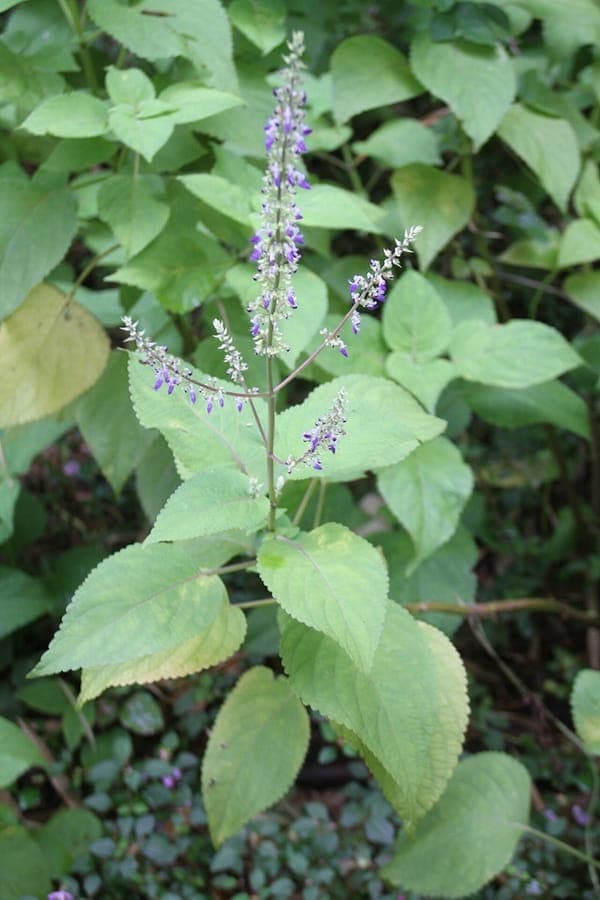
The wild form is far more modest. The photo shows a naturalised plant in a national park in Puerto Rico, with plain green, toothed leaves and a few upright spikes of small blue-violet flowers. This is what the species looks like in nature; all the colourful forms were selected from it during the nineteenth century.
Flowering comes in late summer, mainly as the days shorten. The small, lipped flowers attract bees but have little ornamental value. Once the plant flowers it puts less energy into new leaves and becomes leggy sooner. That is why most gardeners pinch out the flower spikes as soon as they appear.
Ideal location
Coleus is often sold as a shade plant, but that is only half true. Older seed-raised varieties colour best in partial shade and scorch in strong midday sun. Modern cutting-raised cultivars, often labelled as sun coleus, cope well in a sunny bed as long as the soil stays moist. Check the label to see which type you have.
In deep shade both types lose their colour and grow weak. A spot with morning sun and light shade in the afternoon suits most cultivars. Plants should go outside only after mid-May, once nights stay above 10 °C; cold nights cause brown patches and stop growth. Indoors, place the plant by an east- or west-facing window, or a little way back from a south-facing one.
Soil and containers
Coleus wants a humus-rich, open soil that holds moisture but drains well. In containers a good multi-purpose compost for bedding and balcony plants is fine. In beds, work some garden compost into the soil. The pH can be slightly acidic to neutral.
During the growing season, give a balanced liquid feed every two weeks. Too much nitrogen makes the leaves large but duller; too little feed gives small, pale leaves. A pot 15 to 20 cm across is enough for one plant, while in a large trough you can space them 25 to 30 cm apart.
Watering
The large, thin leaves lose a lot of water. Keep the soil evenly moist and never let it dry out completely: a dry coleus wilts within hours, although it usually recovers quickly after a thorough soaking. In warm weather that means watering containers every day.
The plant does not like wet feet either. Let surplus water drain away and do not leave the pot standing in a full saucer. Indoors, water when the top centimetre feels dry; in winter that is roughly once a week.
Free preview
Want to see Coleus (Coleus scutellarioides): growing guide in your garden? Make a free preview of your design.
Pinching and pruning
Pinching out is the most important job. On young plants, nip out the tip above the second or third pair of leaves; two new shoots will grow from the leaf axils. Repeat this a few times and you get a compact, bushy plant instead of a tall, bare stem.
Remove flower spikes as soon as you see them. If a plant becomes too tall or open during the summer, you can cut it back by a third without worry. Do not throw the tips away: they root in a glass of water within a week or two. This is the easiest way to multiply your favourite cultivars.
Maintenance calendar
March to April: Sow indoors at 20 to 24 °C, or take cuttings from overwintered plants. Pinch young plants twice.
May: After mid-May, plant out in beds or containers once nights are warm enough.
June to August: Water regularly, feed every two weeks, pinch out flower spikes. Watch for aphids and whitefly.
August to September: Take cuttings for overwintering.
October: Bring cuttings and perhaps a few parent plants indoors before temperatures drop below 10 °C. Clear the rest of the bed.
November to February: Keep indoors in a bright spot at room temperature. Water moderately, with little or no feed.
Overwintering
Coleus scutellarioides is not hardy at all. Leaves are damaged once temperatures fall below 5 to 8 °C, and the first frost finishes the plant. Bedding plants are therefore usually left to die off.
To keep a cultivar, take cuttings 8 to 10 cm long in late August or September. Root them in water or moist cutting compost and pot them up. Young plants overwinter far better than large, woody parent plants. Keep them on a bright windowsill at 16 to 20 °C, not above a radiator and not against cold glass. In spring, pinch them and take cuttings again, and by May you will have a whole set of new plants. The plant calendar at gardenworld.app shows month by month when to take cuttings, plant out and bring plants indoors.
Toxicity to pets
Coleus is not harmless to pets. The American ASPCA lists coleus as toxic to dogs, cats and horses. The plant contains essential oils that can cause vomiting, diarrhoea, lethargy and loss of appetite when eaten, sometimes with a little blood in the vomit or stools. Contact with the sap can also irritate the skin, in animals and in sensitive people.
Serious poisoning is rare, because animals usually only take a few bites. Still, indoors it is best to keep a coleus out of reach of a cat that likes to chew plants, and outdoors away from a young dog that tests everything with its teeth. If your pet has eaten a lot or shows symptoms, call your vet.
Companion plants
Coleus makes an ideal filler between flowering bedding plants. In partial shade, combine it with busy Lizzie (Impatiens walleriana) and with Heuchera micrantha, another plant grown for its leaf colour. Next to Hosta sieboldiana, the large blue-green leaves give a calm backdrop for red or pink coleus.
In sun, sun-tolerant cultivars go well with Ipomoea batatas, the ornamental sweet potato with lime green or dark purple leaves, and with Canna indica as a tall tropical focal point. Play with contrast: lime next to burgundy, or orange next to purple. Within one container, stick to two or three colours, or the result looks busy.
Final thoughts
Coleus is a rewarding plant for anyone who loves colour and does not want to buy new plants every year: a handful of cuttings gives you fresh plants each spring. Provide light without harsh midday sun (unless you have a sun-tolerant cultivar), evenly moist soil and regular pinching. Do keep in mind that the plant is toxic to dogs and cats. With that in mind, you can enjoy a vivid bed or a lively windowsill from May to October.
Frequently asked questions about Coleus
How much water does Coleus need?
The large, thin leaves lose a lot of water. Keep the soil evenly moist and never let it dry out completely: a dry coleus wilts within hours, although it usually recovers quickly after a thorough soaking.
Where does Coleus grow best?
Coleus is often sold as a shade plant, but that is only half true. Older seed-raised varieties colour best in partial shade and scorch in strong midday sun.
What soil does Coleus need?
Coleus wants a humus-rich, open soil that holds moisture but drains well. In containers a good multi-purpose compost for bedding and balcony plants is fine.

See it in your garden
See Coleus in your garden
One photo of your garden and a few questions. You see the result in about a minute.
Try it with a photoIdentify this plant in your own garden. Identify a plant
Similar plants
Busy lizzy: complete guide
Impatiens walleriana
Discover Busy lizzy (Impatiens walleriana): a colorful flowering plant for shade. Rich blooms, compact, easy-care. Growing tips for gardens and containers.
Sweetpotato: complete guide
Ipomoea batatas
Discover sweetpotato (Ipomoea batatas), a productive vine with nutritious tubers. Learn all about cultivation, harvest, and nutrition.
African arrowroot: complete guide
Canna indica
Everything you need to grow and care for Canna indica in your garden. Learn about sunlight, watering, winter care, and ideal planting partners.
