
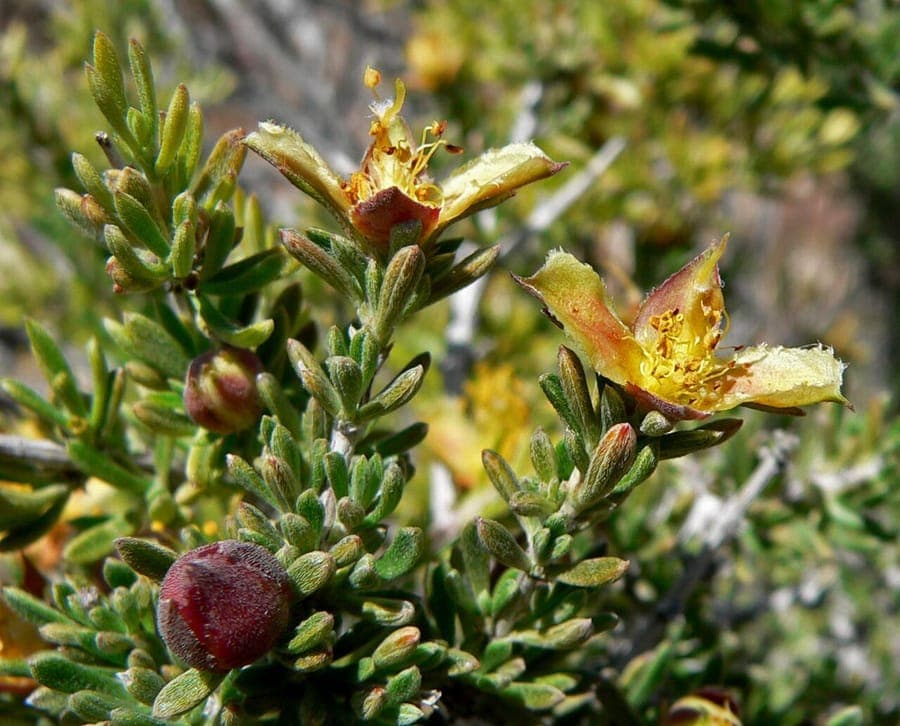
Stan Shebs / CC BY-SA 3.0, via Wikimedia Commons
Blackbrush: complete guide
Coleogyne ramosissima
Want to see Blackbrush: complete guide in your garden?
1 minute, no credit card
Overview
Coleogyne ramosissima, universally known as blackbrush, is a slow-growing, densely branched desert shrub in the rose family (Rosaceae). It is native to the arid interior of the American Southwest, found across Arizona, California, Colorado, Nevada, and Utah. In its natural range it forms extensive, often monospecific stands on dry slopes, mesas, and bajadas between 600 and 1800 metres elevation, giving the landscape a distinctive grey-green carpet that turns almost black after drought or frost - the origin of its common name.
Coleogyne is a monotypic genus, meaning blackbrush is the only species it contains. This botanical singularity underlines how distinct this plant is from its neighbours in the rose family. Despite being a member of Rosaceae - the same family as roses, cherries, and apples - its flowers lack true petals. Instead, four petal-like yellow sepals surround the reproductive parts, giving the flowers a modest but distinctive character.
Blackbrush plays a critical ecological role in the Great Basin and Mojave Desert transition zones, stabilising soil, providing cover for wildlife, and feeding a range of specialist insects. As a garden plant outside North America it remains unusual but is increasingly sought by collectors of xeric and native plants. On gardenworld.app you can explore how structuring shrubs like blackbrush fit into naturalistic dry garden compositions.
Appearance and bloom cycle
Coleogyne ramosissima grows as a densely branched shrub typically 60 to 120 cm tall with a spread of 60 to 150 cm. The stems are grey-brown and end in stiff, spine-like tips - a natural adaptation against browsing. The leaves are small, grey-green, and coarse-textured, tightly clustered along the branches and giving the plant a rugged, spiny appearance. In the driest periods or after frost the stems darken to near-black, the appearance that gives the plant its name.
Flowering occurs in spring, typically April and May. The flowers are small but attractive at close range: four yellow, petal-like sepals surround a cluster of stamens and carpels with no separate petals. After flowering, small oval achenes (brown dry fruits) develop. Because blackbrush is slow-growing, established plants in the wild can be very old - some individuals are estimated to be several hundred years old.
The grey foliage creates a useful contrast with the small yellow flowers in spring. Bees and other small pollinators visit the flowers, though nectar production is limited. In autumn the leaves contract and the stems deepen in colour, which can give the impression the plant has died - this is entirely normal winter rest.
Ideal location
Full sun is essential for blackbrush. In its native habitat it grows on completely open, exposed ridges and plains with direct sun all day. In the garden, choose the driest, sunniest spot available: a south-facing raised bed, a dry slope with sharp drainage, or a gravel garden are all suitable. The plant tolerates extreme heat well above 40 degrees Celsius and strong wind without difficulty.
Avoid shaded positions at all costs: blackbrush responds to shade with minimal growth and essentially no flowering. Low-lying areas where water pools after rain are entirely unsuitable. The ideal position resembles a sun-baked, stony hillside - the closer you can get to this in your garden, the better blackbrush will perform.
Soil
Poor, sharply drained soil is the key requirement. In the wild, Coleogyne ramosissima grows on lean, calcareous or slightly acidic substrates with a pH range of 5.9 to 8.0. The absolute rule is excellent drainage: this plant has evolved in soils that dry out completely between rains and has no tolerance for persistent moisture.
For garden cultivation, amend existing soil by working in 40 to 60 percent coarse grit or fine gravel before planting. The poorer and drier the soil, the better blackbrush will perform. Very modest additions of organic matter are acceptable but avoid compost-rich mixtures. Calcareous soils similar to the limestone plateaus of Utah and Nevada are ideal. Heavy clay must be avoided entirely or heavily amended.
Free design
Want to see Blackbrush: complete guide in your garden? Make a free design now.
Watering
Blackbrush is, once established, one of the most drought-tolerant shrubs you can plant in a garden. During the first growing season, water every one and a half to two weeks to encourage root establishment. After the first year, supplemental irrigation can be drastically reduced or stopped entirely in climates receiving more than 200 mm of annual rainfall.
In a temperate European climate, additional watering after the first year is rarely necessary except during prolonged heat waves of three or more weeks without rainfall. Overwatering is far more dangerous than drought: roots that remain wet for several days will rot rapidly. Always allow the soil to dry out completely between waterings. Winter irrigation is unnecessary and potentially harmful.
Pruning
Coleogyne ramosissima requires very little pruning. The plant naturally maintains a dense, even form and does not need cutting back to preserve its shape. In most situations, removing dead or frost-damaged branches in early spring is all the pruning required.
Hard cutting back is strongly discouraged: blackbrush is slow-growing and recovers poorly from drastic pruning. After a severe winter with significant frost damage, wait until the plant begins to push new growth before removing dead wood, so you can accurately identify which branches are dead. Very light tip trimming immediately after flowering in May or June can be used to encourage a slightly more compact habit if desired.
Maintenance calendar
January-February: dormant; no intervention. Monitor drainage if rainfall is prolonged. March-April: remove any dead wood; check for new shoots as a sign of healthy return from dormancy. First flowers appear. April-May: peak flowering period; no intervention needed. May-June: after flowering, optional very light tip trimming. July-August: deep summer rest in heat; a single deep watering during extreme drought is sufficient. September-October: plant prepares for winter; no pruning. November-December: stems darken to near-black - this is normal seasonal change, not a sign of disease.
Winter hardiness
Coleogyne ramosissima is cold-hardy to USDA zone 5, surviving temperatures down to approximately -26 degrees Celsius, and possibly zone 4. In north-western Europe (USDA zones 7-8) frost damage is almost never a concern. The primary winter risk in mild, wet European climates is not cold but the combination of cold and persistently wet soil: waterlogged, frozen roots suffer far more than roots that are cold but dry.
Ensure excellent drainage at the planting site. A layer of coarse gravel or grit around the crown helps keep the stem bases dry during wet winters. At gardenworld.app you will find design guidance on creating conditions that suit xeric plants like blackbrush in a northern European setting.
Companion plants
In its native habitat, Coleogyne ramosissima grows alongside Artemisia tridentata (big sagebrush), Purshia tridentata (bitterbrush), and Chrysothamnus species. These provide excellent clues for garden companions: silver-grey Artemisia or other sagebrush relatives create striking textural and colour contrast with the dark stems of blackbrush. Low-growing Penstemon species add spring colour. Bouteloua gracilis or Festuca glauca echo the rugged, dry aesthetic without competing for the limited available moisture.
For a desert-style planting in a milder climate, blackbrush pairs well with Yucca species, Agave parryi, and low-growing Opuntia. Avoid moisture-loving plants in the same border - the difference in water requirements will disadvantage one planting or the other. Specialist garden centres focused on xeric or drought-tolerant plants, increasingly found across the UK and continental Europe, are the best source for rare desert shrubs like this one.
Closing
Coleogyne ramosissima is an unusual choice for the adventurous gardener seeking authentic desert and steppe vegetation in their landscape. Its demands are minimal: poor, well-drained soil, full sun, and very little water once established. In return it provides a robust, grey structural shrub with year-round visual interest - its spiny, angular branching pattern is attractive in all seasons - and a modest but characterful spring flowering that feeds early pollinators. For a garden that is genuinely low-maintenance and ecologically grounded, this singular member of the rose family is worth serious consideration.
Want to see Blackbrush: complete guide in your garden? Make a free design now.
Upload a photo, pick a style, and get a photorealistic design with plant list in under a minute.
10,000+ gardens designed already
No credit card required


Similar plants
Basin sagebrush: complete guide
Artemisia tridentata
Everything about Artemisia tridentata: origin, appearance, ideal location, soil, watering, care and companion planting in garden settings.
Antelope bitterbrush: complete guide
Purshia tridentata
Full guide to antelope bitterbrush (Purshia tridentata): planting, soil, pruning, and companion plants for dry gardens.
Yellow rabbitbrush: complete guide
Chrysothamnus viscidiflorus
Grow yellow rabbitbrush successfully: soil, watering, pruning, and companion plants for this drought-tolerant western shrub.