
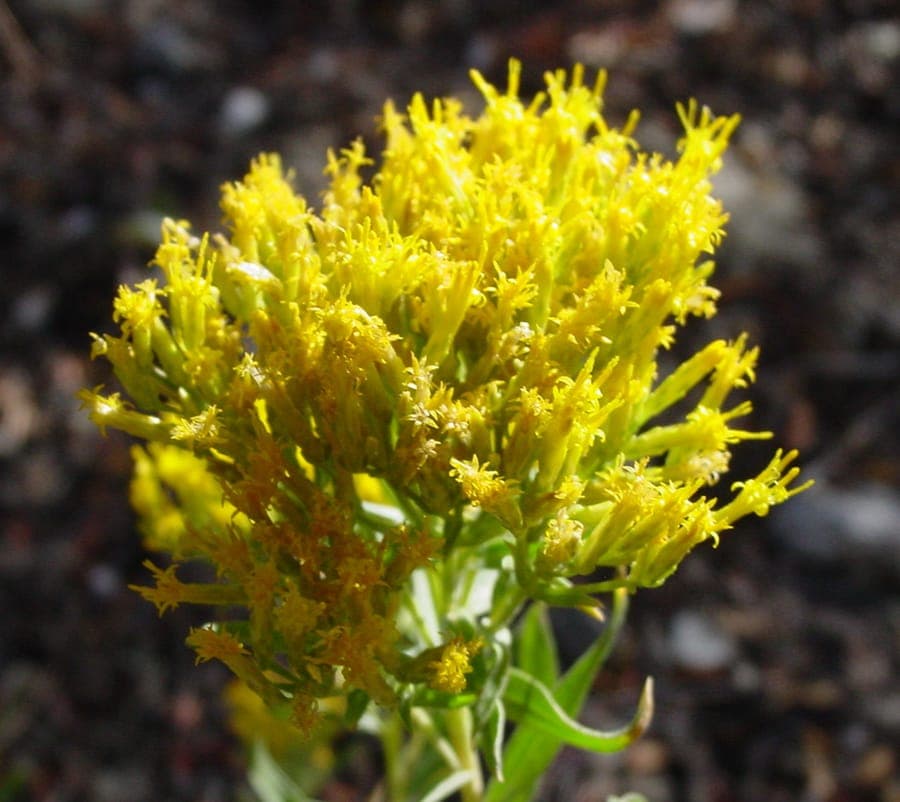
Wallace Keck / Public domain, via Wikimedia Commons
Yellow rabbitbrush: complete guide
Chrysothamnus viscidiflorus
Want to see Yellow rabbitbrush: complete guide in your garden?
1 minute, no credit card
Overview
Chrysothamnus viscidiflorus, commonly known as yellow rabbitbrush, sticky-leaf rabbitbrush, or green rabbitbrush, is a compact, multi-stemmed deciduous shrub in the Asteraceae family. Native to the dry, open steppes and mountain slopes of western North America - from British Columbia and Montana south to Arizona, Nevada, and California - it thrives in conditions that defeat most garden plants: alkaline soil, prolonged drought, extreme temperature swings, and intense sun.
In European gardens, yellow rabbitbrush has carved a niche among enthusiasts of dry garden styles, rock gardens, and prairie-inspired planting. The shrub demands very little once established, tolerating droughts that would stress conventional border plants, and rewards gardeners with an explosion of golden-yellow bloom clusters in late summer and early autumn, precisely when many other ornamentals have finished flowering. It also provides valuable late-season nectar for bees, butterflies, and hoverflies.
The genus name Chrysothamnus derives from the Greek 'chrysos' (gold) and 'thamnos' (bush), a fitting description of the golden autumn display. The species epithet 'viscidiflorus' means 'having sticky flowers', referring to the resinous coating on leaves and flower buds. In its native range, the plant grows on dry, rocky hillsides, along roadsides, and in open sagebrush scrublands up to elevations exceeding 3,000 metres above sea level.
For gardeners seeking a low-maintenance, drought-tolerant shrub that delivers late-season colour and ecological value, yellow rabbitbrush deserves serious consideration. Its requirements are straightforward: full sun, excellent drainage, and alkaline to neutral soil. Give it those conditions and it will reward you for many years with minimal intervention.
Appearance & bloom cycle
Yellow rabbitbrush forms a rounded, multi-stemmed shrub typically 30 to 90 cm tall and 60 to 120 cm wide. Growth rate is moderate in ideal conditions. The stems are erect to slightly arching, densely clothed in narrow, linear leaves 2 to 5 cm long. Leaves are pale to mid-green, slightly sticky to the touch due to a resinous exudate, and fine-textured - an elegant contrast to coarser-leaved neighbours.
The bloom period runs August through October, making yellow rabbitbrush one of the latest-flowering shrubs in the garden. Flower heads are individually small (4–8 mm across) but produced in enormous numbers as dense, flat-topped to slightly domed corymbs. The overall effect in full bloom is a compact golden dome that catches afternoon light beautifully. After flowering, the heads transform into feathery seed clusters that provide ornamental interest well into winter and serve as food for seed-eating birds.
The related species Chrysothamnus nauseosus (now reclassified as Ericameria nauseosa) is larger and more commonly offered in specialist nurseries, but C. viscidiflorus offers the advantage of a more compact habit, better suited to smaller gardens. Several informal selections exist with slightly different growth habits; look for plants labelled 'Douglas rabbitbrush' or 'sticky-leaved rabbitbrush' as these often refer to the same or closely related species.
Foliage turns yellow-green to pale yellow in early autumn before leaf fall. Winter stems provide structural interest and should not be cut until spring to avoid weakening the plant.
Ideal location
Full sun is non-negotiable for yellow rabbitbrush. The plant demands at least six to eight hours of direct sunlight daily for robust flowering and a tight, compact habit. In partial shade, growth becomes lax and bloom significantly reduced. South- or west-facing aspects, particularly those backed by a warm wall, are ideal and will also improve winter survival in colder climates.
In its native western North American range, this species colonises open, well-drained slopes, road cuts, and disturbed ground where competition from taller vegetation is limited. Replicate these conditions in the garden: an open, sunny position with excellent air circulation. Avoid enclosed spots between dense hedges or tall walls on multiple sides, as poor air movement encourages fungal issues on the foliage.
For gardens with heavy clay soils, raised beds or berms are the simplest solution. A raised planting area just 20 to 30 cm above the surrounding grade dramatically improves drainage and creates the microclimate this shrub prefers. Container culture is also viable in a free-draining, loam-based mix with 30% grit addition.
Soil requirements
Yellow rabbitbrush thrives in poor to moderately fertile, sharply draining soil with a pH of 7.0 to 8.5 - neutral to distinctly alkaline. This makes it an excellent candidate for gardens on chalky or limestone-derived soils where many other shrubs struggle. Fertile, nutrient-rich soil promotes soft, lush growth that is more susceptible to frost damage and aphid attack.
On heavy clay, incorporate at least 30% coarse grit or perlite by volume when backfilling the planting hole, and work gravel or crushed stone into the surrounding area to a depth of 40 cm. On light sandy soils, little amendment is needed; a thin 5 cm layer of organic matter such as leaf mould can improve soil structure without over-enriching.
Avoid nitrogen-heavy fertilisers. If the soil pH is below 6.5, a light application of garden lime in autumn will raise pH toward the preferred range. On already neutral or alkaline soils, skip all fertilising entirely - this shrub performs best when slightly starved.
Watering
Once established, yellow rabbitbrush is among the most drought-tolerant shrubs available for European gardens. In its native habitat, the plant survives multi-month dry periods by drawing on deep reserves of moisture through an extensive root system that penetrates 1.5 metres or more into rocky substrates.
During the first growing season after planting (typically April through October), water once every two weeks in the absence of rainfall. This supports root development without creating the waterlogged conditions the plant finds intolerable. Always water at the base rather than overhead; wet foliage combined with warm temperatures invites fungal issues. Drip irrigation or a slow pour around the stem base is ideal.
From the second year onward, supplemental watering is rarely needed in most European climates. During exceptional droughts - more than six weeks without significant rainfall - a single deep watering per month will prevent severe stress without creating dependency. In continental climates with hot summers exceeding 35 °C, monthly watering during July and August is a reasonable precaution.
Winter waterlogging is far more dangerous to this plant than cold or drought. Ensure the planting site drains freely even during prolonged wet winters.
Free design
Want to see Yellow rabbitbrush: complete guide in your garden? Make a free design now.
Pruning
An annual light pruning keeps yellow rabbitbrush compact and encourages more prolific flowering. The best time is early spring, as soon as the last frost risk has passed and the first signs of new growth appear - typically March in western Europe (zones 6–7). Cut back all stems by approximately one-third, always cutting just above a side bud or lateral branch. This removes the oldest wood and stimulates production of vigorous new flowering shoots.
Avoid autumn or winter pruning, as the soft new growth produced afterward is vulnerable to frost damage. A hard rejuvenation cut - reducing the entire shrub to 10 to 15 cm above ground level - is possible every four to five years and usually produces a vigorous flush of new growth. Sterilise pruning tools before and after use to prevent disease transmission between plants.
Remove dead or damaged branches whenever noticed, regardless of season. After a severe winter, some branches may have died back; scratch the bark lightly to check for green wood before cutting. Often, branches that look dead above ground are still alive at the base and will regenerate given time.
Maintenance calendar
January–February: Minimal maintenance. Check for frost damage. Avoid working frozen soil around the root zone.
March: Main pruning: cut all stems back by one-third. Remove any completely dead wood. Expect the first growth buds to swell in the third week of March in zones 6–7.
April: Monitor for new growth. Apply a small amount of lime fertiliser only if soil pH is below 6.5. Plant new specimens after the last frost, spacing 60 to 90 cm apart.
May–June: Active growth period. Keep the area around the plant free of weeds but avoid deep cultivation near the root zone. A mulch of coarse gravel or pebbles suppresses weeds and stabilises soil temperature.
July–August: Pre-bloom and early bloom. Avoid fertilising or major interventions. Water only if drought exceeds four weeks.
September–October: Peak bloom and seed set. Allow seed heads to remain as long as possible for ornamental effect and as a food source for finches and other seed-eating birds.
November–December: Winter preparation. Do not apply organic mulch directly against the stem base; on alkaline, poorly draining soils this can encourage crown rot. A collar of coarse grit around the base keeps the crown dry.
Winter hardiness
Yellow rabbitbrush is remarkably cold-hardy for a shrub from a continental North American climate. In the Rocky Mountains and Great Basin of its native range, it survives temperatures reaching -25 °C or below, provided drainage is excellent. In European garden terms, it is reliably hardy in USDA zones 4 to 7, covering the great majority of central and western Europe.
The primary threat to survival in European gardens is not cold itself but the combination of wet and cold. Heavy, poorly draining soil that stays waterlogged through winter causes root rot that is more lethal than frost alone. In high-rainfall western regions such as the Netherlands, Belgium, and western France, a well-drained planting position is the most important factor for long-term success.
In temperate coastal areas, yellow rabbitbrush overwinters without problems at temperatures down to -15 °C. After an unusually severe winter, some stems may die back; the plant typically regenerates from the root crown. In continental climates with cold but dry winters - much of Germany, Austria, and eastern Europe - the plant is often even more reliable due to the lower winter humidity.
Companion plants
Yellow rabbitbrush combines beautifully with other drought-tolerant plants that share its soil preferences. Proven and attractive combinations include:
- Artemisia 'Powis Castle': Silver foliage provides excellent contrast to the golden flowers of Chrysothamnus. Both thrive in poor, dry, alkaline soil. Space 50 to 70 cm apart.
- Salvia nemorosa 'Caradonna': Deep purple flower spikes bloom earlier in summer, so the transition from purple to gold extends the colour season. Plant 40 cm to each side.
- Festuca glauca 'Elijah Blue': This blue-grey fescue echoes the fine-textured foliage of the rabbitbrush and thrives in identical conditions. Space 30 cm from the shrub.
- Penstemon pinifolius: This drought-tolerant perennial with orange-red tubular flowers blooms in July and August, just before the Chrysothamnus opens, extending the season.
- Lavandula angustifolia 'Hidcote': Lavender and rabbitbrush share a preference for dry, alkaline soils and together attract an impressive range of pollinators.
Avoid moisture-loving plants such as Astilbe, Hosta, or Hydrangea: their soil requirements are diametrically opposed and one partner will always suffer in a mixed planting.
Explore how yellow rabbitbrush fits into a dry, contemporary front garden design using gardenworld.app, where you can upload your own garden photo and test plant combinations visually. For more inspiration on rock garden and prairie border planting, visit gardenworld.app.
Closing
Yellow rabbitbrush is a shrub that earns its place in the garden precisely when others are fading. Its golden bloom in August through October, combined with exceptional drought tolerance, a compact growth habit, and strong ecological value, makes it an outstanding choice for the low-maintenance modern garden. Whether in a rock garden, a prairie-inspired border, or a dry terrace bed, this compact shrub delivers colour, texture, and biodiversity with minimal demand on the gardener's time and water supply.
One practical note: the plant is toxic to livestock if consumed in large quantities, but poses no risk in a garden setting for humans or domestic pets. The resinous scent of the foliage may irritate sensitive skin; gloves are recommended when pruning.
Want to see Yellow rabbitbrush: complete guide in your garden? Make a free design now.
Upload a photo, pick a style, and get a photorealistic design with plant list in under a minute.
10,000+ gardens designed already
No credit card required


Similar plants
Calendula stellata: complete guide
Calendula stellata
Complete guide to Calendula stellata, the star-flowered marigold from Sicily: location, soil, watering and companion planting tips.
Korean chrysanthemum: complete guide
Chrysanthemum x rubellum
Chrysanthemum x rubellum is a hardy autumn perennial with single pink to copper flowers from August to November. Care and combinations.
Helianthus divaricatus: complete guide
Helianthus divaricatus
Helianthus divaricatus is a North American woodland sunflower with yellow summer blooms, ideal for naturalistic borders and shady edges.