
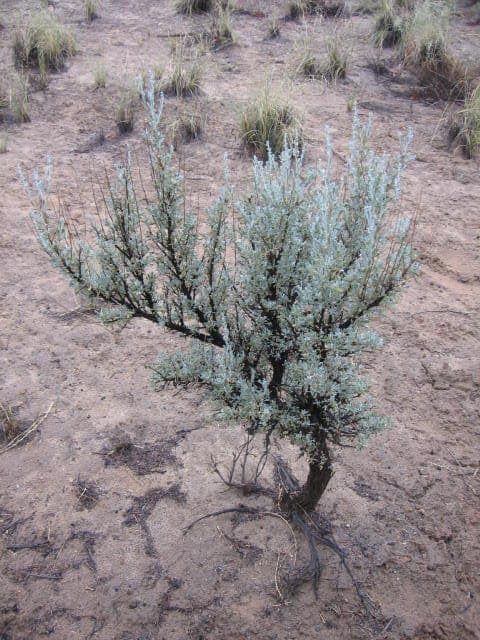
Peemus / CC BY-SA 3.0, via Wikimedia Commons
Basin sagebrush: complete guide
Artemisia tridentata
Want to see Basin sagebrush: complete guide in your garden?
1 minute, no credit card
Overview
Artemisia tridentata, commonly known as basin sagebrush, big sagebrush, or common sagebrush, is a highly aromatic, silver-leaved shrub in the family Asteraceae. Native to western North America, its natural range extends from Alberta and British Columbia in Canada south through Washington, Oregon, California, Nevada, Idaho, Montana, Wyoming, Colorado, Utah, Arizona, and New Mexico into north-western Mexico. The species was formally described by Thomas Nuttall in 1841.
In its native range, Artemisia tridentata dominates vast tracts of semi-arid high-desert country known as sagebrush steppe - one of the most ecologically significant plant communities of the American West. This landscape hosts specialist fauna including pronghorn antelope, greater sage-grouse, and numerous bird species that depend on sagebrush for food and cover throughout the year.
As a garden plant, basin sagebrush has gained a growing following in Europe, particularly for drought-tolerant, xerophytic, and prairie- or steppe-themed planting schemes. The intensely aromatic foliage - instantly recognisable as the quintessential scent of the American West - the soft silver-grey leaf colour, and the compact multi-stemmed form make it a striking specimen. With slow to moderate growth, it typically reaches 80 to 200 cm in its native habitat; in European garden conditions 80 to 120 cm is more realistic.
At gardenworld.app you can design a complete garden layout featuring drought-tolerant aromatic shrubs like Artemisia tridentata as structural anchors of a contemporary, low-water garden.
Appearance & bloom cycle
Artemisia tridentata is an evergreen to semi-evergreen shrub that retains its silver-grey aromatic foliage year-round in mild climates. The leaves are the plant's most distinctive feature: wedge-shaped to spatula-shaped, narrow, 1 to 3 cm long, with three to five shallow lobes at the tip - hence the specific epithet tridentata (three-toothed). Leaves are densely clothed in fine, silky hairs that create the characteristic silver sheen and contribute directly to the plant's drought resistance by reflecting solar radiation and reducing water loss.
Flowering occurs September to October. The flowers are small and individually inconspicuous: yellowish-brown, discoid florets (lacking ray petals, as in all true Artemisia) arranged in plume-like panicles that rise above the foliage. While each individual floret is modest, the overall effect of a mature shrub in full bloom - soft golden-brown plumes against silver foliage - is undeniably attractive. Pollination is primarily by wind.
Fruits are small, wind-dispersed cypselas maturing October to November. After fruit set, the dried inflorescences are best left in place; they contribute a warm buff tone to the winter garden silhouette that is as decorative as any ornamental grass.
Bark on older stems is fibrous, peeling in narrow strips, ranging from grey-brown to red-brown on mature specimens. This character is visible as the shrub ages and adds a further point of interest in winter when the foliage is less dense.
In northern European gardens, the most impressive seasonal display runs from August to November: the combination of silver-grey foliage and golden-brown flower plumes is at its peak.
Ideal location
Artemisia tridentata is uncompromisingly a plant of full sun. In its native habitat it occupies open, unshaded plains and slopes at elevations of 600 to 3,000 m. For garden use, a south- or south-west-facing open position with a minimum of six to eight hours of direct sun is ideal. Partial shade is tolerated to a limited degree but results in looser growth, reduced silver foliage colouring, and diminished aromatic intensity.
The plant is particularly well suited to drought-tolerant borders, gravel gardens, rock gardens, and Mediterranean or steppe-themed planting schemes. In urban gardens it performs well against a south-facing wall that absorbs and re-radiates heat, extending the growing season and reducing frost exposure.
Avoid frost pockets and low-lying areas where cold air settles on clear nights, and any location where water stands around the base in winter. Sagebrush withstands extreme drought far better than it withstands winter wetness. A well-drained, gently sloping position, or a raised bed, provides the best protection against damaging soil moisture in cold weather.
In containers of at least 40 litres, the species can also be grown successfully; move the container under frost-free cover during severe cold spells.
Soil requirements
Artemisia tridentata thrives on dry to semi-dry, free-draining soils. Its pH tolerance runs from 6.0 to 8.2, meaning the plant is at home on neutral, slightly acid, or moderately alkaline, lime-rich soils. In its native range it commonly occurs on alkaline to slightly acid, mineral-poor substrates ranging from sandy loam to loess-like silty clay.
The plant does not need - and does not benefit from - high soil fertility. Over-rich soil with abundant humus and nitrogen encourages lush but floppy growth at the expense of the characteristically compact, silver-grey form. Best results come from lean to moderately fertile, well-drained ground.
On heavy clay soils, work in coarse grit or sharp sand (at least 30 percent by volume) and a little compost to a depth of 30 cm. A drainage layer of 15 cm of coarse grit at the base of the planting hole provides additional insurance in damp positions. On naturally light sandy or gravelly soils, minimal preparation is needed.
At planting, incorporate a small starter dose of potassium sulphate (20 g per square metre) to support root development. After establishment, feed sparingly - a single light application of a low-nitrogen, potassium-rich fertiliser in spring is sufficient for most garden soils.
Free design
Want to see Basin sagebrush: complete guide in your garden? Make a free design now.
Watering
Once established, Artemisia tridentata is remarkably drought-resistant and requires virtually no supplemental watering in average European summers. In its native Great Basin habitat, the plant routinely survives months with almost no precipitation. Average summer rainfall in Belgium, the Netherlands, and northern France is typically sufficient for an established shrub.
During the first two seasons after planting, while the root system is developing, supplemental watering is necessary. Water deeply once a week from April to September, moistening the soil to 25 cm depth. Avoid frequent, shallow watering - this promotes shallow roots and reduces the plant's natural drought adaptation. One thorough soaking per week is always preferable to daily sprinkling.
Once fully established after two to three growing seasons, routine watering can largely cease in typical European summers. Only during exceptional heat events - ten or more consecutive days above 30 °C with no rainfall - is an additional deep watering beneficial.
In winter, the soil should remain dry to barely moist. Never water during frost, and ensure that no water pools at the base of the plant. Winter waterlogging is the most common cause of sagebrush failure in European gardens.
Pruning
Artemisia tridentata needs modest pruning. The plant is multi-stemmed and naturally compact, but after several years it can become woody and open in the interior. The key management step is a light cutback in late spring, once cold weather has passed and new shoots are visible at the base.
In April, trim the stems back by up to one-third of their length (never more than half at one time), cutting just above a visible side shoot or leaf node. Use sharp secateurs or hedge shears. Hard pruning in a single operation causes serious setback and can kill the plant.
Remove dead wood in spring: dead and dying stems are identified by brittleness and absence of new growth. Cut these back to the living base. No further pruning is needed during the growing season unless the plant is outgrowing its allotted space.
Leave the autumn flower heads in place; they have decorative merit and the standing dried stems provide some frost protection for the crown over winter.
Maintenance calendar
January – February: Minimal intervention. Leave the shrub fully intact as self-protection. If prolonged frost coincides with a wet spell, check that the soil around the base is not waterlogged; add a layer of grit if necessary to divert water away.
March – April: Once frost risk diminishes, carry out light pruning: cut back no more than one-third of stems to above a side shoot. Remove dead wood. Gently clear the surrounding area.
May – June: New growth consolidates. No pruning needed. An optional light feed of potassium sulphate (20 g per square metre) encourages aromatic foliage and flower production. Water during prolonged dry spells only.
July – August: Peak growing season. Check whether the plant is overgrowing its intended space but avoid pruning in high summer. Water only in exceptional drought.
September – October: Flowering period. Allow the golden-brown plumes to develop fully. Significantly reduce watering.
November – December: Plant enters winter rest. No fertiliser. Protect the base with dry leaf mulch if hard frosts below -12 °C are forecast.
Winter hardiness
Artemisia tridentata is substantially frost-hardy. In its native Great Basin and Intermountain region it endures temperatures of -25 °C and lower. The species spans USDA hardiness zones 4 to 8. For Dutch and Belgian gardens, which are predominantly in USDA zones 7 to 8, the species is reliably hardy on free-draining soil.
The greatest risk in European gardens is not the cold itself but the combination of cold and persistent soil moisture. Wet soil during frost causes root damage and the die-back of stems that is sometimes mistaken for frost kill. Dry, well-drained soil and an open, airy position are more important to successful overwintering than the hardiness zone number.
In cooler upland zones (USDA zones 5 to 6), such as higher ground in Belgium or the hilly regions of the Netherlands and Germany, a 10 to 15 cm dry mulch of leaves or straw around the base after the first November frosts is recommended. Remove the mulch in March when temperatures consistently rise above freezing.
In zones 7 to 8, established large shrubs are essentially winter-hardy without protection, provided the drainage is adequate.
Companion plants
Artemisia tridentata suits drought-tolerant borders and steppe-style planting schemes. Harmonious companions include:
- Salvia officinalis and Salvia nemorosa (sages): the silver-grey tone of the artemisia complements the purple-blue flower spikes of salvias perfectly. Space at 50 cm.
- Festuca glauca (blue fescue): the steel-blue tufts provide colour contrast that accentuates the silver tone of the artemisia. Space at 30 cm.
- Pennisetum alopecuroides (fountain grass): warm amber-brown plumes form a beautiful complementary colour combination. Space at 50 cm.
- Lavandula angustifolia (lavender): both plants share a preference for dry, sunny, lime-tolerant conditions and have comparable silver-grey foliage tones. Space at 50 cm.
- Stachys byzantina (lamb's ears): the densely woolly silver-grey leaves are a perfect textural partner for the artemisia. Space at 30 cm.
- Yucca filamentosa: the bold architectural form of yucca provides strong structural contrast alongside the airy, aromatic artemisia.
Avoid pairing with moisture-loving plants or shade-requiring subjects. Keep Artemisia tridentata with plants that share its preference for dry, open, sunny conditions.
Conclusion
Artemisia tridentata is a monument of the aromatic plant world - silver, fragrant, and utterly adapted to the sun and drought of the open West. As a garden plant it brings a powerful presence: the intoxicating sage scent when leaves are brushed, the soft shimmer of silver foliage against dark fencing or stone, and the clouds of buff-coloured autumn bloom make it an unforgettable garden presence.
See how basin sagebrush can anchor a beautiful, water-wise garden design by visiting gardenworld.app for personalised planting plans tailored to your space and climate. Explore the full plant blog for more aromatic shrubs and drought-tolerant planting ideas.
Want to see Basin sagebrush: complete guide in your garden? Make a free design now.
Upload a photo, pick a style, and get a photorealistic design with plant list in under a minute.
10,000+ gardens designed already
No credit card required


Similar plants
Calendula stellata: complete guide
Calendula stellata
Complete guide to Calendula stellata, the star-flowered marigold from Sicily: location, soil, watering and companion planting tips.
Korean chrysanthemum: complete guide
Chrysanthemum x rubellum
Chrysanthemum x rubellum is a hardy autumn perennial with single pink to copper flowers from August to November. Care and combinations.
Helianthus divaricatus: complete guide
Helianthus divaricatus
Helianthus divaricatus is a North American woodland sunflower with yellow summer blooms, ideal for naturalistic borders and shady edges.