
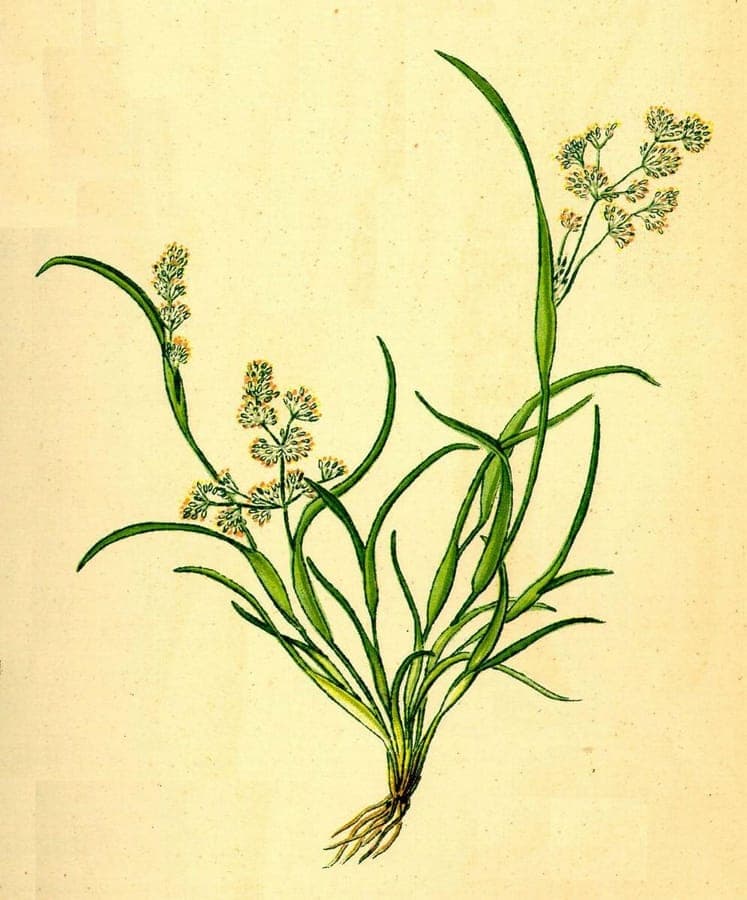
IKAl / CC BY-SA 3.0, via Wikimedia Commons
Coleanthus subtilis: complete guide
Coleanthus subtilis
Want to see Coleanthus subtilis: complete guide in your garden?
1 minute, no credit card
Overview
Coleanthus subtilis is one of Europe's most botanically remarkable and rare grasses, belonging to the family Poaceae. Described formally in 1817 by Seidel, Roemer, and Schultes, based on the earlier work of Trattnick, it is the sole representative of its genus - making Coleanthus a monotypic genus of considerable scientific interest. The species name 'subtilis' (delicate, fine) perfectly captures the thread-like, moss-like appearance of this diminutive plant, which is sometimes called mossgrass in informal English usage.
The distribution of Coleanthus subtilis is distinctly disjunct: it occurs in Central Europe (Germany, Czech Republic, Austria, Poland, and northwestern Russia), East Asia (China, Manchuria, the Russian Far East), and in scattered locations in western North America (British Columbia, Oregon, Washington state). In Europe, the species has declined severely and is listed on the Red Data Books of multiple countries. It is already extinct in Belarus, Italy, and Norway, and populations in France, Germany, and Poland are small and highly fragmented.
The species is strictly tied to a very specific habitat: periodically exposed muddy or sandy banks of ponds, lakes, slow-moving rivers, and reservoirs. These shores must be temporarily flooded in winter and spring, then exposed and drying out in late summer and early autumn, creating open bare mud conditions where the plant can germinate and grow without competition from taller species. It is classified as an annual or ephemeral plant, completing its life cycle during the exposed period and relying on its seed bank to persist through the flooded season.
For those planning ecologically rich garden ponds or water features, gardenworld.app provides design tools to incorporate rare pondside and wetland species into a coherent, thoughtfully planned garden layout.
Appearance & bloom cycle
Coleanthus subtilis is a tiny, low-growing annual grass rarely exceeding 5 to 15 cm in height. Its growth habit is spreading to ascending, with thin, branched stems that lie partially prostrate before curving upwards at the tips. The leaves are narrow and linear, just 1 to 3 mm wide, soft-textured and bright green. The leaf sheaths are characteristically inflated - almost bladder-like - enclosing the stem nodes in a distinctive way that is the hallmark of the genus Coleanthus (from Greek koleos, sheath, and anthos, flower).
The flowering panicles are extremely delicate and small, greenish in colour, indicating that the plant is wind-pollinated. In Central Europe and at lower elevations within its range, the bloom period spans August through November - a late-season window that corresponds to the drawdown of water levels exposing its habitat in late summer. This timing is essential: plants germinate on the freshly exposed mudflat in early summer, grow through July and August, and produce flowers and seeds as the mud dries further in late summer and autumn.
The seeds are tiny and are dispersed by rising water levels in autumn and winter, colonising suitable mudflats elsewhere along the shoreline. The whole plant has a translucent, delicate quality that reflects its specialised niche: a pioneer of open, bare, competition-free mud. In suitable conditions, Coleanthus can form dense, soft green mats covering several square metres of exposed bank, resembling a carpet of fine moss - hence the English common name.
Ideal location
Coleanthus subtilis is inseparably linked to the drawdown zone of ponds, lakes, and slow-moving water bodies. The ideal garden setting is the fluctuating water's-edge zone of a garden pond or constructed wetland where the water level falls by 10 to 20 cm between June and September, exposing bare, moist substrate. The plant will not persist on permanently dry ground and cannot survive continuous submersion. The critical factor is the seasonal rhythm: flooded in winter and spring, exposed and gradually drying in summer.
Full sun is essential. Coleanthus grows on open, unshaded banks; shade from overhanging trees, shrubs, or tall reeds suppresses it completely. The species requires the pioneer zone - open, largely bare ground without dense competitive vegetation. Any position where reed (Phragmites australis), bulrush (Typha latifolia), or sedges have become established is unsuitable, as these tall plants outcompete the tiny Coleanthus entirely.
The light intensity requirement is high (8 out of 10), reflecting the fully exposed, open conditions of its natural habitat on sun-baked mudflats. Humidity of the surrounding air should be moderate to high (7 out of 10), consistent with the lakeside and riverside positions it naturally occupies. As a very small plant, no planting distances in the traditional sense apply; it is sown or introduced as scattered individuals across suitable exposed substrate.
Soil requirements
Coleanthus subtilis grows on nutrient-poor to moderately nutrient-rich bare mud or fine sandy silt. Soil pH in its natural habitats ranges from 5.5 to 6.5 - slightly acidic. The plant is not demanding of nutrients; in fact, enriched soils actively disadvantage it by favouring competitive, tall-growing vegetation that crowds it out. The soil nutriment score of 4 out of 10 indicates that low to medium fertility is appropriate.
For cultivation in a garden setting, a substrate of clean river sand mixed with non-calcareous clay in a 2:1 ratio provides a suitable growing medium. Do not add compost, fertiliser, or organic-rich material, as this would increase nutrient availability and encourage competing plants. The absence of calcium (soil salinity value 0) and slightly acidic pH are important; calcareous substrates are unsuitable. Where the natural pond or water-body substrate is available, it is the simplest and best growing medium for Coleanthus.
Free design
Want to see Coleanthus subtilis: complete guide in your garden? Make a free design now.
Watering
Water management for Coleanthus subtilis is distinct from conventional garden watering. The plant requires a seasonal hydrological cycle: high water levels covering the habitat in winter and early spring, followed by a gradual drawdown in summer to expose bare substrate, reaching near-dry but still moist conditions in August and September when the plant flowers and sets seed.
In a garden pond this can be achieved by allowing natural evaporation to lower the water level during summer without topping up, or by managing a controllable overflow or drain. A drawdown of 10 to 20 cm between June and August creates suitable exposed bank conditions. Once seeds have been dispersed in October, water levels can be allowed to rise again with autumn rains.
During the growing season on the exposed bank, the substrate should remain moist but not waterlogged. In exceptionally dry summers, light hand-watering with a gentle spray to keep the mud surface soft and moist will help the plants survive. Completely dried, cracked mud is unsuitable - the shallow root system cannot penetrate hardened substrate. The atmospheric humidity preference of 7 out of 10 indicates a persistently humid environment consistent with lakeside conditions.
Pruning
As an annual, Coleanthus subtilis requires no pruning in the conventional sense. Management is focused on ensuring habitat suitability rather than shaping the plant. After seed dispersal in autumn, dead plant material can be left in place to decompose on the mud surface; premature removal risks also removing seeds that have not yet fallen. Once the substrate is flooded again in winter, dead plant debris will decay naturally.
The most important maintenance task is the removal of competing vegetation from the pioneer zone before Coleanthus establishes in spring. Young shoots of reeds, bulrushes, and sedges should be pulled by hand or cut back to the mud surface in April and May. This keeps the open, competition-free zone clear for Coleanthus seedlings to emerge and grow. Hoeing the bare mud carefully in early spring can also improve germination conditions by disturbing the surface slightly, mimicking the natural disturbance of shoreline environments.
Protect the growing area from trampling by wildlife or visitors, as the delicate seedlings are extremely fragile. A simple temporary barrier or a discreet marker can be useful in managed garden settings.
Maintenance calendar
January – March: Water level high; habitat zone is flooded. Seeds dormant in the mud. No active maintenance needed for the plant itself.
April: Water level begins to drop naturally as evaporation increases. First bare mud patches become visible. Remove any emerging reed, bulrush, or sedge shoots from the pioneer zone by hand.
May – June: Coleanthus seedlings may emerge on freshly exposed mud. Maintain competition-free conditions by regular weeding of the pioneer zone. Do not allow the mud to fully dry out and crack.
July – August: Plants grow actively on the exposed bank. Keep the mud moist with light watering if needed during extreme heat. Observe the plant's growth and the atmospheric humidity of the site.
August – November: Flowering period. Seeds produced and dispersed by rising autumn water levels. Allow natural seed dispersal to occur before raising water levels deliberately.
November – December: Plants die off. Water level can rise with autumn rains. Seeds overwinter in the mud.
Winter hardiness
As an annual, the above-ground parts of Coleanthus subtilis are frost-sensitive and will not survive hard freezing. However, the seeds in the mud are cold-hardy and survive frozen conditions through the winter, germinating again the following spring when the substrate warms above approximately 8 °C. This seed-bank strategy allows the species to persist through harsh Central European winters in USDA zones 5 to 8.
For cultivation at cold sites (USDA zone 4 and colder), it is advisable to collect ripe seeds in autumn and store them in cool, damp conditions over winter, re-sowing onto suitable exposed substrate in spring. In milder Atlantic climates (USDA zone 8 and warmer), the plant may behave as a winter annual, germinating in mild autumn conditions and completing its cycle before summer drought. Visiting gardenworld.app can help identify the climate zone conditions most suitable for designing a pond environment to support this species.
The relatively high atmospheric humidity preference (7 out of 10) and the Central European distribution suggest that Coleanthus subtilis is best suited to humid, temperate maritime to sub-continental climates - the UK, Ireland, the Netherlands, Belgium, France, Germany, and Central Europe generally.
Companion plants
Coleanthus subtilis, as a pioneer of bare, competition-poor mud, actually requires the absence of dominant companion plants in its immediate zone. However, certain small, non-competitive species share the same habitat and can co-exist naturally nearby.
- Limosella aquatica (mudwort): another highly rare pioneer of exposed muddy shores that shares exactly the same habitat. The two species have been recorded growing together at some European sites and form a characteristic plant community of temporarily exposed lake margins.
- Bidens tripartita (trifid bur-marigold): a taller annual of wet margins that can occupy the wetter edge of the same shoreline without invading the bare mud zone, providing some structural contrast nearby.
- Juncus bufonius (toad rush): a small, fine rush of bare, moist ground with a similar ecological profile, occurring in the same habitat type across Europe and North America.
- Ranunculus sceleratus (celery-leaved buttercup): grows at the wetter margins of the same habitat; its slightly taller form keeps it out of the pioneer zone but it provides a visual complement.
- Cyperus fuscus (brown galingale): a delicate annual sedge of exposed muddy shores in Central Europe, occurring in similar pioneer communities and complementing Coleanthus beautifully in a conservation garden setting.
In all cases, plant these companions at the outer edges of the Coleanthus zone, ensuring that the bare mud area at the heart of the habitat remains open and competition-free.
Closing
Coleanthus subtilis is not a plant for a conventional garden border, but it is a species of exceptional botanical interest and conservation value. For those with a suitable garden pond or constructed wetland, the challenge of providing the precise hydrological conditions this plant requires is a rewarding one. Successfully cultivating Coleanthus subtilis in a private garden contributes directly to ex-situ conservation of a species that has declined dramatically across Europe. Its delicate, translucent form, late-season bloom period, and unique ecological niche make it a fascinating addition to any specialist water garden or botanical collection.
Want to see Coleanthus subtilis: complete guide in your garden? Make a free design now.
Upload a photo, pick a style, and get a photorealistic design with plant list in under a minute.
10,000+ gardens designed already
No credit card required


Similar plants
Sporobolus pungens: complete guide
Sporobolus pungens
Sporobolus pungens is a stoloniferous Mediterranean coastal grass with outstanding salt and drought tolerance, perfect for seaside and dry gardens.
Mediterranean aegilops: complete guide
Aegilops biuncialis
Everything about Aegilops biuncialis, a Mediterranean annual grass with ornamental spikes and outstanding drought tolerance for dry gardens.
Silver bluestem: complete guide
Bothriochloa saccharoides
Full guide to Bothriochloa saccharoides (silver bluestem): site, soil, watering, winter hardiness, pruning, and garden companions.