
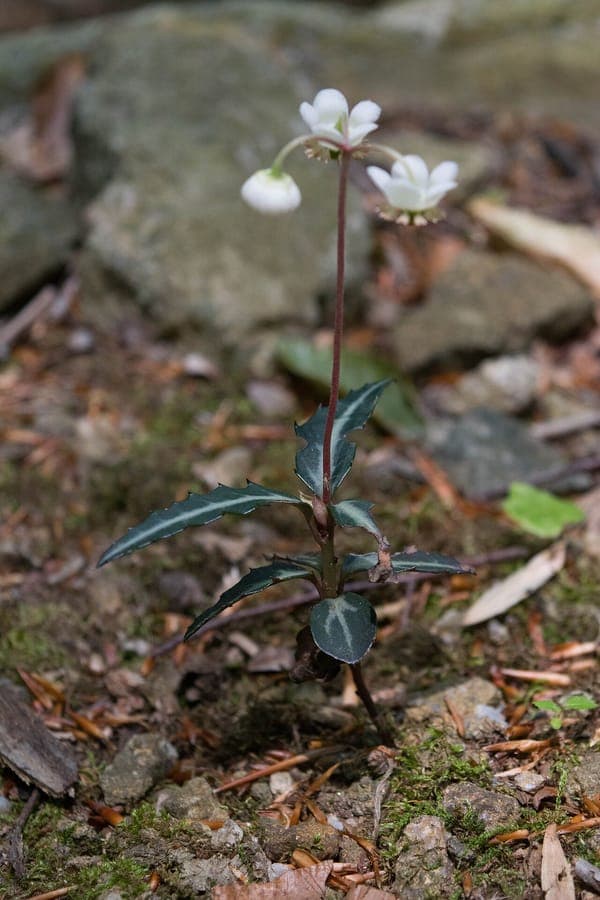
Wasp32 / CC BY 4.0, via Wikimedia Commons
Spotted wintergreen: complete guide
Chimaphila maculata
Want to see Spotted wintergreen: complete guide in your garden?
1 minute, no credit card
Overview
Spotted wintergreen (Chimaphila maculata) is a remarkable, low-growing, evergreen subshrub belonging to the heather family Ericaceae. The species was described in 1813 by the Prussian-American botanist Frederick Pursh, building on earlier work by Linnaeus. Its native distribution is notably broad: from south-eastern Canada through the eastern and central United States into Central America, ranging from Connecticut and Maine to Guatemala and Panama. It has also been recorded as introduced in France.
The name "maculata" refers to the white spots or stripes on the dark-green leaves - a feature that makes the plant instantly recognisable and earns it its common names: spotted wintergreen, striped prince's pine, spotted pipsissewa. In its home territory it grows in the litter layer of dry to moderately moist conifer and mixed forests on acidic, nutrient-poor, well-drained soils, often alongside blueberry and other heath-family plants.
For European gardeners, spotted wintergreen is a rare but intriguing choice for the shade border on acidic soil. Its year-round evergreen foliage, decorative leaf patterns and subtle, fragrant flowers make it a valuable addition for anyone seeking a woodland, naturalistic garden style. On gardenworld.app you will find ideas for shade borders and woodland gardens that remain interesting throughout the year.
Appearance and bloom cycle
Chimaphila maculata is a low-growing subshrub reaching only 10 to 30 cm in height. The stems are woody at the base, creeping or trailing, and slowly form colonies via underground runners. The leaves are the most striking feature: lance-shaped to narrowly elliptic, 3 to 8 cm long, with a glossy, thick, leathery texture. The upper leaf surface is dark green with distinctive white or pale-green markings along the midrib and lateral veins, creating a characteristic pattern that is visible year-round.
The plant typically flowers in June and July, though the exact timing can vary by location and climate. The flowers are small - only 1 to 1.5 cm in diameter - but charming. They are waxy white to pale pink, composed of five rounded, reflexed petals surrounding a crown of prominent stamens around the central green ovary. The flowers hang in a small cluster of three to eight blooms and release a soft, balsamic scent that attracts pollinating insects. After flowering, small, rounded seed capsules develop.
The combination of variegated evergreen foliage and delicate flowers gives spotted wintergreen a long season of ornamental interest that continues throughout the year.
Ideal location
Spotted wintergreen requires a specific location that approximates its natural woodland habitat. It needs light to moderate shade - direct intense sun is not tolerated. Under conifers or lightly shading deciduous trees it thrives best. Dappled light filtering through a tree canopy is ideal.
In its North American homeland, Chimaphila maculata typically grows in the litter layer of dry conifer forests (pines, oaks, hemlocks) on acidic, nutrient-poor, well-drained soil. This means that in the garden it is best placed in a woodland garden, an acid-soil border or beneath acid-loving shrubs such as rhododendron, Pieris or azalea. It also suits an acidic rock slope or raised bed with a suitable acid substrate.
On gardenworld.app you can see how plants like spotted wintergreen can contribute to a woodland-style front garden that stays green and interesting throughout the year.
Soil
Soil requirements are the most critical factor for success with Chimaphila maculata. The plant has a strong preference for acidic soil: a pH between 5.5 and 6.5 is optimal. On neutral or calcareous soil the plant declines rapidly. It grows best in light, well-drained, humus-rich woodland soil with a high concentration of organic litter.
For garden use, the soil must be acidified and enriched with acid organic materials such as pine needle soil, sphagnum moss, composted oak bark or specialist ericaceous compost. Heavy, poorly drained clay soil needs to be replaced or substantially improved by mixing in sharp sand, grit and peat moss.
Avoid calcareous soils entirely. A mulch of pine needle soil or woodland compost helps maintain the correct acidity and mimics the natural litter layer.
Free design
Want to see Spotted wintergreen: complete guide in your garden? Make a free design now.
Watering
Spotted wintergreen has a moderate moisture requirement. It should not dry out, but equally cannot tolerate prolonged waterlogging. In its woodland habitat the soil is typically lightly moist but well drained, with a constant supply of moisture from rainfall filtered through the tree canopy.
In the garden, keeping the soil evenly moist is important, especially during hot summers. Water at the base of the plant using rainwater or softened water - calcareous tap water raises the pH over time and harms the plant. A mulch of pine needle soil or woodland leaf mould helps stabilise soil moisture and reduces the need for supplemental watering.
Overwatering or standing water at the roots leads to root rot. The plant has a fine, shallow root network that benefits from regular, moderate moisture rather than infrequent heavy watering.
Pruning
Spotted wintergreen is a slow grower that needs little cutting back. Dead or damaged twigs can be removed in early spring. A light trim is only needed if the plant creeps beyond its intended boundary.
Spent flowers can be removed if they look untidy, but this is not necessary for plant health. If you want to collect seed or encourage self-seeding, leave the seed capsules in place.
The evergreen foliage remains decorative year-round and should not be cut back, even after flowering. Keeping the plant lightly trimmed encourages denser growth.
Maintenance calendar
January - February: Plant is evergreen and physiologically active, though growth is slow. Protect during extreme frost (below -15 degrees Celsius) with pine branches or horticultural fleece.
March: New growth begins. Check soil acidity. Refresh pine needle or ericaceous mulch if needed.
April - May: Active growth. Keep soil moist. Do not use standard fertiliser; if needed, apply a specialist ericaceous feed.
June - July: Flowering period. Enjoy the subtle, fragrant blooms. Water with rainwater during dry spells.
August - September: Seed capsules ripen. Leave in place for self-seeding or harvest if desired.
October - December: Plant retains its decorative foliage. Check mulch depth. Little attention needed during winter.
Winter hardiness
Chimaphila maculata is cold-hardy to USDA zone 5, corresponding to minimum temperatures of approximately -23 degrees Celsius. In its North American native range it grows in regions with cold winters and deep snow cover. In the temperate climates of the UK, the Netherlands and Belgium (USDA zones 8-9), the plant performs well and typically needs no extra winter protection.
During extreme cold spells (below -10 degrees Celsius) without snow cover, a light protection of pine branches or a layer of dry leaves is advisable to prevent desiccation by winter wind (commonly called "windburn" or winter scorch). The plant is evergreen and retains its leaves year-round.
Companion plants
Spotted wintergreen thrives alongside other acid-tolerant, shade-adapted plants. Good companions include:
- Vaccinium corymbosum (highbush blueberry): shares the need for acidic soil and filtered light; the blue berries make a lovely complement.
- Rhododendron and azalea: structural shrubs that create the ideal dappled shade and share soil requirements.
- Gaultheria procumbens (wintergreen): another low, evergreen woodland plant for the same acidic position.
- Trillium grandiflorum (white trillium): flowers in spring, filling the space before the wintergreen is fully active.
- Ferns: soft, feathery ferns such as Dryopteris or Polystichum form an elegant backdrop for the spotted foliage.
Avoid lime-loving plants such as clematis, Deutzia or buddleja, which require a different soil pH.
Closing thoughts
Spotted wintergreen is a special, evergreen subshrub for shade borders on acidic soil. Its characteristically spotted leaves, subtle fragrant flowers and slow but reliable growth make it a valuable find for anyone building a woodland or naturalistic garden. It can be sourced from specialist heather and woodland nurseries or online plant retailers; general garden centres rarely stock it, but it is well worth seeking out. For more inspiration on shade borders and garden designs tailored to your specific front garden, visit gardenworld.app and explore what is possible.
Want to see Spotted wintergreen: complete guide in your garden? Make a free design now.
Upload a photo, pick a style, and get a photorealistic design with plant list in under a minute.
10,000+ gardens designed already
No credit card required


Similar plants
Zenobia pulverulenta: complete guide
Zenobia pulverulenta
Everything about Zenobia pulverulenta (honeycup): siting, acid soil, pruning and the fragrant white bells, in this complete care guide.
Dwarf huckleberry: complete guide
Gaylussacia dumosa
Everything about dwarf huckleberry (Gaylussacia dumosa): acidic soil, partial shade, pruning and care for this compact North American berry shrub.
Drooping leucothoe: complete guide
Leucothoe fontanesiana
Everything about drooping leucothoe (Leucothoe fontanesiana): shade tolerance, soil, watering, pruning, hardiness and companion plants.