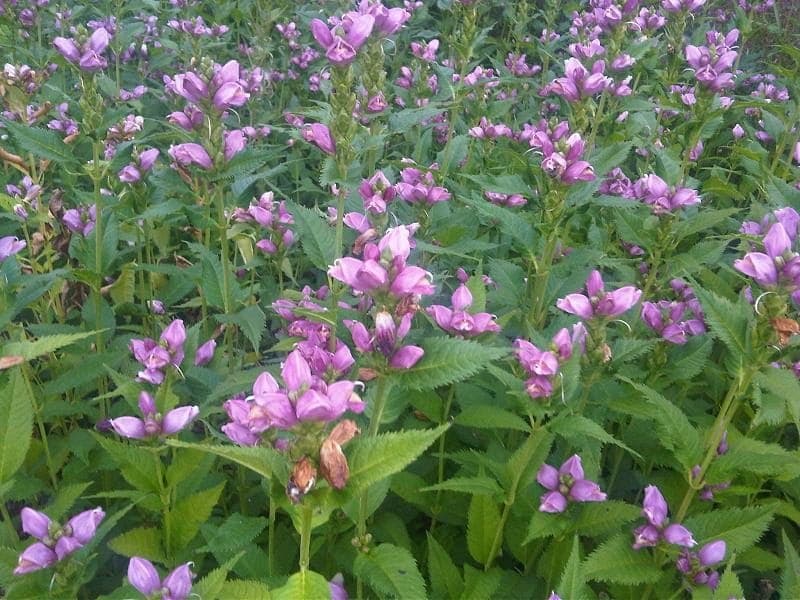
Emőke Dénes / CC BY-SA 4.0, via Wikimedia Commons
Rose turtlehead (Chelone obliqua): complete guide
Chelone obliqua
Want to see Rose turtlehead (Chelone obliqua): complete guide in your garden?
Full design in HD: €7.99
Look after your Rose turtlehead with the GardenWorld app
Identify plants with your camera and get a care calendar with reminders for this plant.


Overview
Rose turtlehead (Chelone obliqua) is a sturdy North American perennial that really gets going just as many border plants are fading. From late August into October it carries dense spikes of pink flowers that look uncannily like the head of a turtle with its mouth open. That shape gave the genus its name: Chelone comes from the Greek for tortoise, and in English all the species are known as turtleheads. This one is sold as rose turtlehead or red turtlehead.
In the wild Chelone obliqua grows in the south-eastern and central United States, in damp woodland, swampy hollows and along stream banks. That tells you exactly what it wants in the garden: moist to wet, humus-rich soil and ideally a little shelter from the fiercest afternoon sun. Where many plants struggle, such as a boggy corner or the edge of a pond, it is perfectly at home. You can have a garden design made on gardenworld.app in which this turtlehead joins other moisture-loving late bloomers to turn a wet patch into a colourful autumn border.
Plants grow 60 to 90 cm tall and around 40 to 50 cm wide, spreading slowly by short rhizomes into a dense clump. Alongside the pink species you will find the white form 'Alba' and the compact Dutch selection 'Ieniemienie', which stays lower and suits a smaller garden or a large container. Be aware that plants sold as Chelone obliqua are sometimes hybrids or the closely related Chelone lyonii; they look very similar and need the same care.
Appearance and bloom cycle
Rose turtlehead produces upright, square stems that rarely flop, even after heavy rain. The leaves are arranged in opposite pairs and are lance-shaped to oblong, 8 to 15 cm long, dark green and coarsely toothed, with deeply impressed veins. As a result the plant looks fresh and tidy all summer, long before it flowers.
Flowering begins in late August and continues into October, sometimes longer in a mild autumn. The flowers are packed into short, sturdy spikes at the tips of the stems and in the upper leaf axils. Each bloom is 2 to 2.5 cm long, two-lipped and closed, with an arched upper lip that hoods over the lower one. The colour is a warm rose to purplish pink, and the inside of the lower lip is often lined with pale hairs. The photo shows a group of these plants well: a dense mass of pink spikes above toothed, glossy green leaves.
Bumblebees adore them. They squeeze their whole bodies between the lips to reach the nectar, an entertaining sight on a sunny September day. After flowering, brown seed capsules remain and stay upright well into winter.
Ideal location
Chelone obliqua grows best in partial shade, or in a spot with morning sun and afternoon shade. Full sun is fine provided the soil never dries out; otherwise the leaf margins scorch and the plant becomes prone to powdery mildew. In deep shade it grows weaker and flowers less freely.
Good places include the margin of a pond, a low spot where rainwater collects, a border on the north-east side of a hedge or a lightly shaded woodland edge. Space plants 40 to 45 cm apart; groups of three to five show off the pink spikes best.
Soil requirements
The ideal soil is humus-rich, moisture-retentive and fertile. Loam and clay that never dry out completely are excellent, and peaty or sandy soil enriched with plenty of organic matter also works well. Temporarily wet ground is no problem; this species even tolerates short periods with water around its base, as at a pond edge.
When planting, dig in a generous amount of well-rotted compost or leaf mould. pH is not critical: slightly acidic to neutral is ideal, and slightly alkaline soil is tolerated too. On dry sandy soil without improvement there is little point in growing it, as it will stay small and parch in summer. A mulch of leaf mould in spring helps hold moisture in.
Free preview
Want to see Rose turtlehead (Chelone obliqua): complete guide in your garden? Make a free preview of your design.
Watering
Water is the key word with rose turtlehead. The soil should stay moist throughout the growing season. On a naturally damp site you will rarely need to water, but in an ordinary border give a thorough soaking every few days in dry weather, especially in July and August when the flower buds are forming.
Never let the soil dry out: drought stress leads to brown leaf edges, mildew and a short, thin display. No extra water is needed in winter. Plants in containers dry out quickly; water them daily in summer and stand the pot in a saucer.
Pruning
You can simply let the plant grow, but one easy trick makes it sturdier. In late May or early June cut the stems back by a third, sometimes called the Chelsea chop. The plant branches, stays a little shorter and flowers slightly later but with more spikes.
After flowering you can leave the stems standing. The seed heads look lovely rimed with frost and give shelter to insects. Cut everything back to just above ground level in February or early March, before the new shoots appear. Every three to four years you can divide older clumps in spring, which rejuvenates the plant and gives you new ones at the same time. Cuttings of young shoots taken in May also root readily.
Watch out for slugs in spring, as they enjoy the young, tender shoots. Once the stems have firmed up, the danger is over.
Maintenance calendar
February to March: Cut old stems down to just above the ground. Spread a layer of compost or leaf mould.
April: New shoots appear. Protect them from slugs. A good month for planting and dividing.
May to June: Water in dry spells. Cut stems back by a third if you want a more compact plant.
July to August: Keep the soil moist while the buds form. Check for mildew in warm, dry weather.
September to October: Peak flowering. Enjoy the bumblebees. Autumn planting is still possible.
November to January: Leave the seed heads for winter structure and insects. Nothing else to do.
Add these tasks to the planting calendar on gardenworld.app and you will be reminded automatically when it is time to cut back or divide.
Winter hardiness
Chelone obliqua is very hardy and withstands temperatures down to roughly -25 to -30 °C without protection. Across Britain, the Low Countries and most of Germany it overwinters in open ground without any trouble. The top growth dies back in autumn and the plant reshoots from its rhizomes in spring.
No protection is needed. Only plants in containers can suffer during prolonged hard frost, because the whole rootball can freeze. Stand such pots against a wall in winter, or sink them into the ground.
Toxicity: rose turtlehead is not known to be toxic to people or pets. As with any ornamental plant, it is still sensible not to eat it and to discourage children and animals from chewing it.
Companion plants
Turtlehead pairs beautifully with other moisture-loving late bloomers from North American prairies and wetlands. Joe Pye weed (Eutrochium maculatum) makes a tall, purplish-red backdrop, while great blue lobelia (Lobelia siphilitica) offers a cool blue counterpoint at a similar height. New England asters such as Symphyotrichum novae-angliae extend the season well into October.
For extra height and structure choose New York ironweed (Vernonia noveboracensis) with its deep purple flower heads, or queen of the prairie (Filipendula rubra). Ferns, hostas and grasses that enjoy moist soil, such as purple moor grass, round off the planting nicely. Avoid pairing it with drought lovers like lavender or sage, whose needs are the opposite.
Final thoughts
Rose turtlehead is a dependable, robust perennial that brings late-summer colour to wet, partly shaded places. It stands up well, needs little maintenance and keeps bumblebees busy deep into autumn. If you have a damp spot in your garden, you will hardly find a more rewarding plant to fill it.
Plant it in groups, keep the soil moist and leave the stems standing over winter.
Frequently asked questions about Rose turtlehead
Is Rose turtlehead winter hardy?
Chelone obliqua is very hardy and withstands temperatures down to roughly -25 to -30 °C without protection. Across Britain, the Low Countries and most of Germany it overwinters in open ground without any trouble.
When and how do you prune Rose turtlehead?
You can simply let the plant grow, but one easy trick makes it sturdier. In late May or early June cut the stems back by a third, sometimes called the Chelsea chop.
How much water does Rose turtlehead need?
Water is the key word with rose turtlehead. The soil should stay moist throughout the growing season.
Where does Rose turtlehead grow best?
Chelone obliqua grows best in partial shade, or in a spot with morning sun and afternoon shade. Full sun is fine provided the soil never dries out; otherwise the leaf margins scorch and the plant becomes prone to powdery mildew.
What soil does Rose turtlehead need?
The ideal soil is humus-rich, moisture-retentive and fertile. Loam and clay that never dry out completely are excellent, and peaty or sandy soil enriched with plenty of organic matter also works well.

See it in your garden
See Rose turtlehead in your garden
One photo of your garden and a few questions. You see the result in about a minute.
Try it with a photoIdentify this plant in your own garden. Identify a plant
Similar plants
Spotted Joe-Pye weed: complete guide
Eutrochium maculatum
Everything about spotted Joe-Pye weed (Eutrochium maculatum): cultivation, location, soil requirements and care for this majestic moisture-loving perennial.
Lobelia siphilitica: complete guide
Lobelia siphilitica
Lobelia siphilitica offers stunning blue blooms and is a moisture-loving perennial. Discover how to successfully grow this North American species in your garden.
New England aster: complete guide
Symphyotrichum novae-angliae
Learn all about New England aster (Symphyotrichum novae-angliae), a stunning fall-blooming perennial.
