Stickpen / Public domain, via Wikimedia Commons
Bacopa (Chaenostoma cordatum): complete guide
Chaenostoma cordatum
Want to see Bacopa (Chaenostoma cordatum): complete guide in your garden?
Full design in HD: €7.99
Look after your Bacopa with the GardenWorld app
Identify plants with your camera and get a care calendar with reminders for this plant.


Overview
Walk past window boxes and hanging baskets in summer and you will see it everywhere: fine, trailing stems studded with small white stars. Garden centres almost always sell it as bacopa, but the correct botanical name is Chaenostoma cordatum. For many years it was known as Sutera cordata, and that older name still turns up on plant labels and in older gardening books. It has nothing to do with the true genus Bacopa, which includes aquatic plants such as water hyssop; the trade name simply stuck.
Chaenostoma cordatum belongs to the figwort family (Scrophulariaceae) and comes from South Africa, where it grows in sheltered, fairly moist spots in the south and east of the country. By nature it is a creeping perennial, but because it cannot take frost, gardeners in Britain and north-western Europe grow it as summer bedding.
Bacopa is loved as a filler: it plugs the gaps between larger plants, spills softly over the edges of containers and provides a calm base of white, lilac or pink. Well-known ranges include 'Snowflake' (the classic white), 'Snowtopia' and 'Snowstorm' (larger white flowers), 'Scopia' (white, pink and lilac) and 'Blutopia' (pale blue to lilac). On gardenworld.app you can have a garden design made in which bacopa and other container plants are placed to suit your patio, balcony or front wall.
Appearance and bloom cycle
The plant forms a dense mat of thin, branching stems 30 to 60 cm long. In a hanging basket or window box they trail over the edge; on the ground the plant stays 10 to 15 cm high. Stems often root where they touch the soil.
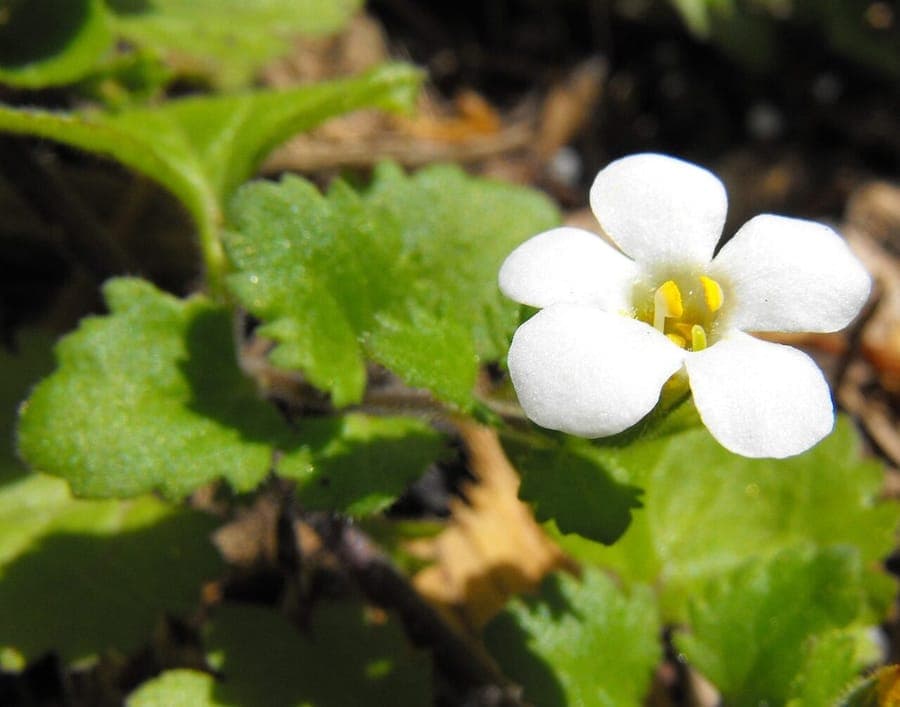
The leaves are arranged in opposite pairs, 1 to 2 cm across, round to broadly heart-shaped and scalloped along the edge. That is where the species name cordatum comes from: it means heart-shaped. The foliage is fresh to mid-green and feels slightly sticky.
The flowers are 1 to 2 cm wide, with five rounded lobes around a yellow centre and yellow anthers. The photo shows exactly such a flower: pure white, opening flat above the toothed leaves. Flowering starts in May and continues until October. Rather than a few big blooms, bacopa produces a steady stream of small flowers scattered across the whole plant. Small bees and hoverflies visit them. The plant is self-cleaning, dropping its faded flowers on its own.
Ideal location
Bacopa grows in sun and partial shade. You will get the best results with morning or evening sun, such as on an east- or west-facing balcony. In full midday sun it flowers well too, but the compost dries out so fast that you will need to water at least once a day. In deep shade it still grows but hardly flowers.
Because it tolerates partial shade, bacopa is a good choice for containers that only get sun for part of the day, where many other summer plants struggle. It suits hanging baskets, window boxes, troughs on a wall and the edges of large tubs. It can also be used as ground cover in a sheltered, partly shaded border, although it looks its best in containers. Space plants 20 to 25 cm apart.
Compost and soil
Use a good container compost that holds moisture while staying open. A mix with some coir or loam retains water better than a very light, peaty blend. Bacopa grows best in slightly acidic to neutral conditions. If you water with hard tap water, young leaves sometimes turn yellow with green veins, a sign of iron deficiency. Rainwater or a feed containing iron will help.
Make sure there is a drainage hole, but avoid an overly dry, gritty mix. Unlike true drought specialists, bacopa wants an evenly moist rootball. A self-watering container is an excellent choice for this plant.
Free preview
Want to see Bacopa (Chaenostoma cordatum): complete guide in your garden? Make a free preview of your design.
Watering and feeding
Water is the single most important thing with bacopa. Never let the rootball dry out completely. If it does, the plant drops all its buds and flowers. It recovers, but it takes two or three weeks before it flowers again. That is why bacopa sometimes hangs green and flowerless in a basket for a while.
Check hanging baskets every day in summer and window boxes every day or two. Water when the top centimetre feels dry, and then thoroughly, until water runs out of the bottom of the pot. Soggy roots with no drainage are just as harmful: standing water leads to root rot.
Bacopa flowers for months and uses a fair amount of food in the process. From May to the end of August, give a liquid feed for flowering plants every week at the recommended rate, or mix a slow-release fertiliser into the compost at planting time.
Pruning
Bacopa needs little pruning. Pinch out the tips once after planting to encourage bushier growth. If the plant becomes long and bare at the base during summer, or has stopped flowering after a dry spell, cut it back by half. Then water and feed it; within a few weeks new shoots with fresh flowers will appear.
Whitefly and aphids sometimes appear, especially in hot, dry weather or under glass. Rinse the plant with water or use a soap-based spray. A healthy, well-watered plant rarely suffers.
Maintenance calendar
March-April: Take cuttings from overwintered parent plants. Tip cuttings 5 cm long root quickly in moist cutting compost somewhere bright and warm.
May: Only plant bacopa outside once the risk of frost has passed, usually from mid to late May. Pinch out the tips once and start feeding weekly.
June-July: Full flower. Water faithfully, even on cloudy but breezy days, as wind dries hanging baskets out quickly.
August: Cut back tired or bare plants by half. Take cuttings if you want to keep the plant.
September-October: Flowering carries on until the first frost. Stop feeding in September. Bring in plants you want to overwinter in good time.
November-February: Overwinter in a cool, bright place, or let the plant go and start again next spring.
Winter hardiness and overwintering
Chaenostoma cordatum is not frost hardy. It can sometimes survive a brief light frost, but it will not survive a prolonged freeze. In the UK and the Low Countries it is therefore treated as an annual.
You can overwinter it, though. In October, cut the plant back to about 10 cm and move it to a bright, frost-free spot between 5 and 12 °C, such as a cool greenhouse, an unheated conservatory or a light stairwell. Keep the compost just moist, never bone dry and never wet. In spring you can move the plant back outside or take cuttings from it. Young plants grown from cuttings often flower more freely than old parent plants.
Bacopa is not known to be toxic to people or pets. There are no reports of poisoning, but it is still best to stop children and animals from eating it.
Companion plants
With its small flowers and soft colours, bacopa is the perfect partner for bigger, bolder plants. A classic window box combines zonal pelargoniums (Pelargonium zonale) in red or pink with a white edging of bacopa tumbling over the front. Add blue trailing lobelia (Lobelia erinus) and you have the familiar trio of red, white and blue.
In partial shade, bacopa looks lovely with busy Lizzie (Impatiens walleriana) and with fuchsias, such as Fuchsia magellanica in a large tub. For silver accents, use liquorice plant (Helichrysum petiolare), whose grey leaves go beautifully with white bacopa. Lilac and blue bacopa varieties suit pink and purple container plants.
Do make sure that all the plants in one container need roughly the same amount of water. True drought lovers such as succulents do not belong next to bacopa.
Final thoughts
Bacopa may not be the showiest plant in your window box, but it is the one that pulls the whole thing together. It fills the edges, softens the lines and flowers from May to October, provided you never let it dry out. A moist rootball, regular feeding and a spot in sun or partial shade are all it needs.
The planting calendar on gardenworld.app shows when it is safe to put bacopa outside, when to take cuttings and when to bring it in. This spring, combine a few white bacopas with your favourite pelargoniums and enjoy an edging of tiny stars all summer long.
Frequently asked questions about Bacopa
Is Bacopa winter hardy?
Chaenostoma cordatum is not frost hardy. It can sometimes survive a brief light frost, but it will not survive a prolonged freeze.
When and how do you prune Bacopa?
Bacopa needs little pruning. Pinch out the tips once after planting to encourage bushier growth.
How much water does Bacopa need?
Water is the single most important thing with bacopa. Never let the rootball dry out completely.
Where does Bacopa grow best?
Bacopa grows in sun and partial shade. You will get the best results with morning or evening sun, such as on an east- or west-facing balcony.

See it in your garden
See Bacopa in your garden
One photo of your garden and a few questions. You see the result in about a minute.
Try it with a photoIdentify this plant in your own garden. Identify a plant
Similar plants
Horseshoe geranium: complete guide
Pelargonium zonale
Learn how to grow Pelargonium zonale successfully in your garden or on your balcony. This guide covers care, ideal location, soil, and seasonal maintenance tips.
Lobelia erinus: complete guide
Lobelia erinus L.
Lobelia erinus is popular trailing plant with blue or red flowers, perfect for hanging baskets and containers. Flowers continuously all summer long.
Busy lizzy: complete guide
Impatiens walleriana
Discover Busy lizzy (Impatiens walleriana): a colorful flowering plant for shade. Rich blooms, compact, easy-care. Growing tips for gardens and containers.
