
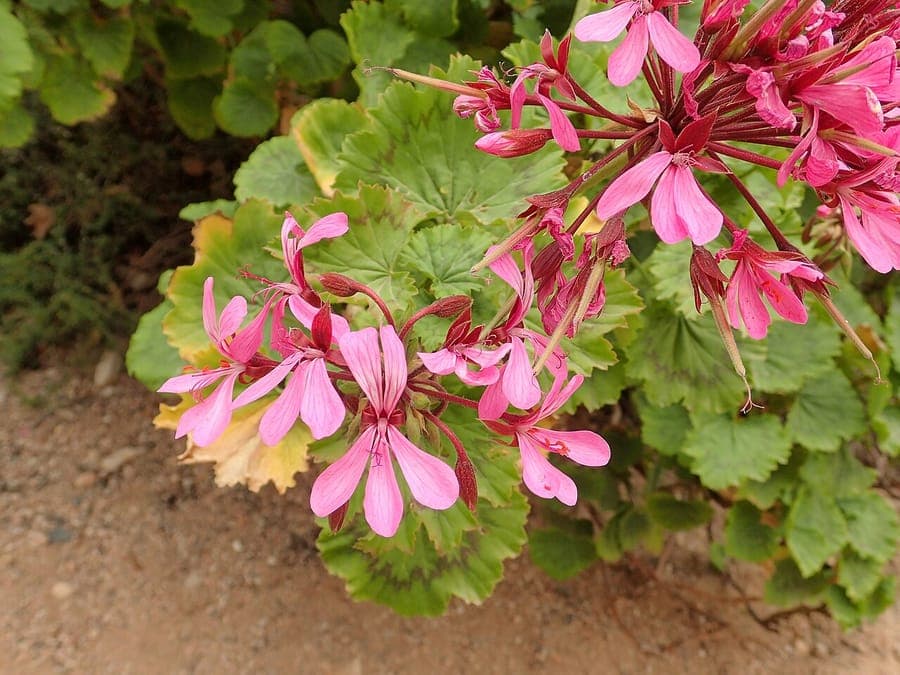
Peter Warren / CC0, via Wikimedia Commons
Horseshoe geranium: complete guide
Pelargonium zonale
Want to see Horseshoe geranium: complete guide in your garden?
1 minute, no credit card
Overview
Pelargonium zonale, commonly known as horseshoe geranium, is a tough and ornamental plant that brings long-lasting colour to patios, borders, and containers from late spring through autumn. Native to the Cape Provinces and KwaZulu-Natal in South Africa, this subshrub from the Geraniaceae family thrives in hot, dry conditions and full sun. In temperate climates like the UK and much of the northern US, it's grown as a half-hardy annual or overwintered indoors due to its lack of frost tolerance.
Typically reaching 30 to 50 cm in height with a spread of around 30 cm, it's compact enough for small spaces but bold enough to make a statement. Its resilience and low maintenance make it a firm favourite among gardeners. Whether you're designing a cottage-style border or a minimalist balcony setup, Pelargonium zonale fits right in. Use gardenworld.app to visualise how this plant integrates into your layout, especially when planning seasonal rotations or colour schemes.
Appearance & bloom cycle
The leaves of Pelargonium zonale are round to kidney-shaped, measuring 5 to 10 cm across. They're lightly hairy and feature a distinct dark horseshoe-shaped band across the middle - a hallmark trait that gives the plant its common name. The band is usually dark green or brownish and sits against a bright green background, creating strong visual interest even when not in bloom.
Flowering begins in June and can continue uninterrupted until the first autumn frosts, typically November in USDA zones 9–10. The flowers are deep purple, arranged in dense umbel-like clusters 5 to 10 cm wide. Each flower has five petals, often with subtle veining or spotting. Deadheading spent blooms encourages repeat flowering and prevents the plant from going to seed. Pollinators like bees and hoverflies are attracted to the nectar-rich flowers.
Ideal location
Plant in full sun - aim for at least 6 hours of direct sunlight daily. South-facing patios, balconies, and borders are ideal. In too much shade, the plant becomes leggy and produces fewer flowers. During peak summer (July and August), containers in full sun can dry out quickly. Use pots at least 25 cm in diameter to retain moisture and consider moving them to partial shade between 1 PM and 5 PM if temperatures exceed 30°C.
To assess sun exposure in your garden, try the sunlight analysis tool on gardenworld.app. It helps pinpoint the best spots for sun-loving plants like Pelargonium zonale.
Free design
Want to see Horseshoe geranium: complete guide in your garden? Make a free design now.
Soil requirements
Use a well-draining potting mix. A blend of two parts multipurpose compost, one part perlite or horticultural grit, and one part garden soil works well. In borders with heavy clay, amend the soil with 20–30% coarse sand to improve drainage. The ideal pH range is 6.0 to 7.0. Always ensure containers have drainage holes, and add a 2–3 cm layer of gravel at the base to prevent waterlogging.
Watering
Water when the top 2–3 cm of soil feels dry. In summer, this usually means every 2 to 3 days, depending on pot size and weather. Water at the base to avoid wetting foliage, which can promote fungal diseases like botrytis. Reduce watering in autumn as growth slows. During indoor overwintering, water every 10–14 days, allowing the soil to dry out between sessions.
Pruning
Pinch back young stems early in the season to encourage bushiness. Throughout summer, deadhead spent flowers to keep the plant tidy and flowering. In late summer (August), cut back leggy stems by up to one-third to rejuvenate growth. Use clean, sharp secateurs to prevent disease transfer. In autumn, remove any woody or damaged stems before bringing the plant indoors.
Maintenance calendar
- Jan–Feb: Keep indoors in cool, bright conditions. No feeding. Water sparingly.
- Mar: Begin light feeding (half-strength fertiliser). Increase light exposure.
- Apr: Take cuttings (8–10 cm long). Harden off for outdoor planting after last frost.
- May: Move outdoors after risk of frost has passed. Start regular feeding.
- Jun–Oct: Water regularly, deadhead weekly, monitor for pests.
- Nov: Bring indoors before first frost. Prune if needed.
- Dec: Rest period. Minimal watering, no fertiliser.
Winter hardiness
Pelargonium zonale is not frost hardy. It's hardy only in USDA zones 10–11. In colder zones (7–9), it must be overwintered indoors. Keep in a cool (5–10°C), bright location like a greenhouse or sunroom. Avoid warm, dry living rooms - they encourage spider mites and leaf drop.
Companion plants
Pair with drought-tolerant companions like Salvia farinacea, Verbena bonariensis, or Angelonia angustifolia. In containers, combine with silver-foliaged plants like Senecio cineraria for contrast. Avoid moisture-loving plants such as impatiens or fuchsias, which have opposite water needs.
Closing
Pelargonium zonale is a low-maintenance, high-impact plant that delivers season-long blooms with minimal fuss. With full sun, well-drained soil, and regular deadheading, it thrives from June to November. Purchase young plants in May from garden centres, or propagate your own from cuttings. Once you've grown it, you'll want it back every summer. For design inspiration, explore gardenworld.app to create a tailored planting plan that highlights its bold foliage and rich purple flowers.
Want to see Horseshoe geranium: complete guide in your garden? Make a free design now.
Upload a photo, pick a style, and get a photorealistic design with plant list in under a minute.
No credit card required


Similar plants
Pelargonium acetosum: complete guide
Pelargonium acetosum
Discover the Sorrel-leaf Geranium: a South African plant with aromatic foliage. Perfect for containers and warm locations. Learn cultivation and care.
Erodium foetidum: complete guide
Erodium foetidum
Rock stork's-bill is a delicate alpine plant with purple flowers and fine foliage. Learn how to grow this Mediterranean charmer in your front garden.
Pelargonium crithmifolium: complete guide
Pelargonium crithmifolium
Discover Samphire-leaf pelargonium: an exotic South African geranium with distinctive foliage. Growing tips, care advice and garden inspiration.