
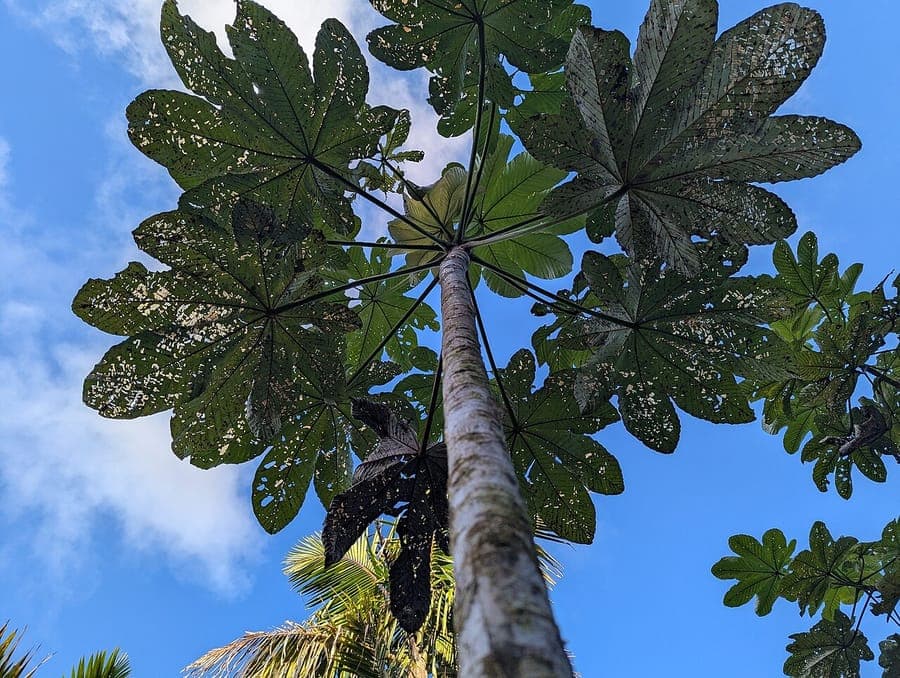
Cjziems / CC BY 4.0, via Wikimedia Commons
Pumpwood: complete guide
Cecropia schreberiana
Want to see Pumpwood: complete guide in your garden?
1 minute, no credit card
Overview
Cecropia schreberiana, commonly known as pumpwood, trumpet tree, or wild pawpaw, is a fast-growing tropical pioneer tree in the nettle family (Urticaceae). Native to the Caribbean basin - Cuba, Haiti, the Dominican Republic, Puerto Rico, Trinidad and Tobago, the Leeward and Windward Islands - and Suriname, it is one of the most ecologically prominent pioneer species of disturbed tropical and subtropical lowland forests.
The genus Cecropia is often called 'trumpet tree' because of the hollow, segmented stems and branches that resemble a bamboo or trumpet system. These hollow cavities house mutualistic ants of the genus Azteca, which defend the tree against herbivorous insects and climbing vines in exchange for shelter and food bodies produced in specialised structures called trichilia. This symbiosis is one of the most celebrated examples of myrmecophily - ant-plant mutualism - in the neotropical literature.
Cecropia schreberiana is a genuine rapid grower: under ideal conditions it can add 2–3 metres of height per year and reach 15–25 metres at maturity. In tropical botanical gardens, collectors' glasshouses, and tropical conservatories in temperate regions, it is prized for its dramatic leaf architecture and ecological interest. In northern European climates such as the Netherlands, Belgium, and Germany, outdoor cultivation is impossible; the tree is strictly a glasshouse or conservatory subject.
Appearance & bloom cycle
The defining feature of Cecropia schreberiana is its enormous, deeply lobed leaves. Individual leaf blades can measure 30–60 cm across and are divided into 7–11 radiating lobes that fan outward from a central point of attachment. The upper surface is dark green and relatively smooth; the underside is covered in dense, soft white hairs that give it a silvery, felted appearance - a reliable field identification character for the species. The long petiole, up to 20–40 cm, is attached near the centre of the blade in a peltate (umbrella-like) arrangement that gives each leaf the appearance of a miniature canopy.
The trunk and main branches are distinctly cylindrical, marked by conspicuous ring-shaped leaf scars that record the tree's growth history. The natural branching pattern is sparse at the base, with the crown developing high up - giving the tree a distinctive palm-like silhouette when young.
Flowering is inconspicuous: yellowish catkin-like flower spikes are wind- or insect-pollinated. The fruits are small, fleshy, drop-shaped structures that ripen to green-yellow and are consumed by flying foxes (Artibeus bats) and various frugivorous birds. Seed dispersal by fauna is a key mechanism in the species' rapid colonisation of new disturbed sites.
In its native tropical climate the tree flowers and fruits almost continuously throughout the year, with peak activity during periods of high humidity and regular rainfall.
Ideal location
In its natural habitat, Cecropia schreberiana demands full sun and high humidity. In tropical gardens it is planted as a specimen on open ground, along watercourses, or as a fast-growing screen or windbreak. Its rapid height gain makes it effective for quick structural planting in large tropical or subtropical gardens.
In temperate climates, the tree is restricted to heated glasshouses, large conservatories, or conservatory conditions. The minimum overwintering temperature is 12–15 °C; prolonged exposure below 10 °C causes leaf damage, and frost is fatal. Choose the brightest, most sun-facing position available in the glasshouse, shielded from cold draughts.
During summer months, established container plants can be moved outdoors once temperatures consistently exceed 18 °C. Gradual acclimatisation over two weeks is essential - direct exposure to outdoor sun after a winter indoors will scorch the large, thin-walled leaves.
Soil requirements
Cecropia schreberiana tolerates a broad range of soils in its native range, from clay-loam to sandy substrates, at a pH between 5.0 and 7.0. The key requirements are good moisture retention combined with adequate drainage - waterlogged roots quickly cause decline.
For container cultivation in temperate regions, a rich, well-structured growing medium works best: two parts quality potting compost, one part perlite or pumice, and one part coconut coir or worm castings. Use pots with generous drainage holes. Terracotta containers help regulate moisture and prevent overwatering.
Repot every one to two years into a progressively larger container, since Cecropia is a vigorous grower that fills its root zone quickly. Root restriction noticeably reduces leaf size, diminishing the plant's most attractive quality.
Watering
Consistent moisture is essential for good growth. In its native range, Cecropia schreberiana experiences 1,500–3,000 mm of annual rainfall distributed throughout the year. In glasshouse or container cultivation, the substrate should never fully dry out, but waterlogging must equally be avoided.
During the active growing season (April to October), water two to three times per week, always checking that the top 2–3 cm of substrate has dried between applications. In winter, reduce to once per week or less, matching the lower light levels and slower metabolism. Always use lukewarm water - cold tap water can cause root shock in tropical species.
Humidity is at least as important as direct watering. Mist the leaves regularly, use a nearby humidifier, or stand the pot on a tray of wet gravel to raise ambient humidity around the foliage. Cecropia schreberiana thrives at 60–80 % relative humidity. Below 40 %, leaf edges brown and curl, and the plant's growth slows markedly.
Free design
Want to see Pumpwood: complete guide in your garden? Make a free design now.
Pruning
Cecropia schreberiana requires minimal pruning. The tree naturally develops a single, straight stem with a high crown and needs no structural guidance. Remove dead leaves and broken branches promptly to prevent fungal entry points.
In container cultivation, it may occasionally be necessary to restrict height by removing the growing tip once the tree reaches the desired size. This encourages modest lateral branching, though the tree's natural inclination is always upward. Heavy renovation cuts are generally counter-productive and destroy the plant's most impressive visual qualities.
Regularly remove senescing leaves, which in a glasshouse environment may hang on rather than fall cleanly. Fallen or hanging dead leaves in humid conditions can promote fungal colonisation if left in contact with the trunk.
Maintenance calendar
March–April: Active growth resumes. Increase watering; begin fortnightly feeding with a balanced liquid fertiliser at half strength. Inspect for red spider mite and whitefly, both common glasshouse pests.
May–June: Move outdoors gradually once nights stay above 18 °C. Acclimatise over two weeks. Increase feeding to weekly.
July–August: Peak growth. Large volumes of water and maximum light required. Water two to three times per week; mist foliage daily for optimal humidity.
September: Begin transition back to glasshouse as nights cool. Gradual move over two weeks.
October–November: Growth slows. Reduce or stop fertilising. Decrease watering to once per week.
December–February: Overwintering. Maintain minimum 12–15 °C. Minimal watering, no fertiliser. Check weekly for pests.
Winter hardiness
Cecropia schreberiana has virtually no frost tolerance. The tree endures brief temperature dips to around 5–8 °C without permanent damage but sustained exposure below 10 °C causes leaf injury and stress. Any frost is fatal.
In USDA hardiness zone 11 and warmer (average minimum above -1 °C), the tree can be grown in the open ground. In Europe, this restricts outdoor cultivation to the warmest microclimates in southern Spain or the Canary Islands. In the Netherlands, Belgium, northern France, and Germany, the tree is viable only as a heated glasshouse subject.
Successful overwintering requires a bright, frost-free space at a minimum 12 °C. Dramatically reduce water and withhold fertiliser during this period. An excessively warm overwintering (above 20 °C) combined with low light can cause weak, etiolated growth - the lack of seasonal rest makes it harder for the plant to harden up properly before the next growing season.
Companion plants
In tropical gardens and botanical collections, Cecropia schreberiana combines impressively with other large-leaved tropical species. In glasshouse or conservatory settings, the following companions work well:
- Heliconia species: Large, banana-like foliage requiring similar high humidity and warmth. The vivid red or orange flower bracts offer a dramatic colour note against Cecropia's green canopy.
- Philodendron selloum (Tree philodendron): Another large-leaved tropical ornamental thriving in identical conditions; the deeply cut Philodendron leaves contrast effectively with Cecropia's peltate form.
- Monstera deliciosa: Popular as a container plant, it tolerates similar humidity and light levels and makes a lush under-storey companion in a large tropical glasshouse.
- Boehmeria nivea (Ramie): A fellow member of the Urticaceae family with silvery leaf undersides - a botanical link that reinforces the collection theme and provides foliar contrast.
- Colocasia esculenta (Taro, elephant ear): A tropical corm plant with bold, arrow-shaped leaves that complement the dramatic silhouette of Cecropia in a tropical display.
If you are planning a tropical or exotic section of your garden - whether outdoors in warmer climates or in a glasshouse - the design tool at gardenworld.app lets you visualise how species like Cecropia fit into a larger planting composition. More inspiration for exotic and tropical plant collections is available at gardenworld.app.
Closing
Cecropia schreberiana is a tree of exceptional ecological and visual drama. In its Caribbean and Amazonian homeland it plays a vital role as a forest pioneer, rebuilding disturbed ecosystems with remarkable speed. For the specialist plant collector in temperate Europe, it is an extraordinary glasshouse subject - fast-growing, architecturally imposing, and carrying with it the fascinating story of its ant-mutualism and bat-dispersed fruit ecology. For those willing to provide the warmth and humidity it demands, pumpwood delivers a genuinely tropical atmosphere that few other plants can match.
Want to see Pumpwood: complete guide in your garden? Make a free design now.
Upload a photo, pick a style, and get a photorealistic design with plant list in under a minute.
10,000+ gardens designed already
No credit card required


Similar plants
False nettle (Boehmeria cylindrica): complete guide
Boehmeria cylindrica
Full guide to Boehmeria cylindrica, false nettle: origin, appearance, ideal location, soil, watering and care for this wetland perennial.
Laportea canadensis: complete guide
Laportea canadensis
Discover Laportea canadensis (Wood-nettle), a fascinating woodland plant. Thrives in moist shaded areas. Complete growing and care guide for this unique species.
Creeping Charlie: complete guide
Pilea nummulariifolia
Discover Creeping Charlie (Pilea nummulariifolia), a tropical trailing plant with coin-shaped leaves. Perfect for indoors and protected outdoor spaces.