
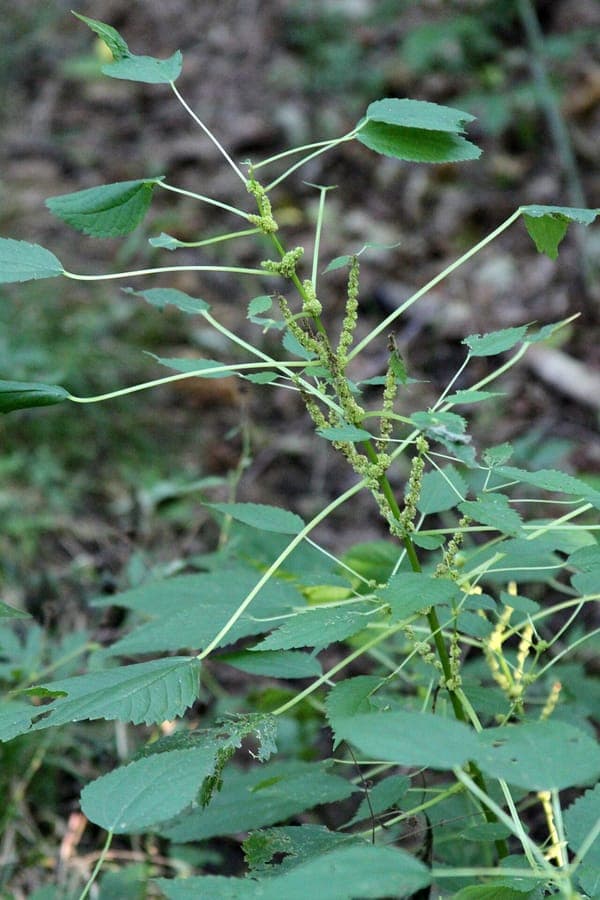
R. A. Nonenmacher / CC BY-SA 4.0, via Wikimedia Commons
False nettle (Boehmeria cylindrica): complete guide
Boehmeria cylindrica
Want to see False nettle (Boehmeria cylindrica): complete guide in your garden?
1 minute, no credit card
Overview
Boehmeria cylindrica, commonly known as false nettle, bog-hemp or smallspike false nettle, is a perennial herbaceous plant belonging to the nettle family (Urticaceae). The species was formally published in 1788 by the Swedish botanist Olof Swartz, building on an earlier Linnaean description. The genus Boehmeria commemorates the eighteenth-century German botanist Georg Rudolf Boehmer. The species epithet "cylindrica" refers to the cylindrical flower spikes that are one of the plant's identifying features.
Boehmeria cylindrica is native to a vast geographical range stretching from southern Canada (Ontario, Quebec and New Brunswick) across the entire eastern United States, through Mexico, Central America, the Caribbean and deep into South America, including Brazil, Colombia, Venezuela and Peru. In Europe it has been recorded as an introduced plant in France. In all these regions the plant occupies wet and moist habitats: swamp forests, stream and river banks, shallow marshes and the edges of floodplains.
For the gardener designing a pond margin, rain garden or moist shaded border, Boehmeria cylindrica is a reliable and easy-going plant that tolerates flooding, thrives in shade and provides lush structural foliage from spring through autumn. Gardenworld.app offers design inspiration for creating water-edge and boggy garden areas where plants like this one can thrive.
Appearance and bloom cycle
Boehmeria cylindrica forms dense, upright clumps of multiple stems, typically reaching 50 to 120 cm in height and occasionally taller in optimal conditions. The stems are erect, slightly four-angled and emerge in clusters from a creeping rhizome system. The leaves are oval to lance-shaped, 4 to 12 cm in length, with a toothed margin and a prominently three-veined surface. The leaf texture is slightly rough to the touch due to minute surface hairs, but - crucially - the plant carries no stinging hairs, unlike its superficially similar relative Urtica dioica. This makes Boehmeria cylindrica entirely safe to handle and work with in the garden, despite its common name of false nettle.
The flowers are tiny and inconspicuous: greenish-white, petal-less and produced in long, narrow, cylindrical spikes emerging from the leaf axils. The bloom period typically runs from July through September, sometimes into October. The plant may be monoecious (male and female flowers on the same plant) or dioecious depending on the individual. Both wind and insect pollination occur. After fertilisation, small dry fruits develop and are dispersed by water, birds and passing animals.
The foliage remains a fresh green well into autumn, sometimes taking on a light yellow tint before the stems die back after the first hard frosts. The rootstock is fully winter-hardy and regrows vigorously each spring.
Ideal location
Boehmeria cylindrica is a plant of moist to wet sites with variable light exposure. In its natural range it grows in swamp forests under alders, willows and ashes, along the banks of streams and rivers, and in shallow marshes. It tolerates full shade to partial shade comfortably; full sun is possible as long as the soil remains consistently wet.
In a garden context it excels at the margins of a pond or water feature, alongside a garden stream, in a rain garden or in a moist border with rich, consistently damp soil. It tolerates periodic flooding of the roots, making it suitable for zones that stand under water during the wet season. In a formal garden it can serve as a structural border plant along the shaded side of a water feature.
Note that the plant spreads via rhizomes and can cover a considerable area on rich, moist soil. In smaller gardens it is wise to monitor and manage its spread by regular division or by installing a root barrier in the soil around the planting area.
Soil
The ideal soil for Boehmeria cylindrica is nutrient-rich, consistently moist to wet and naturally loamy or clayey in texture. It thrives on soils that remain permanently damp or that flood periodically. The plant is not fussy about pH and can grow on slightly acidic to neutral substrates.
Dry or freely draining soils are unsuitable. On sandy soils, frequent irrigation or substantial amendment with compost and water-retaining clay granules is necessary to maintain the required moisture levels. Rich riparian soils - the kind found naturally alongside streams and rivers - are the absolute optimum growing medium.
At the edge of a pond or water feature, Boehmeria cylindrica can be planted directly in the marginal soil or placed in a large container of bog mix at the water's edge. It tolerates water levels a few centimetres above the root crown without any problem.
Free design
Want to see False nettle (Boehmeria cylindrica): complete guide in your garden? Make a free design now.
Watering
Boehmeria cylindrica must never be allowed to dry out. In its natural wetland habitat it grows in saturated or near-saturated soil for most of the year. In the garden the planting site must be kept permanently moist. During dry periods in summer, daily watering is often necessary if the plant is not positioned at a naturally wet site.
At pond margins or in a bog garden, supplementary watering is generally unnecessary as the soil stays naturally wet. For plants in borders on ordinary garden soil, applying a 5 to 8 cm layer of leaf compost mulch around the base is an effective way to retain soil moisture during dry spells and reduce the frequency of watering needed.
In containers, Boehmeria cylindrica has a high water demand. Standing the pot in a saucer or tray of water so it can absorb moisture from below is ideal. Never allow the compost to dry out completely; a drought stress period of even a day can cause wilting and leaf drop. Visit gardenworld.app for more tips on setting up and maintaining waterside garden areas suited to plants like Boehmeria cylindrica.
Cutting and deadheading
Boehmeria cylindrica requires minimal cutting. The stems die back naturally after the first hard autumn frosts. You can leave the dead stems standing through winter as shelter for insects and as a structural winter feature in the bog garden, or cut them back to ground level shortly after the first frost.
In spring, when new shoots emerge from the rhizome, remove any old stems left over from winter if you have not already done so. During the growing season, flower spikes can be removed if you wish to prevent seed dispersal, although in wet marginal habitats the plant spreads more readily by rhizome than by seed. If the clump becomes too large, lift and divide the rhizomes in early spring, replanting the divisions where they are wanted and discarding or composting the surplus.
Maintenance calendar
A month-by-month care guide for Boehmeria cylindrica in a temperate northwest European garden:
- March: New shoots emerge from the rhizome. Remove old stems if not already done. Check soil moisture at the planting site.
- April-May: Rapid vegetative growth. Ensure consistent moisture. Trim back any rhizome extensions that are spreading beyond the intended area.
- June: Plant reaches mature height. Apply mulch around the base if not planted at a waterside position.
- July-September: Flowering period. No intervention needed; leave or remove flower spikes as preferred.
- October: Leaves yellow and begin to die back. Spent stems can be removed or left in place.
- November-December: Stems fully dead. Cut back to ground level or retain as winter structure for wildlife.
- January-February: Dormancy. Rootstock is safe underground. No action required.
Winter hardiness
Boehmeria cylindrica is a robust perennial with excellent frost tolerance. The underground rhizomes survive winters as cold as approximately -20 degrees Celsius, placing this species comfortably in USDA hardiness zone 5. In the Netherlands and Belgium, where winters are generally mild (zones 7 to 8), winter hardiness is virtually never a concern. The above-ground stems die back to soil level each year after the first hard frosts, but the plant regrows vigorously from the rootstock as soon as the soil warms sufficiently in spring.
At waterside positions or in bog garden conditions, no additional winter protection is needed. Container-grown plants are more vulnerable because frozen compost in a pot affects roots more severely than frost in open ground; move containers to a cool but frost-free space such as an unheated garage during hard frost spells. In mild coastal and urban settings in the Netherlands and Belgium the stems sometimes remain partly green well into December before dying back completely. For further guidance on wetland and bog garden planting, explore the resources at gardenworld.app.
Companion plants
Boehmeria cylindrica pairs well with other plants of moist and wet habitats. Excellent companions include:
- Carex acutiformis or Carex riparia (greater pond sedge or greater tussock sedge): provide structural contrast alongside the broad leaves of Boehmeria.
- Caltha palustris (marsh marigold): bright yellow spring flowers appear early in the season while Boehmeria is still small.
- Iris pseudacorus (yellow flag iris): large yellow flowers in May and June, identical site requirements.
- Lycopus europaeus (gypsywort): a slender wetland plant that fits naturally alongside Boehmeria.
- Filipendula ulmaria (meadowsweet): tall creamy-white flowers in summer above the green foliage of Boehmeria.
- Osmunda regalis (royal fern): a large, impressive fern for the same wet, shaded environment.
Closing thoughts
Boehmeria cylindrica is a quietly effective perennial that deserves greater recognition among gardeners who work with wet, damp or waterside sites. It is winter-hardy, simple to establish, low-maintenance and provides lush structural foliage from late spring through autumn. Its textural value - large nettle-like leaves without stinging hairs - makes it a dependable partner for pond margins, bog gardens and moist woodland gardens. Whether you are looking to naturalise a water feature edge or fill in a shaded, perpetually damp corner, false nettle is a plant that reliably delivers. For help designing a garden tailored specifically to wet and waterside conditions, gardenworld.app provides the tools and inspiration to translate your vision into a concrete planting plan.
Want to see False nettle (Boehmeria cylindrica): complete guide in your garden? Make a free design now.
Upload a photo, pick a style, and get a photorealistic design with plant list in under a minute.
10,000+ gardens designed already
No credit card required


Similar plants
Pumpwood: complete guide
Cecropia schreberiana
Complete guide to Cecropia schreberiana: origins, appearance, care requirements and growing tips for this tropical pioneer tree.
Laportea canadensis: complete guide
Laportea canadensis
Discover Laportea canadensis (Wood-nettle), a fascinating woodland plant. Thrives in moist shaded areas. Complete growing and care guide for this unique species.
Creeping Charlie: complete guide
Pilea nummulariifolia
Discover Creeping Charlie (Pilea nummulariifolia), a tropical trailing plant with coin-shaped leaves. Perfect for indoors and protected outdoor spaces.