
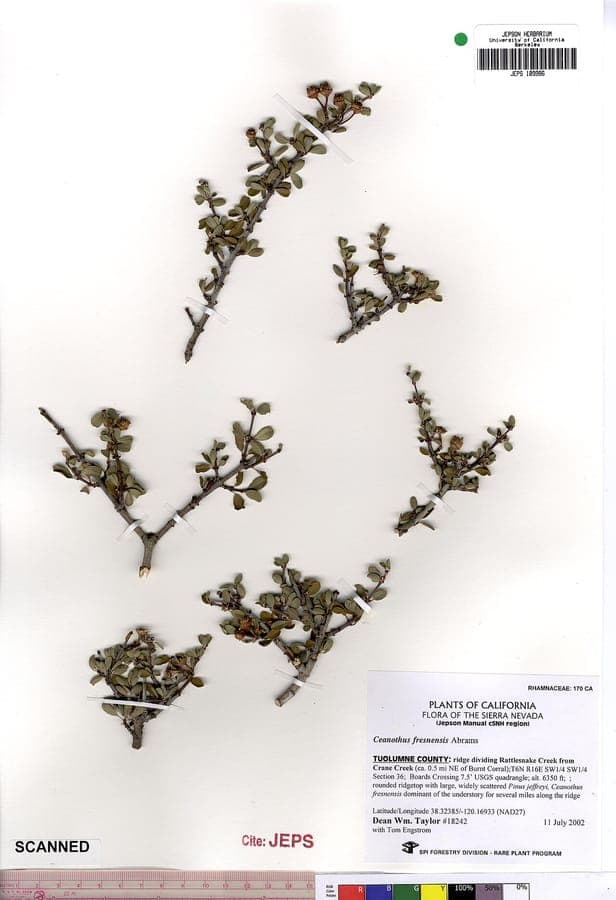
DeanWmTaylor / CC BY 2.0, via Wikimedia Commons
Fresno mat ceanothus: complete guide
Ceanothus fresnensis
Want to see Fresno mat ceanothus: complete guide in your garden?
1 minute, no credit card
Overview
Ceanothus fresnensis, commonly called Fresno mat, is a little-known but botanically interesting shrub native exclusively to the foothills and lower mountain slopes of central California. Described scientifically in 1912 by Dudley ex Abrams, it belongs to the large and horticulturally significant genus Ceanothus in the family Rhamnaceae. The genus as a whole is celebrated for its vivid blue flower clusters that smother the shrubs in spring, and Ceanothus fresnensis shares this trait, though it is less widely cultivated than some of its showier relatives.
What sets Fresno mat apart is its precise adaptation to the central Californian foothill climate: hot, bone-dry summers and mild, moderately wet winters. This makes it a specialist plant rather than a generalist, and growing it successfully outside its native range requires replicating those conditions as closely as possible. For gardeners in warm, dry regions of southern Europe or those with perfectly drained, sun-baked spots in more northerly gardens, it offers something genuinely special: a naturally compact, drought-resistant flowering shrub with the striking blue that is the hallmark of the California lilac group.
The growth habit is described as a subshrub to shrub with a single crown. Growth rate is slow, which suits gardeners who want a long-lived, low-maintenance specimen rather than a fast-growing but short-lived plant. On gardenworld.app you can explore how drought-tolerant shrubs like this one integrate into water-wise front garden designs.
Appearance and bloom cycle
Fresno mat has the typical Ceanothus appearance: small to medium-sized leaves that are oval to elliptical, with a leathery texture and a consistent mid- to dark-green colour that persists through the year in mild climates. The leaf margin is finely toothed. The leaves are arranged alternately along the stems and give the plant a neat, dense appearance between flowering seasons.
The flowers are blue - the characteristic colour of the California lilac group. They appear in dense, branched panicles that cover the plant in spring. In native habitat, flowering typically occurs from March to May. In garden cultivation outside California, the exact timing shifts depending on winter temperatures and local microclimate, but spring flowering can be reliably expected.
Individual flowers are tiny, but their density in the panicles creates a bold, cloud-like mass of colour. The flowers are attractive to bees and other pollinators, making this a valuable plant for supporting local pollinator populations in gardens where it is suited.
After flowering, small three-lobed fruits develop, turning brown when ripe and splitting to release seeds. These fruits are inconspicuous and not decorative. The overall plant habit is compact and spreading rather than upright, making Fresno mat work well as a ground-covering or rock garden shrub.
Ideal location
Full sun is non-negotiable for Ceanothus fresnensis. As a plant of open California hillsides, it expects intense sunshine for most of the day. A south- or south-west-facing position in the garden maximises warmth and light exposure. Partial shade results in reduced flowering, weaker growth, and a more open, floppy habit.
Shelter from cold, drying winds in winter is beneficial, particularly in gardens at the northern edge of the plant's cultivable range. A south-facing wall or fence provides both reflected warmth and wind protection, creating the kind of sheltered microclimate that can mean the difference between thriving and struggling for a marginally hardy plant.
Avoid frost pockets - low-lying areas where cold air collects on still winter nights. Even if the general garden temperature remains acceptable, a frost pocket can expose the plant to temperatures several degrees colder than the surroundings. Position Fresno mat on a slight slope or raised bed where cold air can drain away freely.
In terms of general siting, this plant fits naturally into a Mediterranean-style border, a gravel garden, a rock garden, or a south-facing slope planting. It does not suit moist, shaded corners or any position where water collects.
Soil
Soil requirements are the key differentiator between success and failure with Ceanothus fresnensis. This plant evolved on poor, freely draining, slightly acidic soils with a pH range of 5.8 to 7.0. Rich, fertile garden soils produce lush but structurally weak growth and significantly reduced flowering. They also increase the risk of root disease.
The ideal soil is sandy loam or even pure gritty sand with minimal organic matter. If your garden soil is heavy clay, you have two options: either build a raised bed filled with a sharply draining mix, or abandon the idea of growing this particular ceanothus in the ground and grow it in a container instead.
Important: do not dig or cultivate deeply around established Ceanothus plants. The roots are sensitive to disturbance, and aggressive weeding or planting nearby can cause sudden decline even in otherwise healthy plants. A surface mulch of coarse gravel or grit around the base keeps weeds down without requiring cultivation and also improves drainage around the collar - a critical area prone to rot if kept moist.
Fertiliser is unnecessary and potentially harmful. Ceanothus is adapted to poor soils and relies on symbiotic soil bacteria to fix nitrogen. Adding nitrogen-rich feeds disrupts this system and promotes soft growth susceptible to disease.
Free design
Want to see Fresno mat ceanothus: complete guide in your garden? Make a free design now.
Watering
Once established - typically after one full growing season - Ceanothus fresnensis requires very little supplementary watering in most of north-western Europe. The climate provides sufficient natural rainfall for the plant's modest needs outside the summer months.
During the first year after planting, deep weekly watering during dry spells is necessary to help roots establish. Always allow the soil to dry out significantly between waterings. The goal is to encourage roots to grow downward in search of moisture, not to keep the surface perpetually damp.
In summer, once established, irrigation should be minimised or stopped entirely. This mirrors the plant's natural summer dormancy period in California, when it receives virtually no rainfall for months. Overwatering in summer is the single most common cause of ceanothus failure in European gardens. The symptoms - yellowing leaves, sudden wilting, grey mould on stems - are often mistaken for drought stress and treated with yet more water, accelerating the decline.
In winter, the combination of wet soil and frost is particularly damaging. If your garden has naturally heavy or poorly drained soil, prioritise improving drainage before the wet season rather than trying to water less.
Pruning
Ceanothus fresnensis, like all shrubby ceanothus species, has specific pruning requirements that differ from typical garden shrubs. The critical rule is: never cut back into old, bare wood. Ceanothus does not regenerate from old wood reliably, and hard pruning into thick, mature stems typically kills the cut branches rather than stimulating regrowth.
The correct approach is light annual pruning immediately after flowering. Trim the flowered shoots back by about one third, cutting to just above a leaf or bud. This removes the spent flower clusters, maintains a compact shape, and stimulates the new growth on which next year's flowers will form. Do this promptly after the last flowers fade - in native habitat this would be late spring to early summer.
Remove dead, damaged, or crossing branches as needed throughout the season. If the plant becomes very leggy over several years, gradual renovation over two to three seasons - removing the oldest stems progressively - is safer than a single drastic cut.
Always prune in dry weather to minimise the risk of fungal infection through fresh cuts.
Maintenance calendar
January - February: minimal intervention. Check for frost damage. Ensure drainage around the root zone is functioning. Do not prune.
March - April: flower buds swell and open. Do not fertilise or disturb roots. Enjoy the flowering display and observe pollinator activity.
May - June: peak flowering, then post-bloom pruning. Trim flowered shoots by about a third directly after the last flowers fade. Water only if soil is completely dry.
July - August: summer rest period. Minimal or no irrigation. Watch for spider mite in very hot, dry spells.
September - October: new flower buds form for next year. No pruning. No feeding. Remove weeds gently without disturbing roots.
November - December: apply mulch of coarse grit around the base. Consider protective fleece for young plants if frosts below -5 degrees Celsius are forecast.
Winter hardiness
Ceanothus fresnensis is native to a climate with mild winters and is not particularly frost-hardy by the standards of northern European garden plants. It is reliably perennial in USDA hardiness zones 8 and 9 - broadly corresponding to mild maritime climates in western Europe, including the coastal fringes of the British Isles, western France, Belgium, and the Dutch coast.
In colder inland positions, it is best treated as a plant that needs winter protection or a sheltered wall position. The critical vulnerability is not cold alone but the combination of cold and wet: wet roots during frost are almost always fatal. A plant on perfectly free-draining soil in a sheltered position will survive considerably colder temperatures than the same plant sitting in waterlogged clay.
For the first two winters after planting, protection is advisable regardless of position: a thick mulch of dry straw or bark around the root zone, and horticultural fleece draped over the plant during the coldest nights. After three or four years, established plants in suitable positions develop a degree of hardiness through acclimatisation.
On gardenworld.app you can assess which garden positions offer the most favourable microclimate for borderline-hardy plants like this one.
Companion plants
Fresno mat is most at home in plantings that share its requirements for good drainage, full sun, and low water input. Excellent companions include:
- Cistus species (rock roses): complementary drought tolerance, Mediterranean character, overlapping or sequential flowering.
- Lavandula angustifolia (lavender): same soil and light requirements, attractive to the same pollinators.
- Salvia officinalis and related salvias: aromatic, bee-friendly, and equally tolerant of dry, well-drained soils.
- Rosmarinus officinalis (rosemary): similar cultural needs and effective as a structural backdrop.
- Stipa tenuissima and other fine-textured drought-tolerant grasses as textural contrast.
Avoid mixing with moisture-loving plants. The cultural conflict between a ceanothus and, say, a hydrangea or hosta in the same border is difficult to manage without compromising one or the other.
Closing
Ceanothus fresnensis is a specialist plant that rewards the gardener who is willing to meet it on its own terms. Get the drainage right, plant in full sun, resist the urge to water too often, and this compact shrub will reward you with a spectacular blue flowering display each spring and minimal demands for the rest of the year.
Look for it at specialist Mediterranean plant nurseries and garden centres with a good range of California lilac cultivars. It is less widely available than the more commonly sold Ceanothus thyrsiflorus or Ceanothus x pallidus, but worth seeking out for its botanical distinctiveness. Spring planting gives the best establishment results.
Want to see Fresno mat ceanothus: complete guide in your garden? Make a free design now.
Upload a photo, pick a style, and get a photorealistic design with plant list in under a minute.
10,000+ gardens designed already
No credit card required


Similar plants
Deerbrush ceanothus: complete guide
Ceanothus integerrimus
Complete guide to Ceanothus integerrimus (deerbrush): white spring flowers, drought tolerance, and how to grow this western American shrub in your garden.
Point Reyes ceanothus: complete guide
Ceanothus gloriosus
The Point Reyes ceanothus is an evergreen Californian groundcover with blue flowers. Location, soil and pruning explained in detail.