
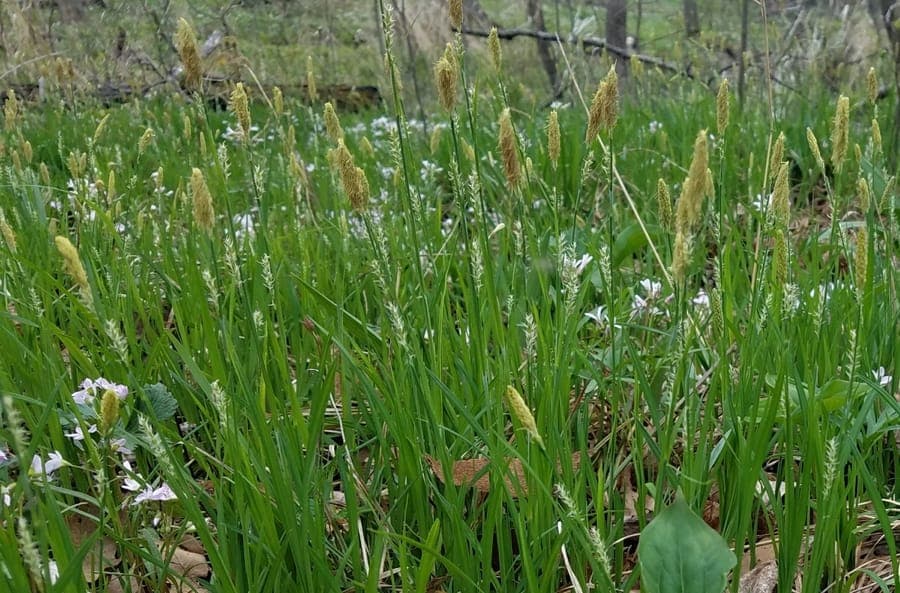
cassi saari / CC BY-SA 4.0, via Wikimedia Commons
Carex woodii: complete guide
Carex woodii
Want to see Carex woodii: complete guide in your garden?
1 minute, no credit card
Overview
Carex woodii, commonly called Wood's sedge or pretty sedge, is an elegant and attractive North American sedge from woodland floor habitats. This species naturally occurs in southeastern Canada and the eastern United States, from Ontario southward to Virginia, and from Pennsylvania to South Carolina.
The plant is renowned for the distinctive purple-tinged coloration in its foliage, particularly prominent in summer and autumn months. The common name references its discoverer, Wood. This sedge is highly suitable for woodland gardens, shade borders, and low-light areas.
The plant holds significant ecological value in forest understories and is important for insect life and small fauna in forest ecosystems.
Appearance and Bloom
Carex woodii develops dense, compact tufts with lustrous foliage, typically reaching 30-50 cm in height. The most distinctive feature is the purple-tinged coloration on the blades, especially visible during warm seasons.
The leaves are fine, grass-like structures creating an elegant silhouette. The plant retains this purple coloration through much of the growing season.
Flower spikes appear from May through June, but are small and inconspicuous. The plant grows compactly and neatly without substantial maintenance intervention.
In autumn, foliage can develop deeper purple tones, especially when exposed to cool temperatures.
Ideal Location
Carex woodii thrives in shade to partial shade. This is a forest floor plant that prefers moist woodland areas. The plant tolerates deeper shade very well.
Optimal placements include:
- Forest understory zones with moisture retention
- Shade borders beneath trees
- Moist forest paths
- Moist, shaded corners
- Beneath deciduous trees
- Natural woodland restoration
- Container shade garden plantings
This is a perfect plant for gardeners wishing to create woodland-like gardens.
Soil Requirements
Carex woodii thrives in moist, humus-rich forest soils. The plant accepts both acidic and neutral pH ranges. Organic-rich, loamy soils are ideal.
The species tolerates nutrient-rich soils well. The presence of substantial organic matter and leaf litter promotes optimal growth.
Free design
Want to see Carex woodii: complete guide in your garden? Make a free design now.
Watering
Once established, Carex woodii requires consistently moist soils. This is not a drought-tolerant species. The plant thrives in woodland-like conditions with even moisture.
In standard gardens, the plant can be potted in moisture-retentive potting soil. Regular watering throughout the growing season is essential. In woodland settings, the plant sustains itself on ambient moisture.
Pruning
Maintenance pruning is essentially unnecessary, as the plant grows compactly and neatly. In early spring, dead foliage from the previous year can be selectively removed.
Autumn leaf litter can be left in situ for winter interest and woodland understory simulation.
Maintenance Calendar
January-February: Check moisture conditions. Inspect under fallen leaf cover. Prepare for new season.
March-April: Growth commences. Maintain consistent moisture. Young shoots emerge. Purple-tinted coloration appears.
May-June: Flowering period. Small, discrete flower spikes appear. Shade preference manifests.
July-September: Growth period. Purple coloration deepens. Plant establishes in woodland environment.
October-November: Plant reaches full size. Autumn purpling intensifies. Leaf-dropping woodland simulation.
December-January: Dormant period. Plant prepares for following season.
Winter Hardiness
Carex woodii is very cold-hardy, rated for USDA zones 4-5 (-20 to -25°C / -4 to -13°F). This is a robust North American forest species.
The plant flourishes in harsh winter weather. Snow cover protects the understory habitat.
Companion Plants
Carex woodii combines beautifully with other forest understory plants:
- Woodland ferns (Polystichum, Dryopteris) - fine texture
- Shade lilies (Convallaria) - white spring flowers
- Forest anemone (Anemone) - delicate spring bloom
- Wild ginger (Asarum) - decorative foliage
- Hostas (Hosta) - contrasting green foliage
- Shade shrubs (Ilex, Taxus dwarf) - structural elements
- Forest groundcovers - woodland ecosystem simulation
These combinations create authentic woodland gardens.
Conclusion
Carex woodii provides refined beauty and ecological value for woodland gardens. The purple-tinged foliage coloration makes this plant highly distinctive. For gardeners wishing to restore woodland, shaded terrain, this represents an essential native species.
Find Carex woodii at specialty shade plant suppliers. Explore your woodland garden possibilities on gardenworld.app!
Want to see Carex woodii: complete guide in your garden? Make a free design now.
Upload a photo, pick a style, and get a photorealistic design with plant list in under a minute.
No credit card required


Similar plants
Flat-stemmed club-rush: complete guide
Bolboschoenus planiculmis
Everything about Bolboschoenus planiculmis: growing conditions, watering, care, and use as a pond margin or wetland plant in garden design.
Great Plains flatsedge: complete guide
Cyperus lupulinus
Everything about Great Plains flatsedge (Cyperus lupulinus): growing conditions, care, garden uses, and ecological value. Tips for pond margins and dry sandy soils.
Golden beak sedge: complete guide
Rhynchospora corymbosa
Everything about golden beak sedge (Rhynchospora corymbosa): a dramatic tropical marginal for pond edges, bog gardens, and wet habitats.