
Unknown authorUnknown author / Public domain, via Wikimedia Commons
Henderson's sedge: complete guide
Carex hendersonii
Want to see Henderson's sedge: complete guide in your garden?
1 minute, no credit card
Overview
Carex hendersonii, commonly called Henderson's sedge, is a clump-forming member of the family Cyperaceae, first described by the American botanist L.H. Bailey in 1887. The species honours Louis Forniquet Henderson (1853-1942), a botanist who spent much of his career studying the flora of the Pacific Northwest of North America. Appropriately, the natural distribution of this sedge is closely tied to that region: it is native to British Columbia in Canada and to the US states of Washington, Oregon, Idaho and California.
In its natural habitat, Carex hendersonii grows in moist deciduous and mixed forests, along the banks of streams and in sheltered, humus-rich woodland understoreys. This ecological profile positions it as a natural shade plant - one that thrives where light is filtered and soil moisture is consistent. For European gardeners seeking a reliable, good-looking sedge for shaded borders, woodland gardens or pond margins, Henderson's sedge offers genuine qualities.
Unlike the rhizomatous and spreading Carex douglasii, Henderson's sedge forms tight, non-invasive clumps that stay in place for years without becoming a management problem. Its moderate growth rate means you do not have to wait too long for a well-established plant, but neither will it overrun its neighbours.
For inspiration on how to incorporate this sedge into a woodland-inspired garden, gardenworld.app offers design visualisation tools and planting ideas.
Appearance and bloom cycle
Carex hendersonii produces dense clumps of medium-width leaves that are dark green and carry a slight sheen not commonly seen in other sedge species. This gives the plant a more polished appearance than its fine-leaved relatives. The leaves arch gracefully outward and reach 30 to 50 cm in height under good growing conditions.
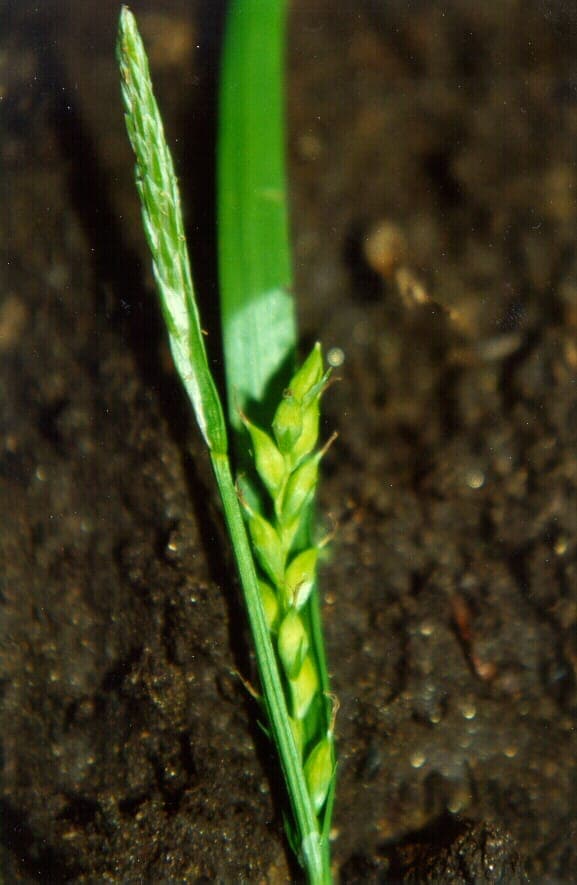
Flowering takes place in late spring and early summer, from April through June. The flower stems rise above the foliage and bear the characteristic sedge spikelets, which start green and gradually turn brown as the seeds mature. Like most Carex species, the flowers are not showy in the traditional sense, but they add a quiet, architectural interest to the plant form. The brown seed heads attract small seed-eating birds through summer and into autumn.
The dark, slightly glossy leaf surface makes Henderson's sedge an excellent backdrop for lighter or more colourful shade plants. White-flowered hostas, cream-coloured astilbes and variegated ferns all benefit from being placed against this rich, dark green foil.
Ideal location
Carex hendersonii is a committed shade plant. It thrives in partial to full shade, with the best results achieved in dappled woodland light - the kind found under the canopy of deciduous trees, where shifting light and shadow create variable but never harsh conditions. A north- or north-east-facing border protected by a fence, hedge or building is also suitable.
Full afternoon sun should be avoided: the leaf tips will scorch and the plant will struggle during dry spells. Morning sun with afternoon shade is the maximum sun exposure this plant handles comfortably in most European conditions.
Henderson's sedge is well suited to the following garden situations: ground cover under tall trees, the shaded margin of a pond or stream, a woodland or shade border, and the wetter, more sheltered corners of a mixed garden. It combines particularly well with other forest-floor plants that share its requirements.
Visit gardenworld.app for examples of woodland-style garden designs that feature sedge species as structural elements.
Soil
The pH preference of Carex hendersonii runs from 6.0 to 7.5, covering neutral to mildly acid conditions. It thrives in humus-rich, moisture-retentive but well-drained soils - the kind of organically deep, loamy soil found in the forests of its Pacific Northwest homeland. In the garden, prepare the planting area by working in a generous amount of well-rotted compost, leaf mould or woodland soil into the top 20 to 30 cm.
Heavy clay soils can work but must be lightened with organic matter to prevent waterlogging. Pure sand dries too quickly and needs substantial compost amendment. A thick mulch layer of fallen leaves or wood chips is highly beneficial: it retains moisture, improves soil structure as it decomposes, and mimics the forest-floor conditions the plant is naturally adapted to.
Avoid calcareous or highly alkaline soils. Fertiliser needs are modest: a light, balanced feed in early spring is sufficient. Avoid heavy nitrogen applications, which produce lush but weak growth.
Free design
Want to see Henderson's sedge: complete guide in your garden? Make a free design now.
Watering
Water is critical for Carex hendersonii. Unlike the drought-tolerant Carex douglasii, this species comes from a consistently moist climate and needs the soil to remain reliably damp. During the first growing season, check the top 3 to 5 cm of soil twice a week and water whenever it feels dry. Deep, infrequent watering is preferable to shallow daily watering, as it encourages the roots to penetrate deeper into the soil.
From the second season onward, an established plant is less vulnerable to short dry spells, but it still performs best when moisture is consistent. In hot, dry summers, water at least once a week. Plants at pond margins or in naturally moist areas generally need no supplemental irrigation.
Never allow water to pool around the crown for extended periods, as crown rot can develop in combination with cold temperatures. Good soil structure and organic mulch help regulate moisture levels and prevent both drought stress and waterlogging.
Pruning
Henderson's sedge requires minimal pruning. The single most important task is the annual late-winter cut-back: in February or early March, cut the entire clump back to approximately 5 to 10 cm above ground level. This removes the old, faded foliage and makes way for the fresh spring growth. A sharp pair of hand shears or a small pruning knife works well for this task.
Do not cut back in autumn or early winter: the old foliage provides insulation for the crown and root zone during cold weather. In mild winters, the leaves may remain largely green all season, in which case only the discoloured tips need to be trimmed rather than a full cut-back.
Every three to four years, divide clumps that have become overly large or that show signs of dying out at the centre. Do this in early spring just as the new shoots emerge, or in early autumn while the soil is still warm. Dig out the entire clump, split it into sections with healthy shoots and roots, and replant immediately at the original depth.
Maintenance calendar
- January - February: Leave undisturbed; add frost-protective mulch only in severe cold.
- March: Cut back to 5-10 cm. Apply leaf compost or garden compost. Refresh mulch layer.
- April: New growth begins. Apply light balanced fertiliser. Renew mulch if needed.
- April - June: Flowering period. Leave flower stems for visual interest and seed set.
- June - August: Water regularly. Check for leaf scorch or drought stress. Keep area weeded.
- September: Divide and replant if needed. Apply a light layer of compost around the base.
- October - November: Plant enters dormancy. Do not cut back yet; old foliage protects the crown.
- December: Full dormancy. No action unless extreme frost is forecast.
Winter hardiness
Carex hendersonii is winter-hardy across USDA zones 6 to 9, tolerating minimum temperatures of approximately -20 degrees Celsius. In the mild, maritime conditions of the Netherlands, Belgium and most of north-western Europe, established plants overwinter without any protection in virtually all situations.
In especially cold winters or in exposed, wind-swept positions, a light protective mulch of leaf mould or straw around the base of the clumps provides adequate insulation. Remove this in March as temperatures rise. Young plants in their first winter benefit from a little extra protection, particularly if planted late in the season.
The dark leaf surface of Henderson's sedge may show some tip browning in hard winters, but the plant recovers quickly once the growing season returns. In mild winters, the foliage remains essentially unchanged all year.
Companion plants
Carex hendersonii is ideally paired with classic woodland shade border plants that share its preference for moist, humus-rich soil in partial to full shade:
- Hosta: The broad, sculptural or glossy leaves of hostas create a strong contrast with the narrower sedge foliage. White or pale-coloured hostas are particularly striking against the dark green sedge.
- Astilbe: Feathery flower plumes in white, pink or red stand out beautifully against the sedge's dark foliage backdrop.
- Helleborus (hellebore): Winter- and early-spring-flowering, with similar shade and moisture preferences.
- Polygonatum (Solomon's seal): Gracefully arching stems and a charming textural contrast.
- Dryopteris (buckler fern): Shares the same site requirements and produces a beautiful layered texture.
- Epimedium: A tough, slightly drier-tolerant ground cover that complements Henderson's sedge in semi-shade.
- Pulmonaria (lungwort): Spotted foliage and early spring flowers make it an attractive companion.
Avoid planting alongside sun-lovers or drought-tolerant Mediterranean plants such as lavender, salvia and stonecrop.
Closing
Carex hendersonii is a rewarding sedge for shaded, moist garden corners that rewards thoughtful siting and minimal care with years of consistent, attractive growth. Its dark, slightly glossy foliage, clump-forming habit and moderate growth rate make it a reliable structural plant for woodland borders, pond margins and shaded mixed plantings.
Whether used as a ground cover under trees, as an accent plant in a shade border or as a backdrop for brighter companions, Henderson's sedge adds depth and quiet elegance to any planting scheme. For more planting inspiration and garden design ideas, visit gardenworld.app.
Want to see Henderson's sedge: complete guide in your garden? Make a free design now.
Upload a photo, pick a style, and get a photorealistic design with plant list in under a minute.
10,000+ gardens designed already
No credit card required


Similar plants
Slenderbeak sedge: complete guide
Carex athrostachya
Full guide to Carex athrostachya: ideal location, soil, watering, pruning and companion plants for garden success.
Douglas' sedge: complete guide
Carex douglasii
Full guide to Carex douglasii: drought tolerance, ideal location, soil, pruning and companion plants for naturalistic gardens.