
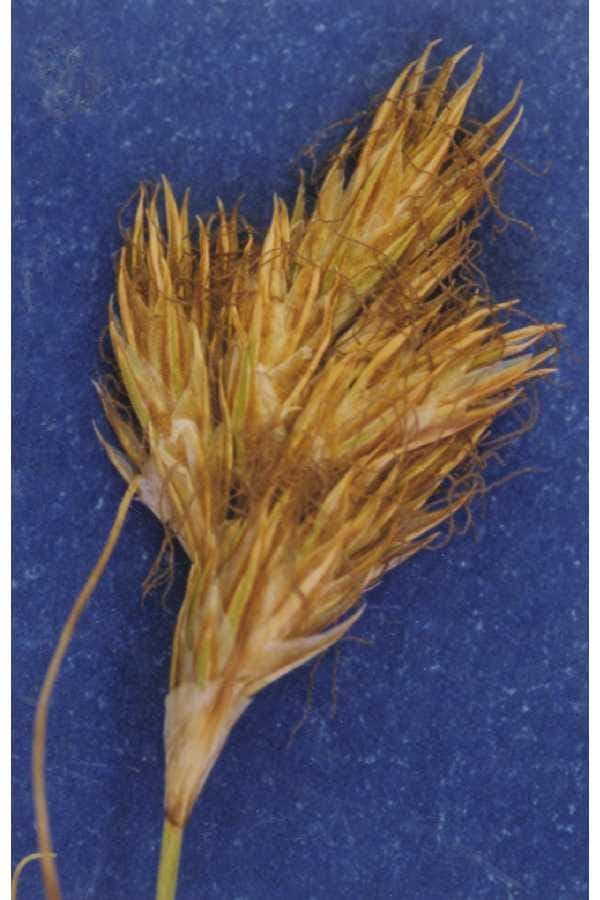
Hurd, E.G., N.L. Shaw, J. Mastrogiuseppe, L.C. Smithman, and S. Goodrich. / Public domain, via Wikimedia Commons
Douglas' sedge: complete guide
Carex douglasii
Want to see Douglas' sedge: complete guide in your garden?
1 minute, no credit card
Overview
Carex douglasii, commonly known as Douglas' sedge, is a rhizomatous member of the family Cyperaceae, described by Boott in 1839. The species is named in honour of the Scottish plant collector David Douglas, who made extensive botanical surveys of western North America in the nineteenth century. Its natural range spans western Canada - Alberta, British Columbia and Saskatchewan - and sweeps south through much of the western and central United States including Arizona, California, Colorado, Idaho, Missouri, Montana, Nebraska, Nevada, New Mexico, North Dakota, Oregon, South Dakota, Utah, Washington and Wyoming, reaching as far south as Baja California in northwest Mexico.
Unlike many sedges that favour wet or shaded conditions, Carex douglasii is notably adapted to dry to moderately moist, open habitats. It grows naturally on dry prairies, semi-arid slopes, in open parklands and along the margins of dry meadows - environments where summer drought is regular. This drought tolerance, combined with a spreading rhizomatous habit, makes it a particularly useful plant for gardeners dealing with dry, sunny sites or for naturalistic, low-irrigation planting schemes.
If you are considering a drought-resilient border or a prairie-inspired planting, gardenworld.app can help you visualise how Carex douglasii fits into your overall garden design.
Historical synonyms for this species include Carex irrasa, Carex fendleriana and Carex nuttallii - all now considered the same species.
Appearance and bloom cycle
Carex douglasii produces spreading mats of fine, narrow leaves through its creeping rhizomes. The leaf texture is fine - finer than many clumping sedges - and the colour is a fresh, bright green. Individual shoots tend to reach 15 to 30 cm in height, but the plant can spread laterally over a wider area to form a tidy, even carpet.
Flowering occurs in late spring and early summer, from approximately May through July. The slender flower stems carry characteristic green to light brown spikelets. After pollination, small brown fruits develop and persist into summer, offering food for seed-eating birds. The foliage remains green and attractive throughout the growing season; in prolonged drought, the leaf tips may bleach slightly, but the plant recovers quickly once moisture returns.
The rhizomatous growth habit distinguishes this species from the clumping Carex athrostachya and Carex hendersonii. While it spreads gradually, it is not invasively aggressive and can be managed easily by edging the mat in spring.
Ideal location
Carex douglasii is one of the more sun-tolerant sedges. It thrives in full sun to light shade, making it useful in positions that would be too exposed for shade-loving species. A sunny border edge, a slope prone to erosion, the verge of a path or driveway, or an open, dry corner of the garden are all excellent placements.
The plant also suits green roof applications, where its low height, drought tolerance and mat-forming habit make it a practical and attractive choice for extensive planting systems. It performs well in rock gardens and gravel gardens alongside other drought-adapted plants.
For north-western European gardens, a position with morning sun and light afternoon shade tends to give the best combination of good colour and manageable moisture needs. Avoid positions with prolonged standing water, as the roots and rhizomes are susceptible to rot in waterlogged conditions.
Visit gardenworld.app for design inspiration and to see how drought-adapted sedge species fit into modern, water-wise garden schemes.
Soil
This sedge has a notably wide pH tolerance, thriving across a range from 6.0 to 8.5, which means it can handle mildly alkaline soils that many other sedges cannot. It adapts to sandy, loamy and lightly clay-based soils, provided drainage is adequate. Waterlogged or persistently wet soils should be avoided.
Because the species is adapted to naturally lean soils, heavy amendment with rich compost can result in lush but floppy, weak growth. A light dressing of compost at planting time, followed by a mulch of grit or wood chips, is sufficient. The grit mulch also helps keep the soil surface open and well-drained, which is beneficial in wet climates.
For moderately fertile, free-draining garden soils, no special preparation is needed beyond loosening the planting area and removing competing weeds. This is a genuinely low-maintenance plant once established.
Free design
Want to see Douglas' sedge: complete guide in your garden? Make a free design now.
Watering
Once established, Carex douglasii is among the most drought-tolerant sedges available for garden use. In the first growing season after planting, regular watering is needed to help the rhizomes spread and anchor into the surrounding soil. Water deeply once a week during dry spells in this establishment phase.
From the second year onward, the plant typically manages on rainfall alone in temperate climates. During exceptional drought, one or two deep waterings per summer will prevent the leaf tips from browning. The plant signals drought stress with slight bleaching and curling of the leaf tips - a cue to water before the condition becomes severe.
Avoid overwatering and avoid sites where water sits after rain. In contrast to Carex athrostachya and Carex hendersonii, this species is not suited to pond margins or boggy corners.
Pruning
Pruning requirements are minimal. The main task is the annual spring cut-back in February or early March, when the previous year's foliage is removed by cutting the mat back to approximately 5 to 8 cm above ground level. This allows the fresh spring growth to emerge unimpeded.
To manage the spread of the rhizomes and keep the mat within its intended area, use a sharp spade to cut around the perimeter of the planting each spring. The separated sections can be lifted and replanted elsewhere. This edging is quick and satisfying work, and gives you additional plants for other dry corners of the garden.
Every three to five years, consider lifting and dividing the entire mat to rejuvenate the planting and maintain vigour.
Maintenance calendar
- January - February: Leave undisturbed; no protection needed in normal winters.
- March: Cut back to 5-8 cm. Lightly loosen soil surface. Apply grit or compost mulch if desired.
- April: New growth appears. Light fertiliser application optional. Check rhizome spread.
- May - July: Flowering period. Flower stems are decorative; leave for seed set and bird food.
- June - August: Check for drought stress. Water deeply once if leaf tips brown severely.
- September: Divide and transplant if needed. No more feeding.
- October - November: Plant enters dormancy. Leave foliage in place for winter protection.
- December: Full dormancy. No action required.
Winter hardiness
Carex douglasii is fully winter-hardy across USDA zones 4 to 9, tolerating minimum temperatures of around -35 degrees Celsius in protected conditions. In practice, this makes it one of the toughest sedges for European garden use, surviving reliably even in exposed, unprotected positions.
The surface-running rhizomes can be vulnerable to hard, bare-soil freezing in the absence of snow cover. A thin grit or bark mulch around the planting provides adequate protection. Remove this mulch in March as new growth begins. Established mats rarely need any winter protection at all.
Companion plants
Carex douglasii works best with drought-tolerant and prairie-inspired companions:
- Festuca glauca (blue fescue): A fine-textured blue-green foil to the bright green sedge.
- Penstemon species: Prairie natives with striking tubular flowers through summer.
- Echinacea purpurea (purple coneflower): Adds bold colour and attracts butterflies and bees.
- Achillea (yarrow): Shares the preference for dry, sunny positions.
- Salvia nemorosa (meadow sage): Lavender-blue flower spikes complement the fine sedge foliage beautifully.
- Sedum (stonecrop): Extremely drought-tolerant, ideal as a low companion between sedge mats.
Avoid pairing with moisture-loving plants such as astilbes, hostas, ferns and bog irises.
Closing
Carex douglasii is a versatile, low-maintenance sedge for sunny to lightly shaded dry positions. Its drought tolerance after establishment, wide pH adaptability and spreading, erosion-controlling habit make it a genuinely useful plant for a range of challenging garden situations. The fine texture and even green cover it provides through the growing season require very little effort to maintain.
Whether used on a sunny slope, along a path edge or as part of a prairie-inspired border, Douglas' sedge earns its place in the garden. Visit gardenworld.app for more ideas on creating beautiful, water-wise planting combinations.
Want to see Douglas' sedge: complete guide in your garden? Make a free design now.
Upload a photo, pick a style, and get a photorealistic design with plant list in under a minute.
10,000+ gardens designed already
No credit card required


Similar plants
Slenderbeak sedge: complete guide
Carex athrostachya
Full guide to Carex athrostachya: ideal location, soil, watering, pruning and companion plants for garden success.
Henderson's sedge: complete guide
Carex hendersonii
Full guide to Carex hendersonii: shade tolerance, moisture needs, soil, pruning and companion plants for woodland gardens.