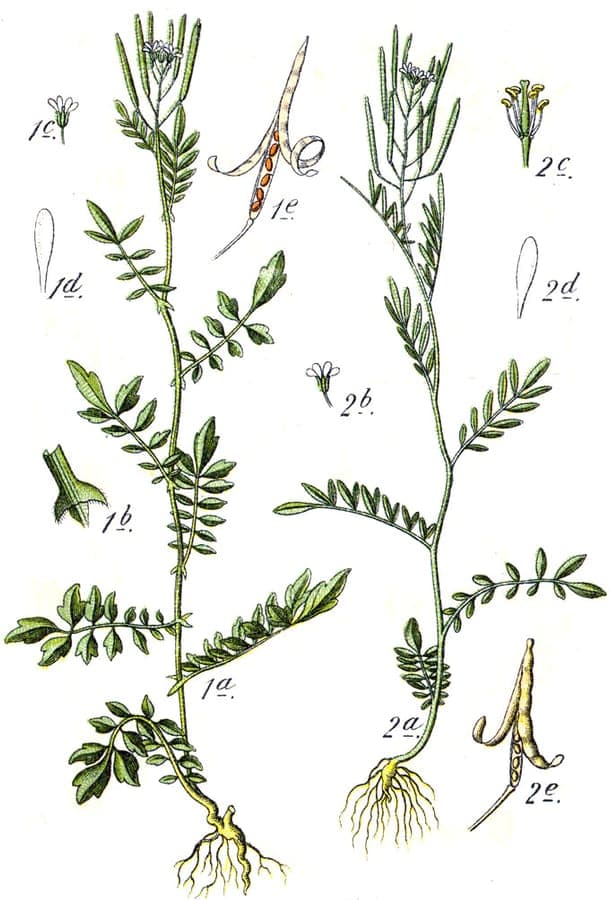
Johann Georg Sturm (Painter: Jacob Sturm) / Public domain, via Wikimedia Commons
Cardamine parviflora: complete guide
Cardamine parviflora
Want to see Cardamine parviflora: complete guide in your garden?
Full design in HD: €7.99
Look after your Cardamine parviflora with the GardenWorld app
Identify plants with your camera and get a care calendar with reminders for this plant.


Overview
Cardamine parviflora, better known as sand bittercress or small-flowered bittercress, is a subtle wildflower from the Brassicaceae family. This rare and habitat-preferring plant grows in natural environments in cool, moist soils. The small-flowered bittercress is a modest plant that deserves much more attention from gardeners who love unusual and native species. Despite its small size, the little plant offers a delicate botanical value.
Appearance and Bloom
Sand bittercress forms a low, rosette-like growth form, usually not taller than 30 centimeters. The leaves are finely pinnate, highly branched, and have a delicate structure. The flowers are indeed very small, usually white or light pink, with four petals typical of the Brassicaceae family. These flowers appear in spring and early summer. The fruit capsules are elongated and narrow, containing small seeds.
Ideal Location
Cardamine parviflora naturally grows in cool, semi-shaded locations. In garden designs, it best suits shadier corners where other plants may grow less. The plant tolerates both full sun and partial shade, though semi-shade is optimal. In natural forms, it grows in open woodlands, along riverbanks, and on moist slopes. Protection from harsh wind is desirable.
Soil
This plant flourishes in slightly acidic to neutral soils that remain consistently moist. A soil with high organic content and good drainage is ideal. Heavier soils can be improved by adding sand and organic material. The plant prefers poor to moderate nutrition soils. Avoid excessive feeding which may lead to excessive leaf growth.
Free preview
Want to see Cardamine parviflora: complete guide in your garden? Make a free preview of your design.
Watering
Sand bittercress requires regular watering, especially during dry periods. The soil should remain consistently moist but not wet. In natural conditions, it grows near rivers and springs. In gardens, adding mulch benefits moisture retention. Drip irrigation can be particularly beneficial during dry summers.
Pruning
Cardamine parviflora requires minimal pruning. Remove dried leaves and flower stems after bloom. The plant naturally declines after seed setting, so remove seed capsules to prevent self-seeding unless this is desired for stand renewal.
Maintenance Calendar
- March-April: Seedlings appear. Thin young plants to suitable distances.
- April-May: Flowering period. Water regularly during dry periods.
- June: Seed setting complete. Remove seed capsules if self-seeding not desired.
- July-August: Plant retreats. Keep water minimal.
- September-November: New seedlings may appear. Keep soil moist.
Winter Hardiness
Cardamine parviflora is quite winter-hardy in the Netherlands. The little plant may experience leaf loss during cold periods, but the roots remain intact. During severe frost periods, mulch provides extra protection. The plant regrows in spring.
Companion Plants
Sand bittercress grows well in company with other moisture-loving wildflowers such as asters, ajugas, and moist groundcovers. Marsh flowers and other Brassicaceae relatives can coexist well. Avoid dominant-growing plants that overshadow the delicate plant.
Closing Remarks
Cardamine parviflora offers gardeners the pleasure of a true wildflower with botanical authenticity. Although small and modest in appearance, this plant brings unique value to any natural or wild garden. With suitable placement and moisture management, sand bittercress grows for many years.
Frequently asked questions about Cardamine parviflora
Is Cardamine parviflora winter hardy?
Cardamine parviflora is quite winter-hardy in the Netherlands. The little plant may experience leaf loss during cold periods, but the roots remain intact.
When and how do you prune Cardamine parviflora?
Cardamine parviflora requires minimal pruning. Remove dried leaves and flower stems after bloom.
How much water does Cardamine parviflora need?
Sand bittercress requires regular watering, especially during dry periods. The soil should remain consistently moist but not wet.
Where does Cardamine parviflora grow best?
Cardamine parviflora naturally grows in cool, semi-shaded locations. In garden designs, it best suits shadier corners where other plants may grow less.
What soil does Cardamine parviflora need?
This plant flourishes in slightly acidic to neutral soils that remain consistently moist. A soil with high organic content and good drainage is ideal.

See it in your garden
See Cardamine parviflora in your garden
One photo of your garden and a few questions. You see the result in about a minute.
Try it with a photoIdentify this plant in your own garden. Identify a plant
Similar plants
Radish: complete guide to sowing, growing and harvesting
Raphanus sativus
Everything about radish (Raphanus sativus): when and how to sow, soil, watering, flea beetle and cabbage root fly, harvesting after four weeks and winter radish.
Brassica cretica: complete guide
Brassica cretica
Brassica cretica, the Cretan cabbage, grows wild on Aegean cliffs. Discover how to grow this drought-tolerant, yellow-flowered Mediterranean perennial.
Corsican cabbage: complete guide
Brassica insularis
Corsican cabbage is a rare Mediterranean rock cabbage with white flowers and blue-green leaves. Location, soil and winter protection.
