
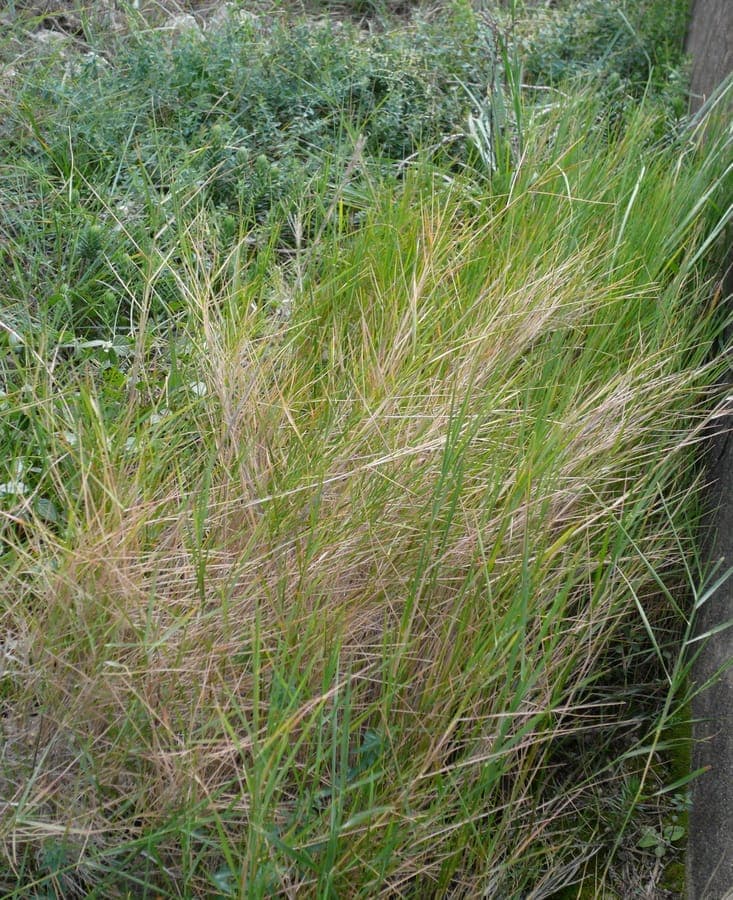
No machine-readable author provided. Pere prlpz assumed (based on copyright claims). / CC BY-SA 2.5, via Wikimedia Commons
Ramose False-brome: complete guide
Brachypodium retusum
Want to see Ramose False-brome: complete guide in your garden?
1 minute, no credit card
Overview
Brachypodium retusum, commonly called Ramose False-brome, is a perennial grass in the family Poaceae native to the Mediterranean basin, with its range extending from Spain and Portugal across southern France, Italy, Greece, Turkey, and the Caucasus, through North Africa and into the Arabian Peninsula. In its native habitat it dominates dry, calcareous garrigue, rocky slopes, and open woodland margins - landscapes where summer drought and thin, alkaline soils are the norm.
This tough, persistent grass forms dense tussocks of stiff, narrow leaves and produces elegant flowering culms in May to July. Its extraordinary drought tolerance, its architectural tussock habit, and its suitability for poor, alkaline soils make it increasingly valuable in European gardens as climate patterns shift toward drier summers. In Mediterranean horticulture it has long served as a ground cover for steep, erosion-prone slopes where little else will grow.
As a garden plant, Brachypodium retusum emphasises structure and fine texture over vivid colour. Its semi-rigid leaves and graceful flowering stems create an authentic Mediterranean atmosphere in rock gardens, dry borders, gravel gardens, and terrace plantings. It pairs beautifully with lavender, cistus, sage, and other drought-tolerant shrubs from the same climatic zone. The plant is reliably cold-hardy to around -10 to -12 degrees Celsius with good drainage, making it suitable for gardens across western and central Europe in well-drained conditions.
Appearance & bloom cycle
Brachypodium retusum forms compact, dome-shaped tussocks 20 to 50 cm in height, with numerous arching culms rising from a central crown. The leaves are narrow, up to 3 mm wide, semi-rigid, and dark green to grey-green. In prolonged drought the leaf margins curl inward slightly - a physiological adaptation that reduces transpiration. The leaf surface is rough with fine hairs, giving a silky sheen in raking light.
Flowering culms emerge in May and persist through to July. They rise to 30 to 50 cm on slender, branching stems bearing compound spikelets of 2 to 3 cm. Individual spikelets are narrow, elongated, and green to light brown, turning golden as they ripen in late June and July. The species name 'retusum' refers to the slightly notched or retuse apex of the glumes. After seed set in July and August, the culms remain standing in an attractive golden-brown state well into autumn and sometimes winter.
The plant expands slowly by short stolons, maintaining a neat clump over time without becoming aggressively spreading. A mature tussock reaches 30 to 50 cm across and can persist at the same site for many years with minimal attention. On richer, moister soils it grows more vigorously and taller; on stony, poor ground it stays compact and densely tufted.
Ideal location
Full sun is essential for best results. Brachypodium retusum thrives in maximum sunlight and actually suffers in too much shade, where it becomes loose and floppy. South or west-facing aspects are ideal. In light partial shade the plant survives but loses its characteristic dense tussock form and flowers less freely.
The plant excels in rock gardens, Mediterranean-style borders, dry gravel gardens, and slope planting. It is suitable as a ground cover on difficult-to-mow banks where soil erosion is a concern. Space plants 30 to 40 cm apart for ground cover use, or 40 to 60 cm in mixed plantings with shrubs. In terrace crevices or between paving stones, it naturalises beautifully, softening hard edges.
Avoid positions where winter waterlogging occurs. In northern European gardens this is the key risk factor: the plant tolerates cold temperatures much better than it tolerates wet roots in winter. Raised beds, free-draining gravel mulch, and sloped sites all help manage this risk.
Soil requirements
Brachypodium retusum demands good drainage and performs best on poor to moderately fertile soils with a pH of 7.5 to 8.0. It is a calcicole (lime-loving) species, thriving on calcareous, stony, or gritty soils. On fertile garden soils it grows rank and tall, losing the compact tussock form that makes it attractive, and becomes more susceptible to waterlogging damage in wet winters.
Soil preparation is minimal on suitable ground. On heavy clay soils, incorporate 30 to 40 percent by volume of coarse horticultural grit into the top 30 cm before planting. Do not add rich compost or well-rotted manure - this triggers the lush, floppy growth that is both aesthetically and structurally problematic. A surface mulch of coarse gravel or crushed stone 1 to 2 cm deep around the crown improves drainage, keeps the soil warm, and reduces moss and weed encroachment.
Free design
Want to see Ramose False-brome: complete guide in your garden? Make a free design now.
Watering
Once established, Ramose False-brome is highly drought-tolerant and needs little or no supplemental watering in typical northern European summers. In the first planting season, water every two weeks during dry spells (more than 14 days without significant rain), applying 1 to 2 litres per plant to help the root system establish. From the second year, reliance on irrigation can be all but eliminated in most UK, Belgian, and Dutch gardens.
During extreme heat waves above 35 degrees Celsius lasting more than a week, a single generous watering may be beneficial. However, regular watering encourages soft, rank growth that detracts from the plant's natural form. The golden rule: water less rather than more. Overwatering is by far the most common cause of failure with this species, especially in winter when excess soil moisture causes crown rot even at temperatures above zero.
Pruning
Brachypodium retusum requires simple annual maintenance. In early March, cut the entire tussock back to 10 to 15 cm above ground level. A pair of sharp hedging shears or a hay knife works well. Wear gloves: the rough leaf edges can cause fine cuts on bare skin. This annual cut removes the accumulated dead and brown-tipped material from the previous season and stimulates the flush of fresh green growth that appears within two to three weeks.
An alternative approach is to leave the tussock standing through winter for its structural and wildlife value, and trim in late February or early March before new growth begins in earnest. The standing winter tussocks have considerable decorative value, catching dew and frost in attractive patterns. Remove any dead culms individually during summer if they become unsightly.
Contain the plant's slow outward spread by cutting back encroaching stolons with a sharp spade each spring. This takes only a minute or two per plant and keeps the tussocks at the desired diameter.
Maintenance calendar
January-February: Leave tussock standing for winter structure and insect shelter. March: Cut the whole tussock back to 10-15 cm. Trim encroaching stolons with a spade. April: Fresh green growth emerges rapidly. No fertilizer needed. Check drainage after heavy rain. May: Flowering culms rise. Enjoy the elegant inflorescences. No action needed. June: Peak bloom. Water only in prolonged drought of 2+ weeks. July: Culms ripen to golden-brown. Attractive seed heads develop. August: Seed dispersal. Tussocks look best in late-afternoon light. Minimal watering. September: Growth slows. No pruning needed. Leave standing. October-November: Brown winter texture. Check gravel mulch around crown. December: Dormancy. No action required. Protect with fleece below -10 degrees Celsius.
Winter hardiness
Brachypodium retusum is cold-hardy to approximately -10 to -12 degrees Celsius (USDA zones 7b to 8a), provided that soil drainage is excellent. In its native Mediterranean range, winters are mild with light frosts; however, it has proved reliably hardy through British, Belgian, and Dutch winters in well-drained positions. The key conditioning factor is not temperature but moisture: wet roots in winter cause crown rot far more readily than frost alone.
In USDA zone 7 or colder regions, a light fleece covering during the coldest weeks provides useful insurance. First-year plants are more vulnerable than established specimens; protect them in their first winter when frost below -6 degrees Celsius is forecast. In well-drained raised beds or gravel gardens, even in zone 7, the plant often overwinters without any protection at all.
Companion plants
Brachypodium retusum is ideally suited to Mediterranean-style and dry garden plantings. Excellent companions include:
- Cistus x purpureus (purple rockrose): bold pink flowers in June, same drought tolerance, thrives in identical conditions
- Lavandula angustifolia 'Hidcote' (lavender): purple flower spikes, same pH preference, stunning visual contrast with fine grass texture
- Salvia officinalis (culinary sage): grey-green aromatic foliage, blue-purple flowers in June, same warm dry site
- Stipa tenuissima (Mexican feather grass): wispy silver-green culms to 40-60 cm, creates a complementary light-catching tapestry
- Thymus vulgaris (common thyme): low ground cover at 10-20 cm, fills gaps between tussocks with fragrant carpet
- Euphorbia rigida (upright spurge): blue-grey foliage, lime-yellow bracts in spring, an outstanding structural companion
Design your Mediterranean-inspired garden layout at gardenworld.app and see how Ramose False-brome integrates with drought-tolerant companions in your specific outdoor space. For more plant profiles and dry garden inspiration, visit gardenworld.app.
Conclusion
Ramose False-brome is an undemanding, characterful grass for anyone creating a low-water, Mediterranean-inspired garden. Its fine texture, graceful blooms, and exceptional drought tolerance make it a compelling choice for rock gardens, dry borders, and gravel gardens throughout western Europe. Plant it in a sunny, well-drained spot and it will reward you with minimal care and maximum structural interest for many years.
Want to see Ramose False-brome: complete guide in your garden? Make a free design now.
Upload a photo, pick a style, and get a photorealistic design with plant list in under a minute.
10,000+ gardens designed already
No credit card required


Similar plants
Sporobolus pungens: complete guide
Sporobolus pungens
Sporobolus pungens is a stoloniferous Mediterranean coastal grass with outstanding salt and drought tolerance, perfect for seaside and dry gardens.
Mediterranean aegilops: complete guide
Aegilops biuncialis
Everything about Aegilops biuncialis, a Mediterranean annual grass with ornamental spikes and outstanding drought tolerance for dry gardens.
Silver bluestem: complete guide
Bothriochloa saccharoides
Full guide to Bothriochloa saccharoides (silver bluestem): site, soil, watering, winter hardiness, pruning, and garden companions.