
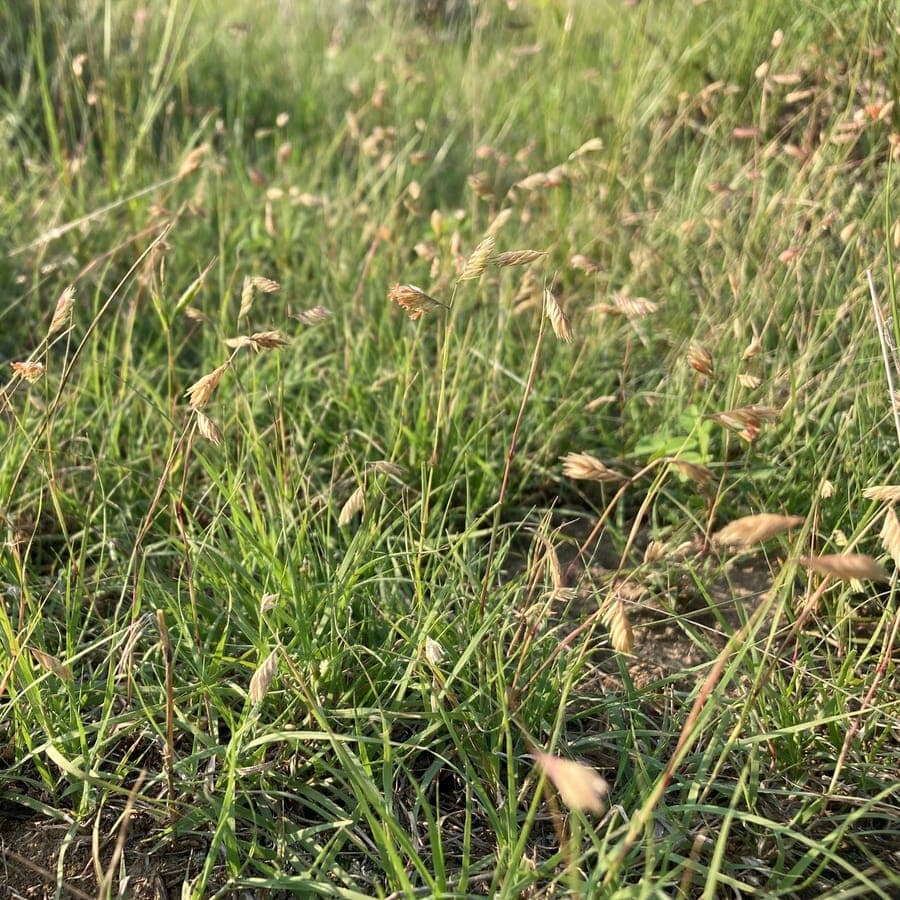
Patrick Alexander https://www.inaturalist.org/people/aspidoscelis / CC0, via Wikimedia Commons
Buffalo grass: complete guide
Bouteloua dactyloides
Want to see Buffalo grass: complete guide in your garden?
1 minute, no credit card
Overview
Buffalo grass - botanically Bouteloua dactyloides, formerly classified as Buchloe dactyloides - is one of the most distinctive and ecologically valuable grasses of the North American Great Plains. Native from central Canada south through the United States to Mexico, it once formed the dominant groundcover of the short-grass prairie, providing sustenance to enormous herds of bison and pronghorn antelope across millions of acres of flat, windy landscape. The common name directly references this relationship with the buffalo that once defined the region.
In ornamental horticulture, buffalo grass has attracted growing interest as a low-maintenance lawn alternative and a ground-covering plant for hot, dry garden conditions. Its fine-textured, blue-green turf, slow growth rate, and exceptional drought tolerance make it attractive to gardeners looking to reduce water consumption and mowing frequency without sacrificing an attractive ground surface. If you are considering an ecological front garden design that reduces irrigation needs, gardenworld.app offers inspiration and ready-to-use layouts incorporating drought-tolerant ground covers.
Appearance and growth cycle
Buffalo grass is a warm-season grass, meaning it grows actively during the warm months - typically from May through September - and enters dormancy during winter, turning a straw-yellow to light tan colour before greening up again in late spring when soil temperatures reliably exceed 15 degrees Celsius.
The individual leaf blades are exceptionally fine, just 2 to 3 mm wide, and typically reach 10 to 15 cm in height, giving the turf a soft, almost carpet-like feel underfoot. The plant spreads by above-ground stolons (runners) that root at the nodes, gradually filling in gaps and forming a dense, weed-suppressing sod. It is a dioecious species - male and female flowers grow on separate plants. Male plants produce distinctive, comb-like spikes on short stems in June and July, which gave rise to the botanical epithet dactyloides (meaning finger-like). Female plants carry inconspicuous bur-like seed heads at the base of the foliage.
Once a sod is established, buffalo grass spreads efficiently via its stolons and can colonise an area without reseeding. In suitable conditions it forms a self-sustaining turf that requires little intervention.
Ideal location
Buffalo grass demands full sun - at least six hours of direct sunlight daily, and ideally more. In partial shade it becomes sparse, loses its characteristic fine texture, and produces fewer stolons, resulting in a patchy, open sward. In its natural habitat it grows on exposed, flat or gently rolling prairie under fierce sun and wind, a background that tells you much about its cultural requirements.
In the garden, it performs best as a ground cover on open, unshaded surfaces: sunny terraces, south-facing slopes, dry front lawns, gravel gardens, and green roofs. It tolerates light foot traffic better than many ornamental grasses, making it a realistic lawn substitute for low-use areas. Avoid positions beneath trees or alongside tall shrubs that cast shade during the critical growing hours of the afternoon.
Soil requirements
Buffalo grass is native to the dry, alkaline, often clay-rich soils of the Great Plains - conditions that would defeat most ornamental plants. In garden cultivation it performs best in free-draining, poor to moderately fertile soils. Rich, moist garden soils encourage lush but open growth at the expense of the compact, tight turf habit that makes the grass attractive. A neutral to slightly alkaline pH suits it well, though it adapts to mildly acid conditions too.
Sandy soils, chalky substrates, and stony, low-nutrient mixes are all excellent choices. Waterlogged or constantly moist soils lead to root disease and thinning of the sward. If your garden soil is heavy clay, incorporate coarse grit generously before sowing or planting to improve drainage. Avoid adding fertiliser or rich compost: buffalo grass does not need it and will respond with rank, sprawling growth rather than the tight turf you want.
Watering
Few grasses match buffalo grass for drought tolerance once established. On a well-drained site with average annual rainfall exceeding 350 mm, the plant requires virtually no supplementary irrigation once the root system is established in its second growing season. During prolonged dry spells it may temporarily turn tan or brown - a state of warm-season dormancy rather than death. When rainfall returns, the sward greens up reliably.
Newly seeded or sodded areas require consistent moisture for the first four to six weeks to ensure good germination and rooting. After that, gradually reduce watering. A deep, infrequent drink (allowing the soil to dry between sessions) encourages the roots to go deeper rather than staying near the surface. In European climates with reasonable summer rainfall, established buffalo grass lawns typically need no additional water through a normal growing season.
Free design
Want to see Buffalo grass: complete guide in your garden? Make a free design now.
Mowing and cutting back
One of the most appealing aspects of buffalo grass as a lawn substitute is its low mowing requirement. For a traditional, neatly kept lawn effect, mowing every three to four weeks during the growing season to a height of 5 to 8 cm keeps the sward dense and uniform. A single cut in early spring - in March or April before the new season's growth begins - removes accumulated dead material and refreshes the sward's appearance.
For a naturalistic, unmowed effect, buffalo grass can simply be left to reach its natural height of 15 to 20 cm, providing a soft, flowing prairie appearance. In this case, one annual cut in early spring is all that is needed. The grass does not need to be cut in autumn; the straw-coloured dormant sward has its own quiet, textural beauty through the winter months.
Maintenance calendar
March - April: Cut back the dormant sward to approximately 5 cm before new growth emerges. Remove any thatch that has accumulated.
May: Watch for weed encroachment in any gaps in the sward. Hand-weed if necessary in newly established areas.
June - July: Peak flowering period. Mow only if maintaining a formal lawn look. No irrigation needed except during extreme drought.
August - September: The grass maintains its colour with normal rainfall. Temporary browning during dry spells is normal and reversible.
October: Reduce or stop any supplementary watering. The grass begins preparing for winter dormancy.
November - February: Dormancy period. The sward takes on a straw-tan colour. No maintenance required.
Winter hardiness
Despite its warm prairie origins, buffalo grass is impressively cold-hardy, tolerating temperatures down to approximately -30 degrees Celsius - placing it solidly in USDA zone 4. It overwinters reliably across northern and central Europe, including the UK, the Netherlands, Belgium, and most of Germany. The dormant sward survives hard frost without protection, and the stolons and crowns remain viable through extended frozen periods.
The key limitation in colder climates is not cold hardiness but the length of the warm growing season. Buffalo grass requires consistently warm temperatures to grow actively and fill in properly, and in climates with short, cool summers it may never form the dense sod it achieves on the American prairie. In northern Europe, the best results come from sheltered, south-facing positions that heat up early in spring.
Companion plants
Buffalo grass pairs well with a range of drought-tolerant perennials and low-growing plants that share its preference for sun and lean soils. Strong companions include Echinacea purpurea for summer colour in bold magenta-pink, Rudbeckia fulgida for late-season yellow flowers that contrast with the blue-green turf, Agastache foeniculum for aromatic lavender spikes that attract pollinators, and Penstemon species for slender, tubular flowers in red, pink, and purple tones.
In a rock or gravel garden, combinations with Sedum, Sempervivum, and Armeria maritima work beautifully - all demand excellent drainage and tolerate summer drought without complaint. Low-growing Salvia nemorosa cultivars and Lavandula angustifolia provide fragrance and colour that complement the fine grass texture. Planting buffalo grass alongside scattered stands of prairie perennials recreates a miniature version of the Great Plains landscape right in your front garden.
For a cohesive design incorporating buffalo grass with complementary perennials, visit gardenworld.app to explore complete front garden design templates adapted to European growing conditions. Look for buffalo grass seed or young plants at specialist nurseries and larger garden centres throughout the growing season.
Closing thoughts
Buffalo grass is one of the most rewarding grasses for the water-conscious, ecologically minded gardener. Its exceptional drought tolerance, fine blue-green texture, minimal maintenance requirements, and reliable cold hardiness make it a genuine alternative to the conventional lawn in suitable growing conditions. Whether used as a low-maintenance lawn substitute, a ground cover on a sunny slope, or a textural backdrop in a prairie-inspired planting, it brings a piece of the American Great Plains to the European garden with style and practicality.
Want to see Buffalo grass: complete guide in your garden? Make a free design now.
Upload a photo, pick a style, and get a photorealistic design with plant list in under a minute.
10,000+ gardens designed already
No credit card required


Similar plants
Sporobolus pungens: complete guide
Sporobolus pungens
Sporobolus pungens is a stoloniferous Mediterranean coastal grass with outstanding salt and drought tolerance, perfect for seaside and dry gardens.
Mediterranean aegilops: complete guide
Aegilops biuncialis
Everything about Aegilops biuncialis, a Mediterranean annual grass with ornamental spikes and outstanding drought tolerance for dry gardens.
Silver bluestem: complete guide
Bothriochloa saccharoides
Full guide to Bothriochloa saccharoides (silver bluestem): site, soil, watering, winter hardiness, pruning, and garden companions.