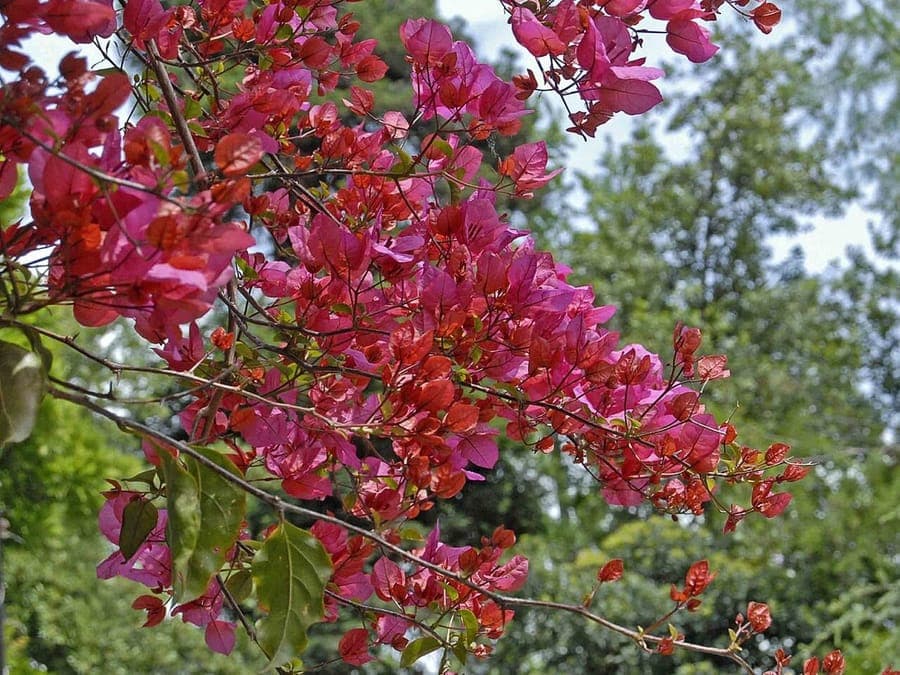
Hectonichus / CC BY-SA 3.0, via Wikimedia Commons
Bougainvillea (Bougainvillea × buttiana): complete guide
Bougainvillea × buttiana
Want to see Bougainvillea (Bougainvillea × buttiana): complete guide in your garden?
Full design in HD: €7.99
Look after your Bougainvillea with the GardenWorld app
Identify plants with your camera and get a care calendar with reminders for this plant.


Overview
Anyone who has walked past a whitewashed wall in Andalucía or Crete smothered in magenta colour has met bougainvillea. In northern Europe this climber will not survive outdoors all year, yet it makes a superb patio plant in a large pot, provided it spends the winter under cover. Bougainvillea × buttiana is one of the best-known groups within the genus. These are hybrids between Bougainvillea glabra and Bougainvillea peruviana, first noticed around 1910 in a garden in Cartagena, Colombia, by a Mrs Butt. The cultivar 'Mrs Butt', also sold as 'Crimson Lake', gave the whole group its name.
Plants in this group are vigorous, generous with their colour and often brighter than either parent. Many of the bougainvilleas sold in garden centres, with bracts in crimson, orange, pink or golden yellow, belong here. They are members of the Nyctaginaceae, the same family as the four o'clock plant. In a container the plant stays manageable at 1.5 to 2.5 m; in a frost-free Mediterranean garden it will happily scramble 6 to 8 m up a wall. On gardenworld.app you can have a garden design drawn up in which a sunny terrace full of pot plants like bougainvillea gets the space it deserves.
Appearance and bloom cycle
What most people call the flowers are actually bracts. Each true flower is small, tubular and creamy white to pale yellow, sitting inside three brightly coloured, papery bracts of 3 to 5 cm. In Bougainvillea × buttiana these bracts tend to be rounder and larger than in Bougainvillea glabra, and they shift colour as they age. A plant that opens orange-red may turn rosy purple a few weeks later. The photo above shows exactly that: red and magenta bracts mingling on the same branches.
The leaves are oval to broadly elliptic, 6 to 10 cm long and fresh green. The stems carry curved thorns of about 1 cm that bite hard, so always wear gloves when handling the plant. In a pot it flowers in flushes from May to October, with a pause of a few weeks between each. A warm, dry spell after a burst of growth triggers the next round of colour.
Position indoors and out
From mid-May to late September bougainvillea wants the hottest spot you have: a south-facing wall, a sheltered terrace or a balcony in full sun. Six to eight hours of direct sunlight a day is the minimum for a good display. In shade it produces long green shoots and very little colour.
Only move the plant outside once night temperatures stay above 10 °C, and give it a week in light shade first so the leaves do not scorch. In a conservatory or heated greenhouse it can stay put all year. A living room is less suitable: in winter it is too warm and too dark there, so the plant drops its leaves and attracts pests.
Compost and containers
Use a free-draining compost for Mediterranean plants, or mix a standard multipurpose compost with a third of coarse grit or clay granules. A pH between 5.5 and 7 suits it well. Put a layer of crocks or granules in the base and make sure the drainage hole is generous, because waterlogged roots rot quickly.
Choose a pot that is not too large. Bougainvillea flowers best when its roots fill the container; in an oversized tub it pours its energy into leaves and stems. Repot only every two to three years, in March, moving up no more than 5 cm in diameter each time. A heavy terracotta pot keeps the plant stable in the wind and lets excess moisture evaporate.
Watering and feeding
Water generously in summer, but only when the top 3 to 4 cm of compost feels dry. On hot days that may mean daily, in cooler weather once a week. A short dry spell after a growth spurt encourages flowering, whereas constantly wet compost does the opposite. Tip away any water still standing in the saucer after half an hour.
Feed every two weeks from April to the end of August with a liquid fertiliser for flowering patio plants, ideally one low in nitrogen and higher in potassium and phosphorus. Too much nitrogen gives long green shoots and few bracts. Yellow leaves with green veins usually point to iron deficiency, which a feed with trace elements will correct. Stop feeding from September.
Free preview
Want to see Bougainvillea (Bougainvillea × buttiana): complete guide in your garden? Make a free preview of your design.
Pruning
Bougainvillea flowers on new growth, so pruning helps rather than hinders. After each flush, cut the faded stems back to two or three pairs of leaves. The plant then pushes out new side shoots that colour up within a few weeks.
Before bringing the plant inside in autumn, cut it back by about a third to a manageable size. That saves space and reduces water loss over winter. The main prune follows in March: remove dead and crossing stems and shorten the longest shoots to 20 to 30 cm. If you want a standard or a pyramid, train the main stems along a sturdy frame or obelisk and tie them in loosely; the plant has no tendrils or aerial roots and simply leans on its thorns for support.
Maintenance calendar
January and February: Rest in a cool, bright spot. Water only when the root ball is almost completely dry.
March: Main prune and repotting if needed. Move the plant somewhere a little warmer, around 15 °C, to start it into growth.
April: Start feeding again and gradually increase watering.
May: From mid-May, once nights stay above 10 °C, move it outside and let it adjust to strong sun.
June to August: Flowering in flushes. Water regularly, feed fortnightly and cut back spent stems.
September: Stop feeding. Check for aphids and red spider mite.
October: Bring the plant in before the first night frost, after trimming it by about a third.
November and December: Keep it cool and bright, and water sparingly.
Overwintering
Bougainvillea × buttiana is not frost hardy. A night just below 0 °C damages leaves and young stems, and a few degrees of frost kill the plant outright. In northern Europe it has to spend winter indoors. The ideal place is bright and cool, between 8 and 12 °C: an unheated conservatory, a frost-free porch or a cool stairwell with a large window.
A dark garage or cellar at 5 to 8 °C will also do, but the plant will then drop all its leaves. That is fine as long as the stems remain green beneath the bark. In that case give hardly any water, a small splash once a month at most. In a warm living room above 18 °C the plant keeps growing weak, pale shoots and becomes prone to mealybug and spider mite.
Toxicity for pets
Bougainvillea does not appear on the ASPCA list of plants toxic to dogs and cats, but it is not entirely harmless. Eating a lot of leaves or bracts can cause vomiting or diarrhoea in dogs, cats and small children. The sap may cause a mild, itchy skin reaction in sensitive people.
The bigger risk is the sharp, hooked thorns. Cats climbing through the branches and dogs chewing the stems can injure their mouths, paws or eyes. Keep the plant away from spots where pets or children play, and clear up prunings straight away. If an animal has eaten part of the plant and seems unwell, contact your vet.
Companion plants
On a sunny terrace bougainvillea and other container plants create a little corner of the Mediterranean. Cape leadwort (Plumbago auriculata), with its sky-blue flowers, contrasts beautifully with magenta bracts. Oleander (Nerium oleander) and African lily (Agapanthus africanus) share the same need for sun and a cool, bright winter home. Lantana (Lantana camara) and Chinese hibiscus (Hibiscus rosa-sinensis) add yellow, orange and red to the palette.
Its relative Bougainvillea glabra, a little less flamboyant but slightly tougher, sits well alongside. Smaller pots of lavender and rosemary around the base bring scent and a green underlayer. Keep thirsty plants such as hydrangeas well away, as their watering needs clash with those of bougainvillea.
Final thoughts
Bougainvillea asks for a little more attention than an ordinary patio plant, but repays you with months of colour that few other container plants can match. Remember three rules: full sun in summer, a snug pot with dry spells between waterings, and a cool, bright place indoors for winter. Stick to those and within a few years you will have a sturdy plant that turns red and purple every summer.
The plant calendar on gardenworld.app gives you a monthly reminder for bringing plants in, pruning and moving them out again, so an early frost never catches your bougainvillea off guard. Start this spring with a single plant in a terracotta pot against your sunniest wall and watch Bougainvillea × buttiana transform your patio.
Frequently asked questions about Bougainvillea
When and how do you prune Bougainvillea?
Bougainvillea flowers on new growth, so pruning helps rather than hinders. After each flush, cut the faded stems back to two or three pairs of leaves.
How much water does Bougainvillea need?
Water generously in summer, but only when the top 3 to 4 cm of compost feels dry. On hot days that may mean daily, in cooler weather once a week.

See it in your garden
See Bougainvillea in your garden
One photo of your garden and a few questions. You see the result in about a minute.
Try it with a photoIdentify this plant in your own garden. Identify a plant
Similar plants
Bougainvillea: complete guide
Bougainvillea glabra
Grow stunning bougainvillea with our complete guide. Learn soil, sunlight, watering tips and how to care for this dramatic flowering vine year-round.
Plumbago: complete guide
Plumbago auriculata
Discover everything about Plumbago auriculata: care instructions, growth habits, appearance, and how to successfully grow this stunning climbing plant in your garden.
Oleander: complete guide
Nerium oleander
Oleander (Nerium oleander) brings Mediterranean elegance to warm gardens. Growing, propagation, toxicity awareness, and container care.
