
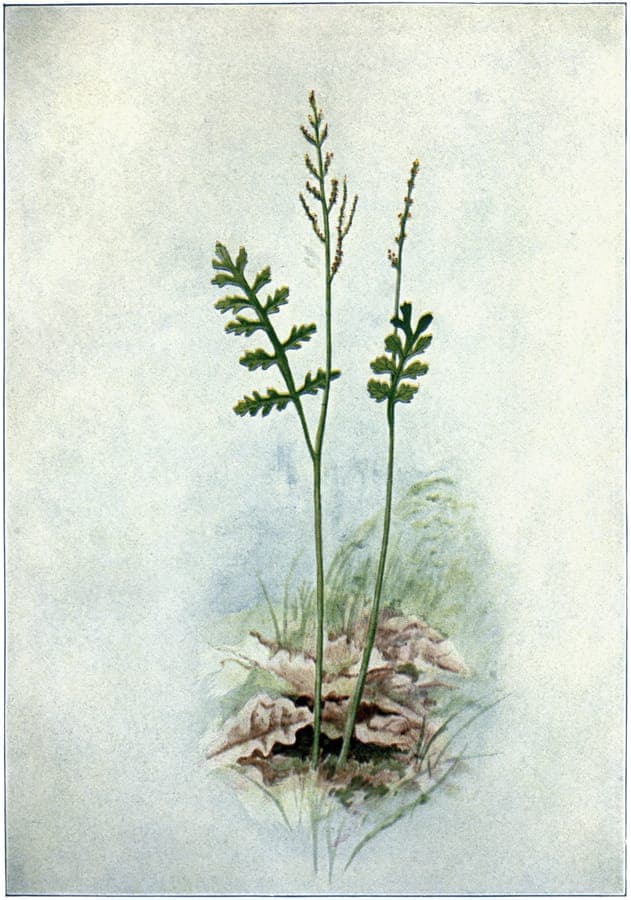
Willard Nelson Clute (writer) & William Walworth Stilson (illustrator) / Public domain, via Wikimedia Commons
Botrychium matricariifolium: complete guide
Botrychium matricariifolium
Want to see Botrychium matricariifolium: complete guide in your garden?
1 minute, no credit card
Overview
Botrychium matricariifolium, commonly called daisy-leaf grape fern, branched moonwort, or daisy-leaf moonwort, is a small, rare fern native to North America and Europe. This species belongs to the Ophioglossaceae family and is distinguished by its delicate, daisy-like foliage and distinctive reproductive structures. The plant grows in moist, partially shaded woodland settings and is less common than related moonwort species.
Botrychium matricariifolium is a frost-hardy, native fern suitable for shade gardens and natural woodland restoration projects, though cultivation remains challenging.
Appearance and characteristics
Botrychium matricariifolium is an extremely small fern, typically only 10-30 centimeters tall. The plant grows in clusters of 1-3 fronds per crown. The most striking feature is its division into two completely different segments: sterile and fertile.
Sterile segment: This portion is green and leaf-like, with finely branched divisions resembling chamomile leaves, hence the scientific name "matricariifolium." The foliage is deeply divided and gives the plant a delicate, lacy appearance.
Fertile segment: This reproductive structure grows above the sterile segment. It consists of a branched spike with numerous sporangia (spore-containing cases). This fertile portion is typically brownish-yellow.
Roots: The plant has short, dark rootlets that grow in surface soil layers.
Ideal location
Botrychium matricariifolium thrives only in specific conditions:
- Shade: Partial to full shade is essential
- Habitat: Woodland settings, preferably under deciduous trees
- Humidity: Moist environment is critical
- Temperature: Cooler climates strongly preferred
- Protection: Sheltered woodland edges ideal
Soil
Soil is critical for this delicate fern:
- Rich, humus-laden, nutrient-rich soil
- Well-draining yet moisture-retentive
- Acidic to neutral pH (5.5-7.0)
- High organic matter content
- Forest soil with abundant leaf litter ideal
Recommendation: Amend soil liberally with leaf mold and aged compost.
Watering
Watering requires careful attention:
- Consistent moisture essential
- Soil must never completely dry out
- Foliage misting helps during dry periods
- Summer drought weakens the plant
- Winter moisture crucial in cold climates
Free design
Want to see Botrychium matricariifolium: complete guide in your garden? Make a free design now.
Growth patterns
Botrychium matricariifolium has an unconventional growth cycle:
- Young fronds emerge in spring
- Growth is exceedingly slow; plants take multiple seasons to mature
- Spore ripening occurs in summer/fall
- Spores are released in autumn
Note: Propagation from spores is exceptionally difficult; most spores are non-viable.
Maintenance calendar
March-April: Plant emerges from winter dormancy. Moisture monitoring essential.
May-June: Vegetative growth. Fronds expand. No fertilizing needed.
July-August: Reproductive structures mature. Fertile segment develops.
September-October: Spores ripen. Plant begins senescence.
November-February: Plant dormant. Minimal moisture provision.
Winter hardiness
Botrychium matricariifolium is highly frost-hardy:
- USDA hardiness zones: 3-8
- Tolerates temperatures down to -30 degrees Celsius
- Snow provides protection against extreme cold
- Excellent for northern climates
Conservation status
This fern has concerning rarity in many regions:
- Listed as rare in Great Britain
- Extinct in Netherlands and Belgium
- Still relatively common in North America
- Protected in some European countries
- Removal from wild not recommended
Companion plants
Botrychium matricariifolium thrives with:
- Other woodland ferns (Phyllitis, Dryopteris)
- Shade plants (Helleborus, Hepatica)
- Groundcover plants (Ajuga, Vinca minor)
- Hosta and other shade-tolerant species
- Moss-rich gardens
Propagation
Propagation is problematic:
- Spores have very specific germination requirements
- Most spores are non-viable
- Cultivation from spores is virtually impossible
- Growth from spores is extremely slow
- Commercially available plants are rarely seen
Recommendation: Purchase only from established growers. Harvesting from wild is unethical and illegal in many countries.
Final thoughts
Botrychium matricariifolium is a fascinating, frost-hardy fern for specialized woodland gardens. Though exceptionally rare and challenging to cultivate, it offers unique botanical interest. For serious fern collectors, it can be a rewarding addition, but only when sourced from sustainable growers. Its preference for moist, woodland-rich environments with acidic soil means this plant requires carefully managed habitat. Respect for this rare species and its natural occurrence is crucial for its conservation.
Want to see Botrychium matricariifolium: complete guide in your garden? Make a free design now.
Upload a photo, pick a style, and get a photorealistic design with plant list in under a minute.
10,000+ gardens designed already
No credit card required


Similar plants
Azores Adderstongue: complete guide
Ophioglossum azoricum
Ophioglossum azoricum is a rare fern from Europe and Macaronesia. Learn how to cultivate this delicate, moisture-loving fern in shaded gardens.
Northern moonwort: complete guide
Botrychium boreale
Northern moonwort (Botrychium boreale), also called boreal moonwort, is a rare fern from northern regions with distinctive moon-shaped leaflets. Discover cultivation and care tips.
Botrychium virginianum: complete guide
Botrychium virginianum
Discover the enchanting grape fern, a rare botanical gem with unique bifid structure and spore clusters. Perfect for shade gardeners and collectors.