
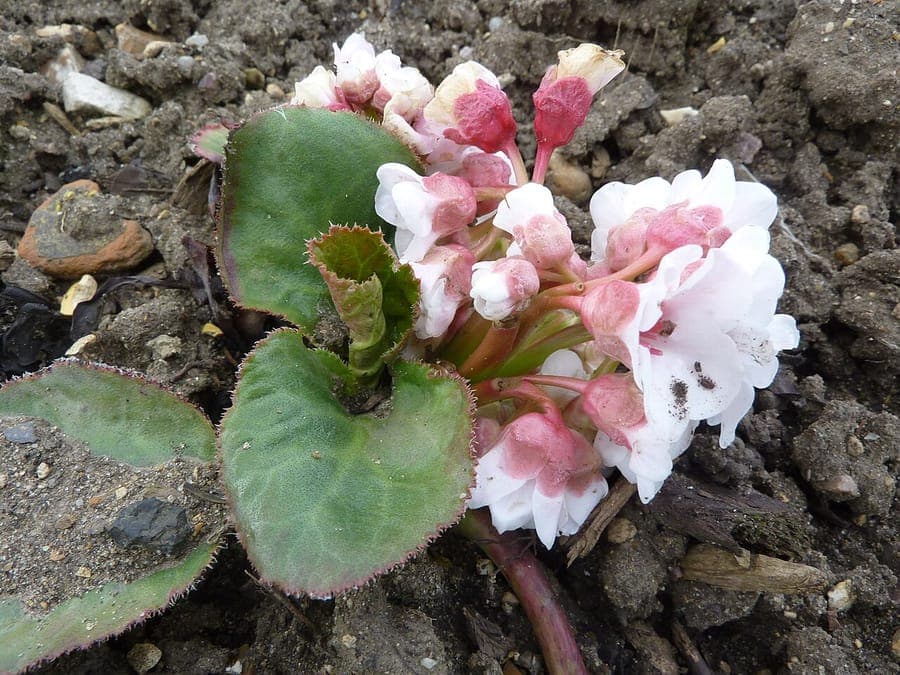
Magnus Manske / CC BY-SA 3.0, via Wikimedia Commons
Bergenia ciliata: complete guide
Bergenia ciliata
Want to see Bergenia ciliata: complete guide in your garden?
1 minute, no credit card
Overview
Bergenia ciliata, also known as hairy bergenia or Kashmir bergenia, is a semi-evergreen, succulent-leaved plant from the mountainous regions of Nepal and the Himalaya. This self-sufficient plant is celebrated for its enormous, hairy-fringed leaves and striking pink flowers that appear early in spring. Bergenia species are ideal shade plants that add natural, woodland charm and provide early season color.
Appearance and Bloom
Bergenia ciliata forms a compact, ground-covering plant with massive, deeply undulating leaves (up to 30 cm) that are distinctly hairy on the undersides, earning the plant its common name. The leaves discolor in autumn and winter to deep red or purple, providing year-round interest. Flowers appear early in spring (February-April) in stiff clusters of pink to magenta florets above the foliage. The flower stems remain decorative even after the flowers fade.
Ideal Location
Plant Bergenia ciliata in half-shade to full shade. The plant tolerates full sun but thrives best with afternoon shade. Perfect for the base of trees, under shrubs, or alongside shaded walls. Provide protection from intense low winter sun that can cause leaf bleaching. Wind is generally not problematic.
Soil
Bergenia ciliata prefers nutrient-rich, well-draining soil but is surprisingly adaptable. Sandy loam enriched with organic matter works well. Poorly drained heavy clay is best avoided; amend with compost to improve structure. Soil pH can be neutral to slightly acidic. The plant tolerates poor soils, though rich soils produce better growth.
Watering
On moisture-rich, well-draining soil, established Bergenia ciliata is fairly drought-tolerant. In drier conditions, especially in shade, regular water is essential, particularly during growing seasons. Avoid summer drought stress. Prevent waterlogging, which causes root rot. Winter requires less water.
Free design
Want to see Bergenia ciliata: complete guide in your garden? Make a free design now.
Pruning
Pruning is rarely needed for Bergenia ciliata. Remove unsightly or damaged leaves, especially in spring to make way for new growth. Old flower stems can be removed for a neat appearance, though they remain interesting. Allowing the plant to grow naturally usually yields the best effect.
Maintenance Calendar
January-February: Enjoy winter foliage, inspect for leaf damage. March-April: Flowers may appear, minimal maintenance. May-June: New leaf growth, add compost for nutrition. July-August: Ensure sufficient moisture, water if needed. September-October: Enjoy autumn foliage, stop feeding. November-December: Minimal maintenance, protect from extreme cold.
Winter Hardiness
Bergenia ciliata is extremely hardy, tolerating temperatures to -15degC or lower, though leaves may freeze in very severe winters. Since foliage can suffer heavy night frost damage, protecting winter leaves is beneficial. The plant typically recovers well, and in slightly warmer regions (above -5degC) foliage remains green.
Companion Plants
Excellent companions for Bergenia ciliata:
- Ivy (Hedera, for shade-tolerant under-planting)
- Moss (for texture contrast)
- Small beech shrubs (for structure)
- Ferns (for delicate frond contrast)
- Hostas (for leaf-size variation)
Closing
Bergenia ciliata is a valuable shade-lover that provides benefits year-round: large, architectural leaves, early spring flowers, and winter interest. Plant sweeps of this self-sufficient species for endless garden pleasure.
Garden centers across the UK stock healthy specimens. Create your own bergenia planting design using gardenworld.app/en!
Want to see Bergenia ciliata: complete guide in your garden? Make a free design now.
Upload a photo, pick a style, and get a photorealistic design with plant list in under a minute.
No credit card required


Similar plants
Korean astilbe: complete guide
Astilbe grandis
Discover Korean astilbe (Astilbe grandis): a tall shade plant with elegant flower plumes for pond edges and borders.
Heuchera pilosissima: complete guide to seaside alumroot
Heuchera pilosissima
Seaside alumroot (Heuchera pilosissima), an elegant North American dwarf perennial with hairy red-tinged foliage and red flower spikes.
Starry saxifrage: complete guide
Micranthes stellaris
Full guide to Micranthes stellaris, the starry saxifrage: location, soil, blooming and garden use. A tough alpine plant for moist, shady rock faces and pond margins.