
Stemonitis / CC BY-SA 3.0, via Wikimedia Commons
Starry saxifrage: complete guide
Micranthes stellaris
Want to see Starry saxifrage: complete guide in your garden?
1 minute, no credit card
Overview
Starry saxifrage (Micranthes stellaris (L.) Galasso, Banfi & Soldano) is a compact, low-growing rock plant from the saxifrage family (Saxifragaceae). Until 2005 it was classified within the genus Saxifraga and widely known as Saxifraga stellaris L. - a name still found in many older garden books and herbarium records. The genus revision, undertaken by Galasso, Banfi and Soldano using molecular phylogenetic data, transferred this and several related species to the closely allied genus Micranthes.
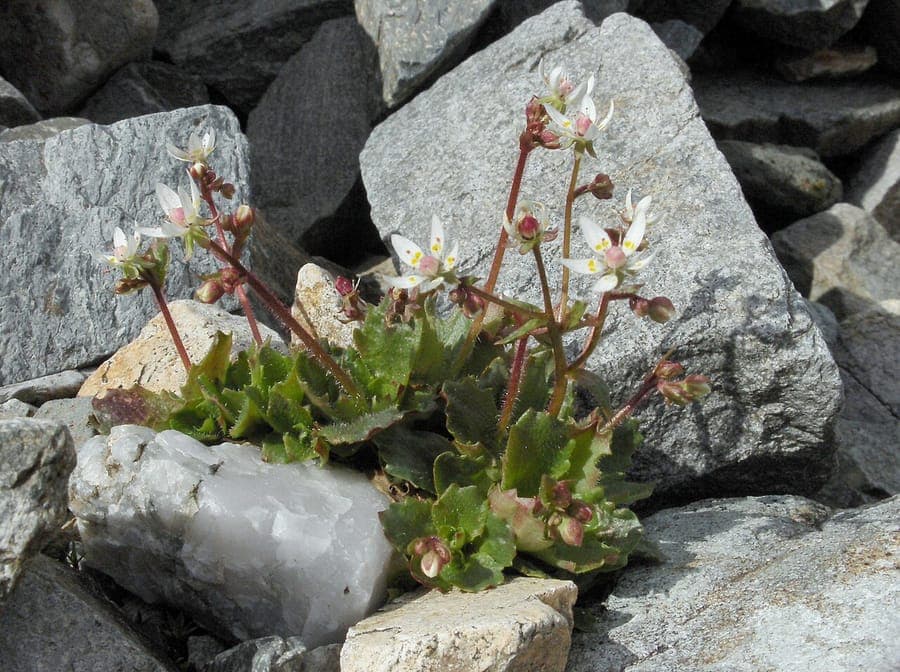
The specific epithet 'stellaris' refers to the star-shaped pattern of the flowers: each bloom has five narrow white petals surrounding prominent red styles and yellow anthers. In French the plant is called 'saxifrage etoilee' (star saxifrage), in Swedish 'stjarnbracka', and in English, simply, 'starry saxifrage'.
The natural distribution of starry saxifrage covers northern and north-eastern Europe, the Alps and mountainous areas of central and south-eastern Europe, and parts of Arctic North America (Labrador, Quebec, Nunavut, Greenland). In the UK it is a well-known native of upland streams, wet cliff ledges and alpine flushes from Scotland and the Lake District to Wales and Ireland. In the Netherlands and Belgium it is absent or very rare in the wild but grows successfully in cultivation. Garden designs for shady, moisture-rich gardens and naturalistic water features on gardenworld.app show how this plant can be used to charming effect.
Appearance and bloom cycle
Starry saxifrage forms compact rosettes 5 to 15 cm tall. The leaves are oval to spatula-shaped, slightly leathery, with toothed margins, and mid to dark green. The leaf tips and margins are sometimes tinged reddish. The upper surface is glossy with a faintly sunken midrib.
From June to August - depending on altitude and local climate - slender flower stems 10 to 25 cm tall arise from the rosettes. The stems are pinkish to reddish and branched near the top, each branch ending in a small cluster of five to ten flowers. Each individual flower is star-shaped, white with red styles and yellow anthers, measuring 8 to 12 mm across. The petals are narrow and distinctly separated, emphasising the star form.
After flowering the plant produces small capsules containing numerous tiny seeds. The flowers attract small hoverflies, solitary bees and small butterflies. The plant also spreads vegetatively via offsets and small side rosettes.
Ideal location
Starry saxifrage is quintessentially a plant of cool, moist, north-facing rock faces, mountain streams and wet alpine grassland. In the garden it thrives in a half-shaded to fully shaded position with high atmospheric moisture.
Particularly suitable positions include:
- The moist margin of a pond or stream, especially on the north-facing side
- A shaded rock crevice or wall joint with constantly seeping water
- A sunken border or north-facing container in a cool spot
- An alpine garden with consistently cool, moist conditions
The plant tolerates neither drought nor full sun in warm conditions. Heat is its principal enemy. In the cool, oceanic climate of the British Isles and north-western Europe it is far easier to grow than in continental regions, provided the position remains cool and moist throughout summer. Garden designs for naturalistic, shaded gardens on gardenworld.app demonstrate how starry saxifrage integrates with other moisture-loving plants.
Soil
Starry saxifrage has specific soil requirements. In nature it grows on acidic to mildly acidic, humus-rich rocky soil (pH 6.5 to 7.0) with a constant supply of moisture. A nutrient-poor to moderately fertile substrate is ideal: on excessively rich soil the rosettes become too large and loose.
In the garden, a suitable growing medium consists of:
- 2 parts coarse, acidic leafmould or forest compost
- 1 part fine grit or crushed slate for drainage
- 1 part river sand
Constant moisture at the root zone is essential, but standing water must never be allowed to accumulate. A free-draining yet moisture-retentive structure - comparable to a permanently moist moss mat - is ideal.
Avoid lime-rich soils: starry saxifrage is calcifuge (lime-hating) and grows almost exclusively on acidic rocks such as granite, slate and gneiss in nature.
Free design
Want to see Starry saxifrage: complete guide in your garden? Make a free design now.
Watering
Consistent soil moisture is the single most important factor in successfully growing starry saxifrage. In its native habitat it grows beside mountain streams, on waterlogged rock ledges and in wet alpine grassland. It never tolerates complete drying out of the root zone.
In garden cultivation this means regular watering, particularly during dry summer spells. At a pond margin or in a constantly moist, shaded bed, supplementary watering is limited. In containers, daily watering may be necessary during warm periods.
Use soft water - rainwater or decalcified tap water - to avoid lime accumulation in the soil. Hard tap water raises soil pH over time and will gradually harm the plant. Use a fine-droplet watering can to avoid displacing rosettes.
In dry, freezing winters, a little moisture at the root zone prevents desiccation. Cold alone does not harm this plant, but cold combined with drying winds can damage the rosettes.
Pruning
Starry saxifrage requires minimal maintenance. The main intervention is removing spent flower stems after flowering in July and August. This keeps the rosettes compact and prevents unnecessary energy expenditure on seed production at the expense of vegetative spread.
Occasionally remove damaged or aged outer leaves from rosettes throughout the season. This improves air circulation and reduces the risk of fungal issues in damp conditions.
The plant self-multiplies freely via small side rosettes growing on short runners. In spring or autumn you can gently detach these and replant elsewhere. This quickly builds an attractive low mat or colony of starry saxifrage along a pond edge or in rock garden crevices.
Maintenance calendar
January-February: Dormant. Rosettes are low-growing and may be partially hidden. In severe frost, protect with a light covering of pine needles. Do not seal completely: air circulation is needed.
March-April: New leaves begin to expand. Remove winter protection as overnight frosts diminish. Detach and replant side rosettes if required.
May-June: Rapid growth. Maintain consistent moisture. First flower stems begin to appear from late May.
July-August: Full flowering. Enjoy the white starry blooms. Remove spent flower stems promptly after flowering.
September: New side rosettes are produced. Ideal period for division and replanting in mild areas.
October-November: Growth slows. Apply a light mulch of coarse compost or pine needles around the root zone.
December: Dormant. Keep root zone lightly moist during frost-free periods.
Winter hardiness
Starry saxifrage is highly frost-tolerant. As a native of subarctic and alpine regions - from Greenland and Iceland to northern Russia, and from the Norwegian coastal mountains to the Alps - it withstands severe frost and deep snow cover without difficulty. It falls in USDA hardiness zones 3 to 6, making it one of the hardiest perennials available for northern gardens.
In British, Dutch and Belgian winter conditions - moderate frost with relatively little snow cover - it is entirely reliable. The principal winter threat is not cold itself but a combination of dry, bitter wind and frozen soil that desiccates the rosettes. A sheltered position or a light covering of pine needles that shields rosettes from drying wind is entirely sufficient protection.
Late spring frosts after warm spells may damage young flower stems, but the rosettes themselves recover without difficulty. Visit gardenworld.app for more information on frost-tolerant shade plants for the garden.
Companion plants
Starry saxifrage combines most naturally with other moisture-loving and shade-tolerant plants. Classic combinations include:
- Alongside other Saxifraga species such as Saxifraga aizoides (yellow mountain saxifrage) for a varied, flower-rich rock garden
- With blue lobelia (Pratia pedunculata) as a low spreading carpet
- Next to small moisture-loving ferns such as hard shield fern (Polystichum aculeatum) or hard fern (Blechnum penna-marina)
- With water mint (Mentha aquatica), marsh marigold (Caltha palustris) and watercress (Nasturtium officinale) at pond margins
- In combination with cuckoo flower (Cardamine pratensis) and lesser marshwort (Apium inundatum) for a wet wildflower planting
Avoid combining with drought-tolerant Mediterranean or steppe plants: their water requirements are entirely incompatible with starry saxifrage. Look for it at specialist alpine nurseries or rock garden plant suppliers in the UK and the Netherlands.
Closing thoughts
Starry saxifrage is a small but superbly elegant plant for the cool, moist corner of the garden. Its white, star-shaped flowers from June to August above compact green rosettes make a delightful summer display, particularly along pond margins and in shaded rock plantings. It is robust, cold-tolerant to arctic conditions and asks only for constant moisture and shade from strong summer sun.
Whether you are planting a naturalistic pond margin, a shaded rock garden or an alpine plant combination, starry saxifrage deserves a permanent place. Visit gardenworld.app for garden designs that show how to use this and other exceptional small perennials to their full effect.
Want to see Starry saxifrage: complete guide in your garden? Make a free design now.
Upload a photo, pick a style, and get a photorealistic design with plant list in under a minute.
10,000+ gardens designed already
No credit card required


Similar plants
Meadow saxifrage: complete guide
Saxifraga granulata
Complete care guide for meadow saxifrage (Saxifraga granulata): ideal for rockeries, bloom cycle, soil needs, and winter hardiness in USDA zones 4-9.
Mossy saxifrage: complete guide
Saxifraga hypnoides
Complete care guide for mossy saxifrage (Saxifraga hypnoides): fine moss-like foliage, pink flowers, alpine rockeries, and hardiness in USDA zones 4-9.
Yellow mountain saxifrage: complete guide
Saxifraga aizoides
Discover yellow mountain saxifrage, a beautiful alpine plant for rock gardens. Growing tips for this hardy mountain dweller.