
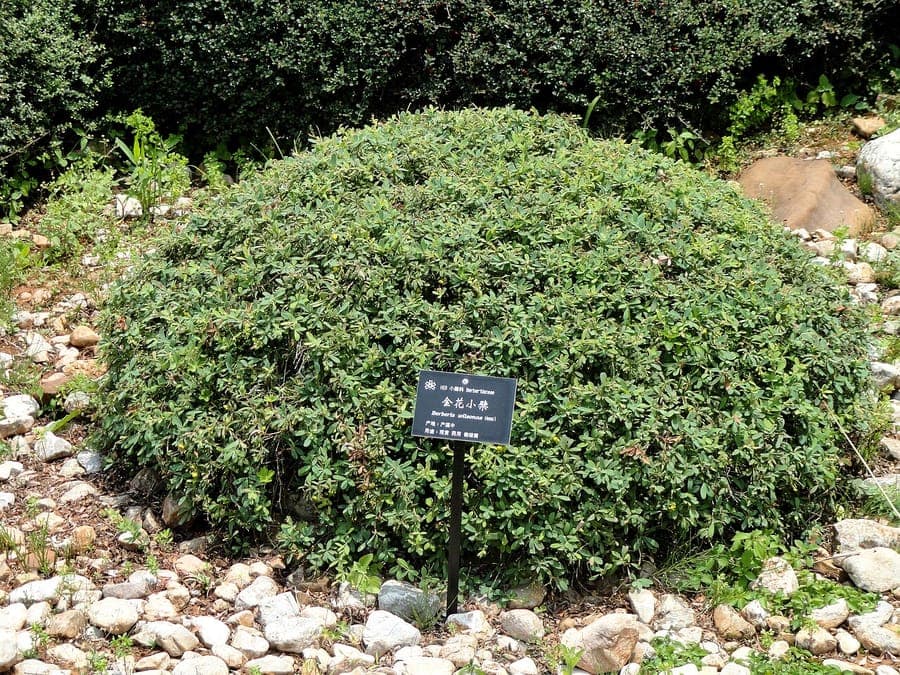
Daderot / Public domain, via Wikimedia Commons
Berberis wilsoniae: complete guide
Berberis wilsoniae
Want to see Berberis wilsoniae: complete guide in your garden?
1 minute, no credit card
Overview
Berberis wilsoniae, commonly called Mrs Wilson's Barberry or Wilson Barberry, is an elegant thorny shrub from Southeast Tibet to South-Central China and northern Myanmar. This semi-deciduous to deciduous shrub is renowned for its fine branching, graceful growth habit, and stunning red berries. With its spiny branches, it's an excellent choice for hedging and defensive landscape design.
Appearance and bloom
Wilson's Barberry forms an attractive, loosely structured shrub of 1.5-2 meters tall. Leaves are small, narrowly lance-shaped, typically finely serrated and develop beautiful red tones in autumn. Small yellow flowers appear in spring in compact clusters, followed by bright red, oval berries that are highly ornamental in fall. Berries persist on branches throughout autumn.
Ideal location
Berberis wilsoniae thrives in full sun to light shade. At least 4-6 hours of direct sunlight promotes better flowering and fruiting. In full shade, the plant grows but becomes less dense. The shrub tolerates wind exposure well and suits open garden locations. Sheltered placement is appreciated but not essential.
Soil
This barberry grows in well-draining soil but is quite adaptable. Heavy clay soil can be amended with sand or organic matter. The plant accepts moderately fertile soil. pH may be neutral to slightly alkaline. Good drainage is more important than nutrient richness.
Watering
Once established, Berberis wilsoniae tolerates drought well. During the first year of growth, water regularly to establish deep roots. Later, water only during very dry spells. The plant tolerates both very dry and fairly wet conditions well, as long as waterlogging doesn't occur.
Free design
Want to see Berberis wilsoniae: complete guide in your garden? Make a free design now.
Pruning
Pruning after flowering helps keep the shrub compact. Remove dead or damaged branches in early spring. For hedging applications, regular pruning can be performed. Take care with sharp thorns when pruning; gloves are essential. Natural growth can also be attractive.
Maintenance calendar
Winter: Prune for shape; remove dead wood. Spring: Feeding may be applied; growth begins. Summer: Occasional watering during dry spells. Autumn: Berries ripen; enjoy color changes; minimal maintenance.
Winter hardiness
Berberis wilsoniae is extremely cold-hardy to approximately -15 degrees Celsius. The plant grows well in temperate climates of Europe and North America. In very harsh climates, some wind protection may help. The plant is highly durable and can thrive for decades.
Companion plants
Wilson's Barberry pairs beautifully with other autumn-interest plants. The red berries contrast strikingly with yellow and green foliage of neighbors. The thorny structure provides valuable wildlife protection. For garden design inspiration, visit gardenworld.app/en for personalized designs featuring hedges and screen plantings.
Closing
Berberis wilsoniae is a classic choice for durable and attractive garden screens. With minimal maintenance and years of visual interest, it's a valuable addition. For personalized hedge and woodland planting concepts, visit gardenworld.app/en for expert designs.
Want to see Berberis wilsoniae: complete guide in your garden? Make a free design now.
Upload a photo, pick a style, and get a photorealistic design with plant list in under a minute.
No credit card required


Similar plants
Heavenly bamboo: complete guide
Nandina domestica
Everything about heavenly bamboo (Nandina domestica): planting, pruning, hardiness, and colour impact. Note: berries are toxic to birds and pets.
Colorado barberry: complete guide
Berberis fendleri
Everything about Berberis fendleri, the Colorado barberry with yellow flowers and red berries. Perfect as a thorny hedge or specimen shrub in dry gardens.
Jeffersonia diphylla: complete guide
Jeffersonia diphylla
Discover Twinleaf, a charming woodland plant from North America. White flowers, unique foliage, perfect for shady borders.