
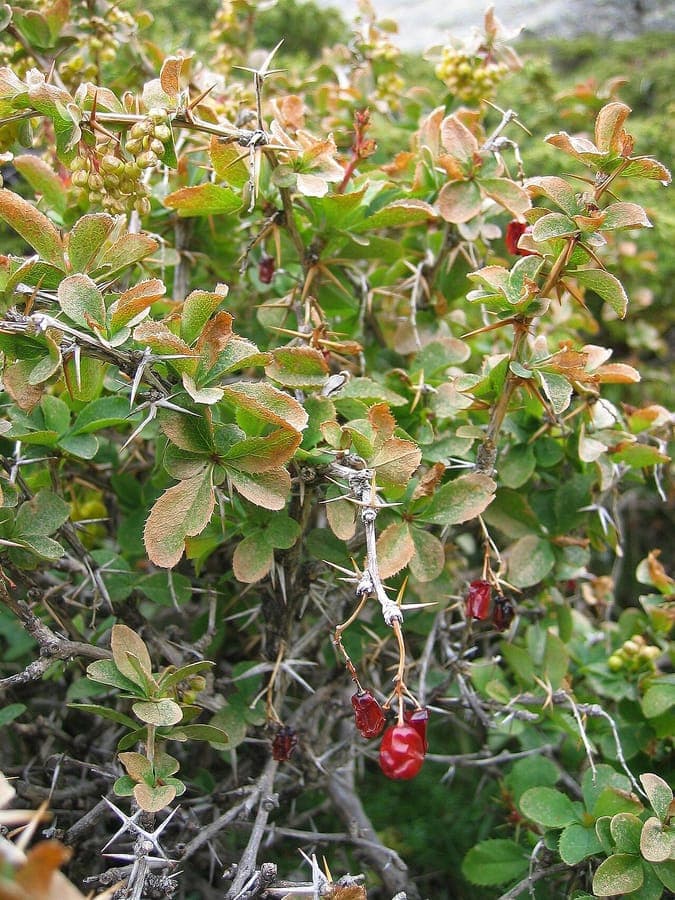
User:Tigerente / CC BY-SA 3.0, via Wikimedia Commons
Berberis aetnensis: complete guide
Berberis aetnensis
Want to see Berberis aetnensis: complete guide in your garden?
1 minute, no credit card
Overview
Berberis aetnensis, known as Mount Etna barberry or Sicilian barberry, is an elegant shrub native to the mountainous regions of Sicily, Sardinia, Corsica, and southern Italy. This species belongs to the Berberidaceae family and takes its name from Mount Etna where it naturally grows on Sicily. With its acid-loving nature, bright yellow flowers, and glossy red berries, it makes a distinguished addition to Mediterranean and rock gardens.
Berberis aetnensis is a frost-hardy, long-lived shrub that provides years of color with minimal maintenance once established.
Appearance and bloom
Berberis aetnensis forms a compact, upright shrub reaching 1-2 meters at maturity. The branching stems are armed with sharp, yellow spines covering the entire plant. Foliage consists of small, narrow leaves that are deep green with a subtle glossy finish.
Flowers: The plant produces bright yellow flowers in May and June. These small, prolific flowers appear in clusters along the branches and attract pollinators. The warm yellow color stands out beautifully against dark green foliage.
Berries: Following flowers, glossy red to dark red berries develop. These attractive fruits persist well into autumn and provide food for birds.
Ideal location
Berberis aetnensis requires abundant sunlight for optimal flowering and berry production:
- Full sun: Ideally 6-8 hours of direct sun daily
- Partial shade: Tolerates 4-5 hours of sun, but with reduced flowering
- Shade: Avoid; plants become leggy and non-flowering
- Wind tolerance: Extremely wind-hardy; excellent for exposed sites
Soil
This is where Berberis aetnensis truly excels - it thrives in acidic conditions:
- Acid soils (pH 5.5-6.5)
- Well-draining, poor soils
- Avoids alkaline soils
- No supplemental fertilizing needed; actually performs better without it
- Naturally grows in rocky, infertile mountain soils
Recommendation: Plant in natural, unfertilized soil for best results. Over-feeding reduces flowering.
Free design
Want to see Berberis aetnensis: complete guide in your garden? Make a free design now.
Watering
Once established, this shrub is exceptionally drought-tolerant:
First year after planting:
- Water regularly during growing season
- Ensure soil does not completely dry out
- Gradually reduce watering as plant establishes
Established plants:
- Highly drought-tolerant; minimal watering needed
- Water only during extreme drought
- Tolerates low rainfall areas
Summer:
- Infrequent watering; excess moisture promotes root rot
Pruning
Pruning is minimal:
- Plant grows naturally compact and orderly
- Remove dead or damaged wood in early spring
- Light pruning after flowering to maintain shape
- Avoid heavy pruning; recovery is slow
- Use sharp pruners for clean cuts
Maintenance calendar
January-February: Inspect for winter damage. Remove dead branches.
March-April: Growing season begins. Monitor watering. New leaf growth emerges. Set young plants for growth.
May-June: Peak flowering. Bright yellow blooms appear. Minimal maintenance needed.
July-August: Berries begin forming. Reduce watering to minimal. Summer rest.
September-October: Berries ripen to dark red. Plant prepares for dormancy.
November-December: Berries remain attractive. Plant enters dormancy.
Winter hardiness
Berberis aetnensis exhibits excellent cold resistance:
- USDA hardiness zones: 6-9 (possibly zone 5 in protected sites)
- Tolerates temperatures down to -15 degrees Celsius
- Foliage remains intact through winter in most climates
- Snow provides protection against extreme cold
- Excellent for northern European gardens
Companion plants
Berberis aetnensis pairs well with:
- Other Mediterranean shrubs (Helianthemum, Cistus)
- Aromatic plants (Rosemary, Lavender)
- Rock garden plants (Alpine phlox, Dianthus)
- Dwarf conifers
- Other Berberis species
- Alpine garden plants
Final thoughts
Berberis aetnensis is a frost-hardy, low-maintenance shrub that adds exceptional interest to gardens. With yellow spring flowers, bright red berries, and compact growth, it delivers visual rewards year after year. This Mediterranean treasure is ideal for water-wise, drought-tolerant gardens. Source quality plants from reputable nurseries and plant in full sun with well-drained acidic soil for best results.
Want to see Berberis aetnensis: complete guide in your garden? Make a free design now.
Upload a photo, pick a style, and get a photorealistic design with plant list in under a minute.
No credit card required


Similar plants
Heavenly bamboo: complete guide
Nandina domestica
Everything about heavenly bamboo (Nandina domestica): planting, pruning, hardiness, and colour impact. Note: berries are toxic to birds and pets.
Colorado barberry: complete guide
Berberis fendleri
Everything about Berberis fendleri, the Colorado barberry with yellow flowers and red berries. Perfect as a thorny hedge or specimen shrub in dry gardens.
Jeffersonia diphylla: complete guide
Jeffersonia diphylla
Discover Twinleaf, a charming woodland plant from North America. White flowers, unique foliage, perfect for shady borders.