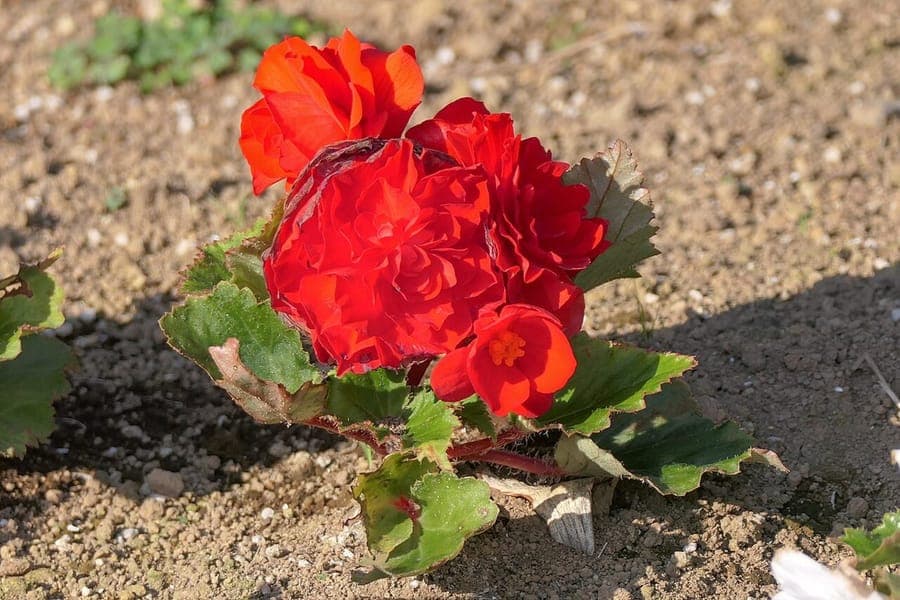
MaedaAkihiko / CC BY-SA 4.0, via Wikimedia Commons
Tuberous begonia: complete guide
Begonia × tuberhybrida
Want to see Tuberous begonia: complete guide in your garden?
Full design in HD: €7.99
Look after your Tuberous begonia with the GardenWorld app
Identify plants with your camera and get a care calendar with reminders for this plant.


Overview
The tuberous begonia (Begonia × tuberhybrida) is a fixture of every bulb catalogue and a reliable choice for shady patios, balconies and borders. Anyone who has looked closely at a fully double tuberous begonia understands its appeal: the flowers resemble small roses or camellias and, in the large-flowered types, can measure more than 10 cm across.
Begonia × tuberhybrida is not a wild species but a group of hybrids developed from the 1860s onwards in England, Belgium and France from Andean species such as Begonia boliviensis, Begonia pearcei and Begonia veitchii. That origin in cool, moist mountain forests tells you exactly what the plant wants: mild temperatures, light shade and soil that stays moist without becoming waterlogged. Belgian growers, particularly around Ghent, long played a leading role in breeding and tuber production.
The plant grows from a flat, brown tuber that you bring back into growth each spring. After summer the foliage dies down and the tuber can be stored somewhere frost-proof, so a single tuber lasts for years. Wondering where tuberous begonias would look best in your own garden? On gardenworld.app you can have a garden design made that takes the shady spots in your garden into account.
There are three main groups. Large-flowered cultivars carry big, double, rose- or camellia-like blooms, sometimes with a contrasting edge (picotee) or frilled petals. The Multiflora group stays more compact, with smaller but more numerous flowers, and copes with a little more sun. Trailing tuberous begonias (Pendula group) have long, cascading stems and are ideal for hanging baskets.
Appearance and bloom cycle
Tuberous begonias grow 20 to 40 cm tall, while trailing forms have stems up to 50 cm long. The stems are succulent, flushed red and fairly brittle. The leaves are lopsided and heart-shaped with a pointed tip, toothed at the edges and 10 to 20 cm long, glossy mid-green or bronze-green, sometimes edged with red.
The plant is monoecious, carrying both male and female flowers. The large, double blooms you admire are the male flowers. Beside them there are often two smaller, single female flowers with a three-winged ovary behind the petals. The photo shows exactly this: a young plant with large, double red flowers and one smaller single bloom with a yellow centre.
The colour range covers red, orange, apricot, yellow, pink, salmon and white, plus bicolours. Flowering runs from June until the first frost, usually in October. If you want the very biggest blooms, pinch out the small female flowers as soon as they appear, so all the energy goes into the male flower.
Ideal location
Tuberous begonias like dappled or partial shade: a spot with morning sun and shade at midday, or filtered light beneath trees. Strong midday sun scorches the leaves and bleaches the flowers. Multiflora types tolerate a little more sun than the large-flowered ones.
Shelter matters just as much. Wind and heavy rain snap the brittle stems and damage the large flowers. A sheltered patio, a balcony under an overhang or a corner between walls and shrubs is ideal. Only plant outdoors after mid-May, when there is no further risk of frost, spacing plants 25 to 30 cm apart.
Soil requirements
In pots use an open, humus-rich compost with a slightly acidic pH between 5.5 and 6.5. A good multipurpose compost mixed with some perlite or grit lets excess water drain away. A layer of clay pebbles or crocks in the bottom of the pot helps too.
In the ground the plant needs loose, humus-rich soil that holds moisture but never becomes boggy. Work a few spadefuls of compost or leaf mould into the top 20 cm. On heavy clay that stays wet the tubers soon rot, so there it is better to grow them in pots or a raised bed.
Free preview
Want to see Tuberous begonia: complete guide in your garden? Make a free preview of your design.
Watering and feeding
Keep the compost evenly moist, but never wet. Water when the top 2 cm feels dry, and water the soil rather than the tuber or the leaves: water sitting in the hollow on top of the tuber causes rot. Wet foliage in the evening increases the risk of powdery mildew and grey mould, so water in the morning if you can.
From June to the end of August give a liquid feed for flowering plants every 10 to 14 days, or a high-potash tomato feed. Stop feeding from September so the tuber can ripen.
Starting tubers and pruning
You can start tubers into growth from March. Lay them hollow side up and rounded side down on moist compost in a tray, barely covering them. At 15 to 20 °C in a bright spot, pink buds appear after a few weeks, followed by the first leaves. Then pot each tuber into its own 12 to 15 cm pot, with the top just below the surface.
Pruning is hardly needed. Remove spent flowers and yellowing leaves to prevent fungal problems. Trailing forms can be pinched once in June for a bushier plant. If you don't want to start tubers yourself, buy ready-grown plants in flower in May.
Maintenance calendar
March–April: Start tubers indoors at 15 to 20 °C. Pot up as soon as the first leaves appear.
May: Harden plants off in a sheltered spot. Move outdoors or plant out after mid-May.
June–August: Water evenly, feed every two weeks, remove faded flowers. Check for powdery mildew and for vine weevil grubs in pots.
September: Stop feeding. Water less as nights turn cooler.
October: Lift tubers after the first light frost, or by mid-October.
November–February: Store tubers dry and frost-proof at 5 to 10 °C. Check now and then for rot.
Overwintering
Begonia × tuberhybrida is not hardy. Leaves and flowers die at the first frost, and a frozen tuber is lost. Lift the tubers once the foliage yellows or after the first light frost, and certainly before the first hard frost.
Cut the stems back to a few centimetres above the tuber and leave the tubers to dry for one to two weeks in an airy, frost-proof place. The remains of the stems then come away easily. Remove clinging soil and store the tubers in dry peat-substitute, sand or a paper bag at 5 to 10 °C, for example in a cool shed, cellar or garage. Check them over the winter for mould or shrivelling. Tubers in pots can also be left in the dry compost, provided the pot is kept dry and above freezing.
A major enemy in containers is the vine weevil (Otiorhynchus sulcatus). Its white, C-shaped grubs hollow out the tuber from within. Check for tunnels in the tuber when you lift it.
Toxicity to pets
Begonias are toxic to dogs, cats and horses. According to the ASPCA they contain soluble calcium oxalates, and the underground parts, meaning the tubers, are the most toxic. In dogs and cats eating them mainly causes drooling, vomiting and an irritated mouth. In grazing animals such as horses, larger amounts can damage the kidneys.
In practice, store the tubers over winter where your dog cannot reach them, and keep dogs that like digging away from containers with tuberous begonias. The plant is not meant for human consumption either; the sap can irritate the mouth and throat. If you suspect your pet has eaten some, call your vet.
Companion plants
Tuberous begonias suit other shade-loving seasonal plants. Fuchsias, such as the hardy Fuchsia magellanica, ask for the same light shade and shelter. In containers they look lovely beside blue or white trailing lobelia (Lobelia erinus) spilling over the edge.
In a shady border, place them in front of hostas such as Hosta sieboldiana and ferns such as the soft shield fern (Polystichum setiferum). The finely cut fern fronds contrast beautifully with the large begonia flowers. To keep track of when to start tubers and when they can go outside, use the plant calendar on gardenworld.app.
Final thoughts
The tuberous begonia (Begonia × tuberhybrida) is a plant for anyone who loves large, lavish flowers in a shady spot. Given shelter, even moisture and dry, frost-proof winter storage, the same tuber will flower again year after year. Do keep an eye on dogs and cats, though, since the tubers in particular are toxic.
Frequently asked questions about Tuberous begonia
How much water does Tuberous begonia need?
Keep the compost evenly moist, but never wet. Water when the top 2 cm feels dry, and water the soil rather than the tuber or the leaves: water sitting in the hollow on top of the tuber causes rot.
Where does Tuberous begonia grow best?
Tuberous begonias like dappled or partial shade: a spot with morning sun and shade at midday, or filtered light beneath trees. Strong midday sun scorches the leaves and bleaches the flowers.
What soil does Tuberous begonia need?
In pots use an open, humus-rich compost with a slightly acidic pH between 5.5 and 6.5. A good multipurpose compost mixed with some perlite or grit lets excess water drain away.

See it in your garden
See Tuberous begonia in your garden
One photo of your garden and a few questions. You see the result in about a minute.
Try it with a photoIdentify this plant in your own garden. Identify a plant
Similar plants
Fuchsia: complete guide
Fuchsia magellanica
Master growing Fuchsia magellanica with its elegant hanging flowers. Care tips, ideal conditions, and winter protection for this South American gem.
Lobelia erinus: complete guide
Lobelia erinus L.
Lobelia erinus is popular trailing plant with blue or red flowers, perfect for hanging baskets and containers. Flowers continuously all summer long.
Hosta sieboldiana: complete guide
Hosta sieboldiana
Hosta sieboldiana growing guide: large blue-green shade plant from Japan. Complete care tips, placement and maintenance for shady gardens and woodland areas.
