
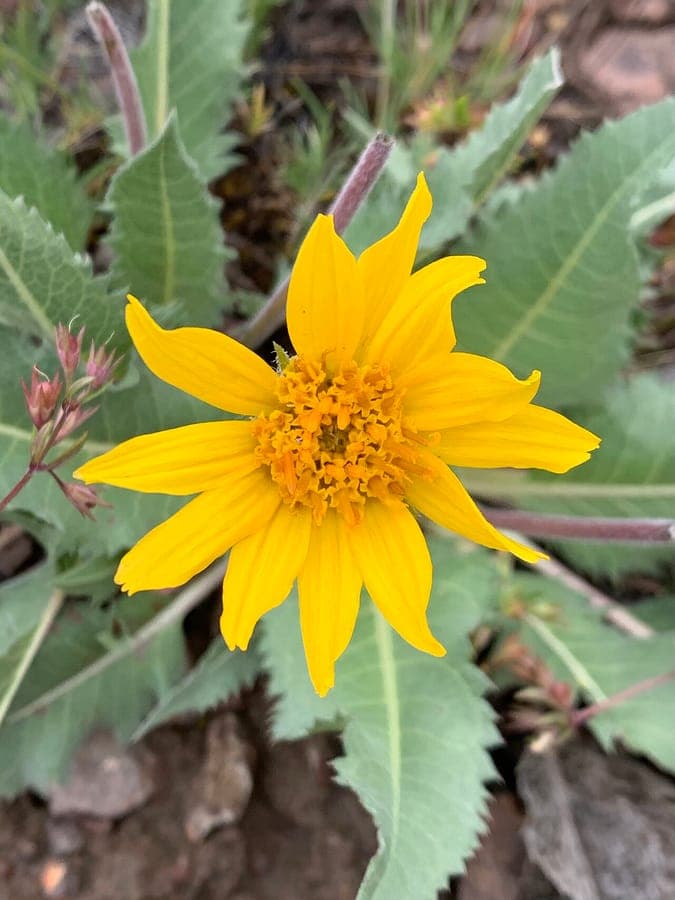
no rights reserved / CC0, via Wikimedia Commons
Serrate balsamroot: complete guide
Balsamorhiza serrata
Want to see Serrate balsamroot: complete guide in your garden?
1 minute, no credit card
Overview
Serrate balsamroot (Balsamorhiza serrata) is one of the lesser-known species within the Balsamorhiza genus, a group of drought-adapted perennials native to the western United States. Described in 1913 by Aven Nelson and J.F. Macbride, it is among the more recently named species in the genus. Its natural range covers California, Nevada, Oregon, and Washington, where it grows on dry, open slopes and in sagebrush plant communities at low to moderate elevations. The species name serrata refers to the distinctly toothed leaf margins that set it apart from close relatives like Balsamorhiza hookeri and Balsamorhiza macrophylla. Unlike some other balsamroots, it grows with a multiple-stem habit from a single crown, giving it a slightly fuller, more branching appearance. Like all balsamroots it develops a stout, deep taproot that anchors the plant firmly and sustains it through even prolonged summer droughts, making it exceptionally long-lived on the right site. It remains virtually unknown in European horticulture, but for gardeners seeking unusual drought-tolerant perennials it is a rewarding find. Explore ideas for naturalistic dry gardens at gardenworld.app.
Appearance and bloom cycle
Serrate balsamroot produces a compact basal rosette of grey-green leaves with distinctly serrated margins - the identifying feature of the species. The leaves are covered in fine hairs that give them a soft, matte texture and help reduce water loss in dry conditions. They typically reach 20 to 35 cm in length, shorter and less deeply divided than those of Balsamorhiza macrophylla, but distinctive in their own right. From April through June, multiple flowering stems emerge above the rosette, each bearing a single bright yellow flowerhead 5 to 8 cm across. These resemble small sunflowers and are rich in nectar and pollen. Bees, butterflies, and hoverflies visit frequently during the blooming period. After flowering, small brown achenes ripen and attract seed-eating birds. The multiple-stem growth habit means the plant presents slightly more flowers per clump than single-crown relatives of similar size.
Ideal location
This species demands full sun, with at least six hours of direct sunlight daily. It is ideal for dry borders, rock gardens, gravel gardens, and sloping beds where drainage is naturally excellent. A south- or west-facing position is best. The plant does not suit sheltered, shaded, or humid positions. In its native range it grows in open, exposed terrain under full sun and wind, and replicating those conditions in the garden is the key to success. It works well as part of a prairie or steppe planting scheme, where its relatively compact rosette fits neatly between taller companion plants.
Soil requirements
Good drainage is the primary requirement. Serrate balsamroot grows on lean, free-draining soils - sandy loams, gravelly substrates, or shallow soils over rock - with a pH of 5.8 to 7.0. It prefers a slightly more neutral to mildly acidic soil than some of its relatives, but remains adaptable. Heavy clay soils are unsuitable. If planting into clay-dominated ground, improve the planting hole with coarse sand and fine gravel. Do not add rich compost or fertiliser: nutrient-poor conditions encourage flowering and closely replicate the plant's natural growing environment.
Free design
Want to see Serrate balsamroot: complete guide in your garden? Make a free design now.
Watering
Once established, serrate balsamroot handles extended dry spells without difficulty. During its first growing season, regular watering helps develop the deep taproot. From the second year onward, natural rainfall in most temperate European regions provides adequate moisture. During droughts exceeding four weeks, a thorough deep watering every two weeks is enough. Overwatering is the chief threat, particularly in winter when standing water around the root crown leads rapidly to rot.
Cutting back
Pruning demands are minimal. After flowers fade, stems can be removed at the base for a neat appearance, or left standing to provide seed for birds and allow self-seeding in favourable spots. On suitable ground the plant can establish small seedling colonies over time. In early spring, before new foliage emerges, clear away the previous season's old dry leaves. No hard annual cutback is necessary.
Maintenance calendar
January-February: dormant; check drainage and avoid water pooling at the crown. March: remove old dry foliage; inspect the crown for health after a wet winter. April: first flower buds appear; no feeding required. May: peak flowering; enjoy the golden blooms and observe pollinator activity. June: blooming ends; decide on seed head management. July-August: driest period; water deeply every two weeks if needed during prolonged heat. September: rosette remains decorative; check drainage before autumn rains. October: plant enters dormancy. November-December: full dormancy; no special treatment needed on well-drained sites.
Winter hardiness
Serrate balsamroot is reliably cold-tolerant. It survives temperatures down to approximately -20 degrees Celsius and sits in USDA zones 5 to 8, making it suitable for most of temperate Europe including the Netherlands, Belgium, and much of the UK. Winter rot caused by prolonged waterlogging is a greater risk than cold temperatures alone. On a well-drained, open site, no winter protection is needed and the plant will return dependably each spring.
Companion plants
Serrate balsamroot partners naturally with other drought-adapted prairie and coastal-range plants. Penstemon species in blue, purple, and pink tones provide strong colour contrast against the yellow blooms. Salvia azurea, Echinacea purpurea, and Gaillardia aristata are well-matched companions on dry, sunny ground. Fine ornamental grasses from specialist nurseries and garden centres add texture and movement. Low Artemisia species in silver-grey pick up the muted tones of the balsamroot's foliage. Avoid moisture-demanding plants that cannot tolerate the same dry conditions.
Closing thoughts
Serrate balsamroot is a genuine rarity in European gardens - a plant that offers golden flowers, distinctive toothed foliage, and excellent drought resilience in a compact, multi-stem habit. For the gardener who enjoys planting something out of the ordinary, it is an excellent choice for any dry, sun-exposed border or naturalistic front garden design. Its low maintenance needs, long lifespan on a suitable site, and strong support for pollinators make it as practical as it is beautiful. Once planted in the right spot it will return reliably for many years, growing stronger season by season with no replanting required. Find out how to design a prairie-inspired front garden that looks good year round at gardenworld.app, where planting plans are tailored to real local conditions.
Want to see Serrate balsamroot: complete guide in your garden? Make a free design now.
Upload a photo, pick a style, and get a photorealistic design with plant list in under a minute.
10,000+ gardens designed already
No credit card required


Similar plants
Hooker's balsamroot: complete guide
Balsamorhiza hookeri
Hooker's balsamroot (Balsamorhiza hookeri) is a drought-tough western prairie perennial with bold golden flowers, ideal for sunny, dry garden borders.
Cutleaf balsamroot: complete guide
Balsamorhiza macrophylla
Cutleaf balsamroot (Balsamorhiza macrophylla) is a bold prairie perennial with deeply divided large leaves and bright yellow sunflower-like blooms for dry gardens.