
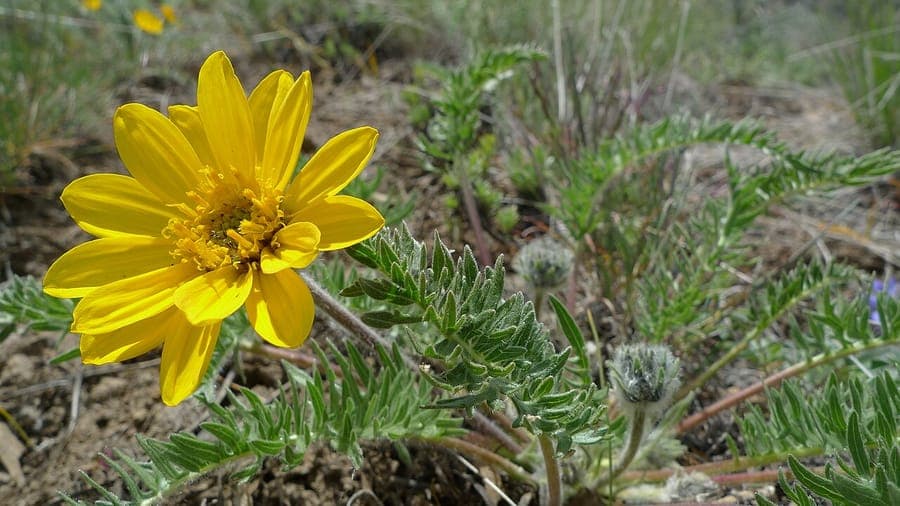
Thayne Tuason / CC BY-SA 4.0, via Wikimedia Commons
Hooker's balsamroot: complete guide
Balsamorhiza hookeri
Want to see Hooker's balsamroot: complete guide in your garden?
1 minute, no credit card
Overview
Hooker's balsamroot (Balsamorhiza hookeri) is a striking herbaceous perennial belonging to the Asteraceae family, native to the dry prairies, sagebrush flats, and rocky hillsides of western North America. First described by Thomas Nuttall in 1840, this species is named after the botanist William Jackson Hooker. Its natural range spans California, Idaho, Nevada, Oregon, Utah, and Washington, where it colonises open, exposed slopes with minimal rainfall. In European gardens it remains relatively rare, but for anyone drawn to drought-resilient planting and naturalistic design it deserves far more attention. At gardenworld.app you can explore prairie-style planting schemes that bring this Western wildflower spirit to European front gardens.
Appearance and bloom cycle
The plant develops a basal rosette of deeply dissected or pinnately lobed, grey-green leaves densely covered in fine hairs. These leaves feel velvety to the touch and provide visual interest throughout the year, even when the plant is not in bloom. Individual leaves typically reach 15 to 40 cm in length and create a soft, feathery mound close to the ground. From April through June - and sometimes into early July at higher elevations - numerous flowering stems rise from the rosette, each topped with a single bright yellow flowerhead. These flowerheads measure 5 to 8 cm across and resemble miniature sunflowers, with a central disc of tubular flowers surrounded by strap-shaped ray florets. The flowers are highly attractive to bumblebees, solitary bees, and butterflies. After pollination, small brown achenes form that provide food for seed-eating birds such as finches.
Ideal location
Full sun is non-negotiable for Hooker's balsamroot. It demands at least six hours of direct sunlight daily to produce its characteristic abundance of flowers. In its natural habitat it grows on completely open, unshaded slopes, and in a garden setting it performs best in south- or west-facing positions. It is an excellent candidate for dry borders, gravel gardens, rock gardens, and sloping sites where drainage is naturally good. The plant suits the front of a border where its low, spreading rosette will not be overshadowed. It also works well in a mixed prairie planting, a xeriscaped front drive, or a wildflower meadow strip. Sheltered, shaded, or damp corners should be avoided.
Soil requirements
This species asks very little of its planting medium, but drainage is the one non-negotiable requirement. It thrives in lean, gritty, or sandy soils with a pH range of 6.6 to 9.0 - reflecting the alkaline mineral soils of its native range. On rich, heavy, moisture-retentive clay the plant will decline rapidly. When planting into clay-dominated borders, dig a generous hole and backfill with a blend of sharp sand and fine gravel to improve drainage. Avoid adding fertiliser or rich compost: overly fertile conditions produce lush foliage at the expense of flowering. A poor, free-draining medium is exactly what this plant needs to perform at its best.
Watering
Once established, Hooker's balsamroot is exceptionally tolerant of dry conditions. During its first growing season, water regularly to help it develop a deep taproot. From the second year onward, supplemental irrigation is rarely necessary in temperate European climates. In regions with wet winters and dry summers, rainfall usually provides sufficient moisture. During prolonged droughts lasting more than four weeks, a deep but infrequent soak every two weeks is adequate. Overwatering is far more damaging than drought stress: roots sitting in waterlogged conditions, particularly in winter, will rot quickly. Always let the planting area dry out thoroughly between waterings.
Free design
Want to see Hooker's balsamroot: complete guide in your garden? Make a free design now.
Cutting back
Maintenance requirements are minimal. After the flowers fade, you can cut the stems back to the rosette for a tidy appearance, or leave them standing to allow the seed heads to ripen. Ripe seed heads attract goldfinches and other small birds, making self-seeding possible in suitable spots. Remove any dead or damaged leaves from the basal rosette as they appear throughout the growing season. In early spring, before new growth emerges, clear away last year's old leaf material to make room for fresh foliage. No aggressive cutting is required at any stage.
Maintenance calendar
January-February: plant is dormant; ensure drainage is not blocked by debris. March: remove old basal leaves as new growth begins; check for any signs of root rot if the site has been wet. April: flower buds form; enjoy the first golden flowers; no feeding required. May: peak flowering period; observe pollinators and leave flowers undisturbed. June: blooming ends; decide whether to leave seed heads for birds or remove them to prevent excessive self-seeding. July-August: dry season; water every two weeks during extreme heat. September: rosette remains active; inspect drainage ahead of autumn rains. October: plant prepares for dormancy. November-December: full dormancy; no mulching needed on well-drained sites.
Winter hardiness
Hooker's balsamroot is impressively cold-tolerant. In its native range it survives winters with temperatures dropping to -25 degrees Celsius or colder. It is reliably hardy in USDA zones 4 to 8, making it suitable for nearly all of temperate Europe. In the Netherlands, Belgium, and the UK it will overwinter without protection on any well-drained site. Frost damage is almost exclusively linked to wet winter conditions: roots standing in cold, waterlogged soil are vulnerable to rot. On a dry, open site with good air circulation, the plant poses no winter concerns.
Companion plants
Hooker's balsamroot associates beautifully with fellow drought-tolerant prairie species. Penstemons in shades of blue, pink, and purple provide excellent floral contrast. Salvia azurea, Echinacea purpurea, and Ratibida columnifera make natural companions on dry hillsides. Fine-textured grasses from specialist nurseries and garden centres add movement and contrast to the bold rosette form. Low-growing Artemisia species echo the silver-grey foliage tone. Gaillardia and Rudbeckia extend the yellow-and-gold colour theme. Avoid pairing with moisture-loving species such as Astilbe or Ligularia, which require conditions incompatible with balsamroot's needs.
Closing thoughts
Hooker's balsamroot is an underused gem for anyone seeking a low-maintenance, wildlife-friendly, and visually striking perennial for a dry, sunny garden. Its long bloom season, tactile hairy foliage, and exceptional drought resilience make it a practical as well as a beautiful choice. Whether planted in a gravel garden, a prairie border, or a naturalistic front yard, it rewards the gardener with minimal effort and maximum impact. Discover how plants like this can transform your outdoor space at gardenworld.app, where expert planting plans meet real garden conditions.
Want to see Hooker's balsamroot: complete guide in your garden? Make a free design now.
Upload a photo, pick a style, and get a photorealistic design with plant list in under a minute.
10,000+ gardens designed already
No credit card required


Similar plants
Cutleaf balsamroot: complete guide
Balsamorhiza macrophylla
Cutleaf balsamroot (Balsamorhiza macrophylla) is a bold prairie perennial with deeply divided large leaves and bright yellow sunflower-like blooms for dry gardens.
Serrate balsamroot: complete guide
Balsamorhiza serrata
Serrate balsamroot (Balsamorhiza serrata) is a rare western prairie perennial with toothed leaves and vivid golden flowers, thriving in dry, open, sun-drenched gardens.