
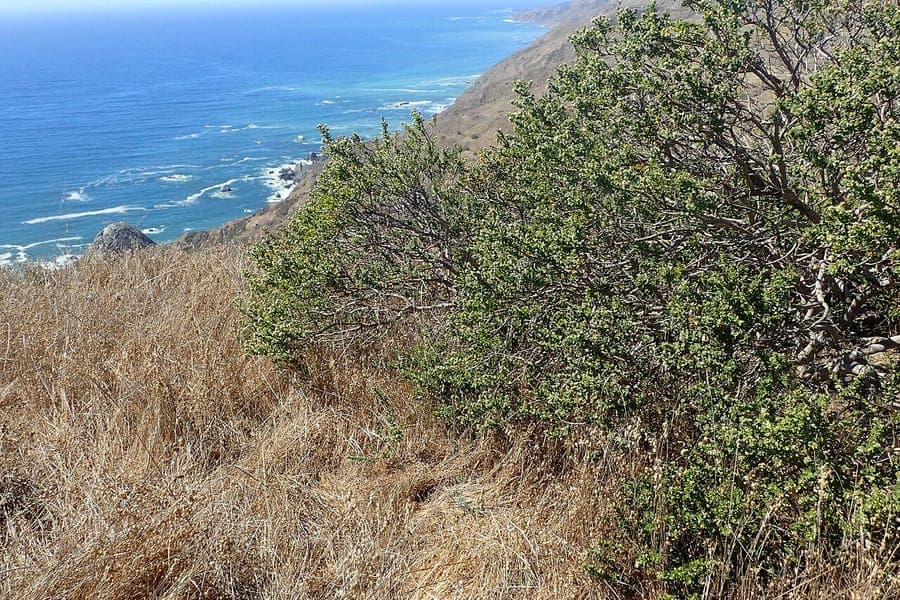
Krzysztof Ziarnek, Kenraiz / CC BY-SA 4.0, via Wikimedia Commons
Coyote brush: complete guide
Baccharis pilularis
Want to see Coyote brush: complete guide in your garden?
1 minute, no credit card
Overview
Coyote brush (Baccharis pilularis) is a native, evergreen shrub or groundcover in the Asteraceae family, originating from California, Oregon, New Mexico, and northwest Mexico. Gardeners and landscape designers treasure this plant for its resilience: it thrives on poor, dry soils where most plants struggle to survive. The botanical name refers to the small, round flower heads the plant produces in autumn. In its low-growing form - the one most commonly used in gardens - coyote brush forms a compact, dense mat that looks attractive and effectively protects slopes from erosion.
The plant is dioecious, meaning male and female flowers grow on separate plants. The female plant produces fluffy seeds that disperse on the wind in autumn, creating a spectacular show that resembles a light snowfall. Beyond its ecological value, coyote brush is also garden-design flexible: as a low, spreading groundcover around 30 to 90 cm tall, or as an upright shrub reaching up to 3 metres, depending on the cultivar chosen.
On gardenworld.app you can explore garden designs where this drought-resistant native shrub plays a central role in a water-wise front yard layout.
Appearance and bloom cycle
Baccharis pilularis has small, leathery, dark-green leaves with finely toothed margins. The leaves measure roughly 1 to 2 cm in length and crowd the stems densely, giving the plant a fine, detailed texture year-round. Unlike many ornamental shrubs, coyote brush retains its foliage throughout winter, making it especially valuable where winter interest is desired.
Flowering occurs in late summer and autumn, typically from August through November. The flowers themselves are small and inconspicuous - creamy white, fluffy florets clustered in round heads measuring 3 to 6 mm across. It is the feathery, silver-white fruits on the female plant that truly command attention. When the ripe seeds release, a cloud of white fluff envelops the plant for several weeks. This phenomenon can be challenging for hay fever sufferers but is one of the most charming seasonal spectacles the plant offers.
Male plants produce pollen that contributes significantly to local ecosystems: numerous native bees, butterflies, and hoverflies visit the flowers. Coyote brush is therefore an excellent choice for gardeners wanting to support biodiversity.
Ideal location
Coyote brush is a full-sun plant. It performs best in an open, fully sunny position and tolerates partial shade, though in shadier conditions it grows more open and less compact. In its native habitat the plant grows along coastlines, on hillsides, and in chaparral-type dry scrubland, always in full sun.
The plant is particularly suited to sloped gardens where erosion control is a priority. Its extensive root system grips the soil and prevents washout during heavy rain. It also excels alongside dry stone walls, south-facing borders, and gravel gardens. Along exposed coastal locations it tolerates salt-laden winds well, making it suitable for seaside plots.
The growth rate is moderate to fast, meaning a new planting will close into a continuous mat within two to three growing seasons. This makes it efficient for covering large areas quickly while keeping maintenance low.
Soil
One of the greatest strengths of coyote brush is its adaptability to poor soils. The plant asks almost nothing of soil fertility and grows well on sandy, rocky, or loamy ground. The one absolute requirement is good drainage: the roots cannot tolerate prolonged waterlogging, and root rot will set in quickly if water sits around the base.
Optimal soil pH ranges from 5.5 to 7.2 - a broad window that covers most ordinary garden soils. Additional fertilising is generally not necessary and can actually be harmful: on overly rich soils the plant grows too fast and becomes loose and wind-prone. A light mulch of gravel or coarse bark around the base helps retain moisture and suppress weeds.
When planting in heavy clay soil it is worth improving the site with sharp sand and coarse compost to improve drainage. In gardens with good, lightly sandy soil, coyote brush is virtually maintenance-free once established.
Watering
Once coyote brush is established - which typically takes one full growing season - it is exceptionally drought-tolerant. In its native range it survives months of summer drought without irrigation. In the garden, during dry spells a weekly deep watering is sufficient, and in rainy temperate climates supplemental summer watering is rarely needed.
During the first year after planting, regular watering is essential to allow the root system to develop properly. In the first growing summer, water two to three times per week, ensuring the water penetrates at least 30 cm into the soil. This encourages roots to grow deeply and builds drought resilience for later years.
Overwatering is a greater threat than drought. Avoid irrigation schedules that keep the soil permanently moist, especially during cool winter months. A regime of allowing the soil to dry slightly between waterings, then drenching deeply, suits this plant far better than daily light watering.
Free design
Want to see Coyote brush: complete guide in your garden? Make a free design now.
Pruning
Coyote brush responds well to pruning and can be cut back hard without harm. The best time for a thorough prune is early spring before new growth begins, usually in February or early March. Cutting the plant back to around 15 to 20 cm encourages dense, compact regrowth and refreshes the plant's overall appearance.
During the growing season, overlength shoots can be trimmed in summer to maintain the desired shape. This is not strictly necessary but improves neatness. Remove dry branches and spent flowering stems as you notice them.
For low-growing groundcover forms such as the popular cultivar 'Twin Peaks', annual pruning is not always required; a light tidy every three to four years is generally sufficient. Taller shrub forms benefit from more regular pruning to prevent them becoming open and straggly.
After pruning there is no need to treat cut surfaces with wound sealant. The plant heals quickly from mechanical damage.
Maintenance calendar
January - February: inspect the plant for frost damage and remove dead wood once the coldest nights are past. Plan the main pruning session.
March: carry out the main spring prune before new growth starts. Apply a light layer of compost around the base if desired.
April - May: new shoots begin to emerge. Ensure adequate water during prolonged dry spells. No fertiliser needed.
June - July: active growth period. Monitor for pests such as aphids or mites, though coyote brush is generally resistant.
August - October: flowering period for male plants; female plants develop fluffy fruits. Enjoy the ornamental display. Gradually reduce watering.
November - December: seed dispersal occurs. Rake fallen leaves away from the mat to prevent fungal issues. Protect young plants in harsh winters with a layer of leaves or fleece.
Winter hardiness
Coyote brush is hardy to USDA zone 7b, corresponding to a minimum temperature of around -15 degrees Celsius. In the mild-winter coastal regions of western Europe it can be grown outdoors year-round. With a good site choice and well-drained soil, the plant can overwinter successfully in temperate maritime climates.
The key to successful overwintering is drainage. Wet, cold soils are more damaging than cold alone. Plant coyote brush on a slightly raised site or add coarse sand to the planting hole to improve water run-off. Young plants are more frost-sensitive than established specimens; protect them during their first two winters with a loose covering of leaves or horticultural fleece.
In severe winters where temperatures drop below -10 degrees for extended periods, the above-ground portions may die back, but the roots usually survive and the plant re-sprouts in spring. In areas prone to hard frosts, overwintering in a cool, frost-free greenhouse is a safer option.
Companion plants
Coyote brush combines beautifully with other drought-tolerant, Mediterranean and Californian-native plants. Use gardenworld.app to visualise companion planting combinations for your specific front garden layout.
Excellent partners include lavender (Lavandula angustifolia) for fragrant purple flowers, culinary sage (Salvia officinalis) for silver-grey foliage mass, and blue fescue (Festuca glauca) for contrasting fine texture. Rosemary (Salvia rosmarinus) is a classic companion thanks to the shared preference for drainage and full sun.
For a wilder, naturalistic look, combine coyote brush with Californian native grasses such as Nassella pulchra, or with manzanita species (Arctostaphylos). In European settings, Cistus, Phlomis, and low-growing Juniperus cultivars pair well with coyote brush.
Coyote brush is available from specialist native-plant nurseries and online garden centres. It is worth seeking out named cultivars such as 'Twin Peaks' or 'Pigeon Point' that have been selected specifically for compact, low-growing garden use.
Closing
Coyote brush is one of those rare garden plants that demands little but delivers much. Its drought tolerance, the beautiful feathery autumn fruits, its value for pollinators, and its ability to stabilise slopes make it a genuinely versatile choice for any garden with a dry, sunny spot.
Whether you want to clothe an erosion-prone slope, cover a low-maintenance strip, or create a wildlife-friendly border, coyote brush deserves serious consideration. With the right site selection and a good establishment period in the first year, this plant will largely look after itself for decades, offering a fresh seasonal spectacle each autumn.
Want to see Coyote brush: complete guide in your garden? Make a free design now.
Upload a photo, pick a style, and get a photorealistic design with plant list in under a minute.
10,000+ gardens designed already
No credit card required


Similar plants
Willow baccharis: complete guide
Baccharis salicina
All about Baccharis salicina, the willow baccharis from the southern USA. Care, location, pruning and garden combinations for this tough native shrub.
Desert broom: complete guide
Baccharis sarothroides
All about Baccharis sarothroides, the desert broom of the Sonoran Desert. Drought-tolerant, ecologically rich, and nearly maintenance-free once established.