
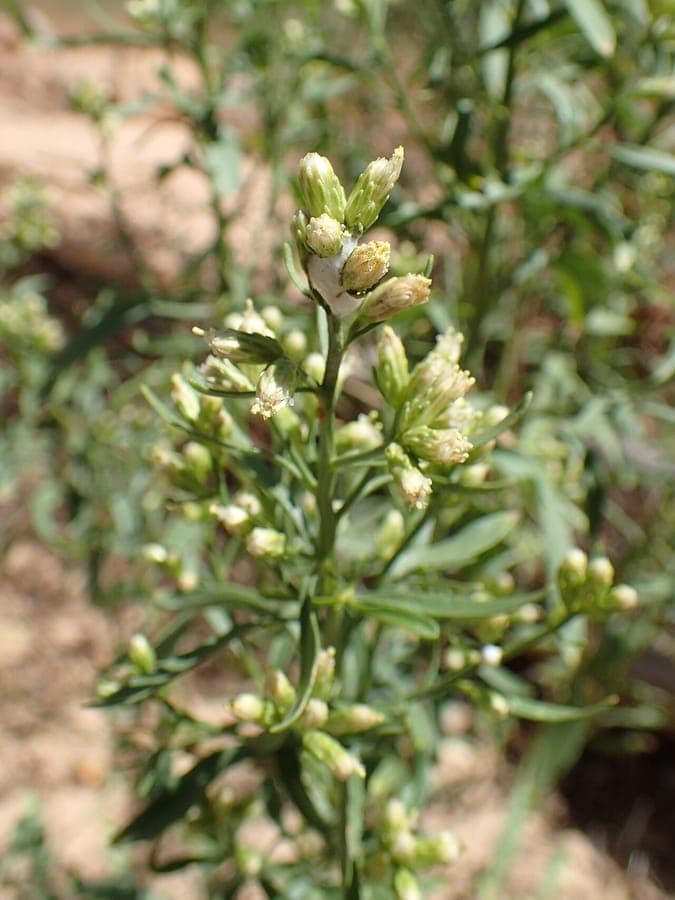
Kenraiz / CC BY-SA 4.0, via Wikimedia Commons
Willow baccharis: complete guide
Baccharis salicina
Want to see Willow baccharis: complete guide in your garden?
1 minute, no credit card
Overview
Baccharis salicina, commonly known as willow baccharis, Emory's baccharis, or great plains false willow, is a remarkable fast-growing shrub from the daisy family Asteraceae. The species was first formally described by botanists Torrey and Gray in 1842. Its scientific name salicina means 'willow-like', referring to the narrow leaves that so closely resemble those of a true willow. In the wild, this plant grows along dry riverbeds, in moist lowland basins, and on alkaline soils across the southwestern United States and northern Mexico.
The native range covers Arizona, California, Colorado, Kansas, Nevada, New Mexico, Oklahoma, Texas, and Utah, as well as parts of northwestern and northeastern Mexico. Willow baccharis is dioecious: male and female flowers are borne on separate plants. After flowering, female plants produce conspicuous fluffy seed heads that resemble thistle down and are carried far by the wind. Under favorable conditions the plant grows rapidly to 1 to 3 meters in height and spread.
For gardeners seeking a tough, drought-tolerant shrub for a dry border, a streamside planting, or a windbreak, Baccharis salicina is a compelling option. You can design a complete landscape plan at gardenworld.app that uses the willow baccharis as a structural plant within a water-smart, low-maintenance garden. The plant also contributes real ecological value: bees, butterflies, and hoverflies visit its flowers throughout the flowering season.
Appearance and bloom cycle
Willow baccharis is a deciduous to semi-evergreen shrub with a multi-stemmed growth habit. The stems are erect, green to grey-green, and often lightly ridged. The leaves are lance-shaped to linear, 2 to 8 cm long and typically 3 to 10 mm wide - strongly resembling true willow leaves. They have a smooth texture and are light green to grey-green. The foliage sits alternately along the stems, giving the plant an airy, transparent appearance.
The flowers are small and creamy white to pale yellow. They appear in dense cluster-like flower heads arranged at the tips of the branches. The main flowering period falls in late summer and early autumn, from August through October. Baccharis species are dioecious, meaning each plant bears either only male or only female flowers. After flowering, female plants develop the extensive fluffy seed plumes that are one of the plant's most striking features, lasting for weeks on the plant.
The seed plumes are silvery white and can form spectacular clouds on windy days. This is both a decorative highlight and a practical consideration: the plant self-seeds readily and can become invasive on favorable sites. Within its native range it is considered a vigorous coloniser.
Ideal location
In the wild, Baccharis salicina favors watercourses, dry river valleys, and level sites with moist to moderately dry conditions. In the garden, the best location is an open, sunny spot with full sun or light partial shade. The plant does not tolerate deep shade and blooms far less freely in shadier conditions.
Willow baccharis is particularly well-suited to sites where the soil may be temporarily wet, such as alongside ditches, pond edges, or in rain gardens - gardens designed to capture and process rainwater runoff. At the same time, once established, the plant also tolerates periods of drought, making it versatile for variable climates. At gardenworld.app you can explore how to combine the willow baccharis with complementary plants for a water-conscious garden design.
The plant works excellently as a windbreak, informal hedge, or planting for hard-to-access areas such as embankments and slope edges. In urban gardens it provides rapid screening. Avoid sites combining harsh wind-dry conditions with strongly alkaline soil in regions with no summer rainfall at all.
Soil
Baccharis salicina is not demanding of soil quality but performs best in moderately fertile, well-drained to slightly moisture-retentive ground. It has a notable tolerance for alkaline soils and grows well at pH 7.0 to 8.5. This makes it particularly valuable on calcareous soils in dry climate areas where many plants struggle.
Heavy clay can be used provided drainage is adequate; in compacted soils it is worthwhile improving the planting hole with coarse sand or perlite. On light, poor sandy soils the plant benefits from a handful of mature compost at planting, but heavy fertilizing is unnecessary and may encourage lush growth at the expense of flowering. In naturally alkaline river soils it thrives without any amendment.
A mulch layer of organic material such as wood chips around the base of the plant helps retain moisture and prevents root damage from drying out. Keep the mulch a few centimetres away from the stem base to limit fungal growth. Replenishing the mulch layer each spring is sufficient for soil health maintenance.
Watering
In the first year after planting, regular watering is essential to allow the plant to establish properly. During dry periods, water deeply once a week to encourage the roots to grow deeper into the soil. Once well-established - which can take six to twelve months depending on the site - willow baccharis becomes considerably drought-tolerant and requires little supplemental watering in most climates.
The plant does show a preference for some summer moisture, reflecting its natural habitat alongside watercourses. In dry summers, watering thoroughly every two to three weeks promotes healthy growth and good flowering. Always water at the base of the plant rather than using overhead sprinklers, keeping the foliage dry and minimizing the risk of fungal disease.
In autumn and winter, supplemental watering is rarely needed. The plant is partially dormant and transpiration is minimal. In areas with significant winter rainfall or near a high water table, no additional watering is needed throughout the cold season at all. Warning signs of too-dry conditions include drooping, discoloured leaves; too-wet conditions manifest as yellowing leaves and limp stems.
Free design
Want to see Willow baccharis: complete guide in your garden? Make a free design now.
Pruning
Baccharis salicina is a vigorous grower and can spread considerably without intervention. Regular pruning keeps the plant compact and promotes fresher, healthier foliage. The ideal pruning time is early spring, once the risk of severe frost has passed but before the new shoots have broken. Cut the plant back to one-third or one-half of its volume at this point. It responds by pushing out strong new growth and will still flower in the same year on the new wood.
You can also remove the spent flowering stems in late winter after the seed plume production has ended, both to limit seed dispersal and to keep the plant tidy. Always use sharp pruning tools and disinfect them between plants to avoid spreading disease. For severely overgrown or oversized specimens, a hard rejuvenation cut to 20 to 30 cm above the ground is effective and the plant will regrow strongly.
Note that pruning female plants before seed dispersal prevents unwanted self-sowing. In locations where spreading is undesirable, removing the seed plumes before they are carried by the wind is an effective control measure.
Maintenance calendar
January and February: The plant is largely dormant. Inspect stems for frost damage. No pruning needed unless there are clearly dead or damaged branches. Keep the mulch layer intact.
March: Pruning season begins. Cut stems back to one-third to one-half of the plant's volume. Remove dead and crossing branches. Add a fresh layer of organic mulch around the base.
April and May: New foliage emerges. Check for aphids and other pests. Water during prolonged drought. A light application of balanced garden fertilizer is optional.
June and July: The plant grows vigorously. Keep adequate moisture available but avoid waterlogged conditions. Monitor whether the plant is spreading too aggressively.
August and September: Peak flowering. Female plants produce the eye-catching seed plumes after flowering. Enjoy the display. Remove plumes promptly if self-seeding is unwanted.
October: Leaf fall begins. Leave the stems in place to provide overwintering habitat for insects. No more pruning this year.
November and December: Full dormancy. In cold regions, protect roots with additional mulch. Check for storm damage to stems.
Winter hardiness
Baccharis salicina is moderately cold-hardy. In its native habitat it experiences mild to cool winters with little frost. The plant is rated for USDA zones 7 to 10, meaning it tolerates temperatures down to approximately -15 degrees Celsius. In regions with harder winters, frost damage to the stems may occur, but the plant generally rebounds strongly from the base in spring.
In the cooler parts of western Europe - where temperatures occasionally dip below -10 degrees Celsius - frost protection for young plants is advisable. Mulch the root zone generously with 10 to 15 cm of organic material or grit. Stems can also be wrapped with burlap or horticultural fleece during extreme cold spells. Older, established plants are generally hardier than young specimens and recover better from any frost damage.
In coastal regions with a maritime climate - mild and moist - willow baccharis overwinters successfully in most years. In continental climates with severe, dry frosts, the species is less reliable and deserves a sheltered position or extra winter protection.
Companion plants
Willow baccharis pairs well with other robust, drought-tolerant shrubs and perennials that thrive in comparable open, sunny conditions. Consider Vitex agnus-castus (chaste tree), Buddleja davidii (butterfly bush), Caryopteris x clandonensis (bluebeard), various Salvia species, and grasses such as Muhlenbergia capillaris (pink muhly grass) or Panicum virgatum (switchgrass).
Along water margins or in rain gardens it combines naturally with Salix (willow), Cornus sericea (red twig dogwood), and Phragmites australis (common reed) for a naturalistic waterside planting. In a dry border it can serve as a structural backbone, combined with lavender, sage, and Yucca filamentosa for a xeriscape effect. Your local garden centres may carry drought-tolerant shrubs that pair well with baccharis. Use gardenworld.app to design the complete planting scheme professionally and create a garden that is both beautiful and water-wise.
Closing
Baccharis salicina, the willow baccharis, is a powerful, adaptable shrub that commands attention through its rapid growth, feathery foliage, and spectacular autumn seed plumes. It is ideal for challenging situations where other plants fail: dry riverbanks, alkaline soils, windswept locations, or sites with variable moisture. Its ecological value - as a nectar source for bees and butterflies, a soil stabilizer, and a windbreak plant - makes it an asset in any modern, sustainable garden.
With the right location and annual rejuvenation pruning, the willow baccharis becomes a reliable, low-maintenance element in any garden. Visit gardenworld.app for a personalised garden design that integrates the willow baccharis into your outdoor space and makes room for nature.
Want to see Willow baccharis: complete guide in your garden? Make a free design now.
Upload a photo, pick a style, and get a photorealistic design with plant list in under a minute.
10,000+ gardens designed already
No credit card required


Similar plants
Calendula stellata: complete guide
Calendula stellata
Complete guide to Calendula stellata, the star-flowered marigold from Sicily: location, soil, watering and companion planting tips.
Korean chrysanthemum: complete guide
Chrysanthemum x rubellum
Chrysanthemum x rubellum is a hardy autumn perennial with single pink to copper flowers from August to November. Care and combinations.
Helianthus divaricatus: complete guide
Helianthus divaricatus
Helianthus divaricatus is a North American woodland sunflower with yellow summer blooms, ideal for naturalistic borders and shady edges.