
Stickpen / Public domain, via Wikimedia Commons
Desert broom: complete guide
Baccharis sarothroides
Want to see Desert broom: complete guide in your garden?
1 minute, no credit card
Overview
Baccharis sarothroides, commonly known as desert broom, broom baccharis, or desert-broom, is one of the most iconic shrubs of the Sonoran Desert and adjacent arid regions of the southwestern United States and northern Mexico. The botanist Asa Gray described the species in 1882. The name sarothroides means 'resembling a broom' - an apt description for the densely branched, upright stems that form a compact, broom-like silhouette even when leafless.
The native range covers Arizona, California, New Mexico, Texas, and adjoining areas of northeastern and northwestern Mexico. Desert broom grows in dry washes, on rocky slopes, and in open desert landscapes, typically at elevations of 300 to 1,500 meters. Within its home territory it is one of the few shrubs that remains green throughout the year in an otherwise bare desert setting.
For enthusiasts of xeriscape gardening, rock gardens, and Mediterranean-style plantings, Baccharis sarothroides is an exceptionally valuable plant. You can create a professional garden design at gardenworld.app that uses desert broom as a structural anchor in a water-smart, low-maintenance plan. Its ecological value is also enormous: the plant is one of the most reliable nectar sources for native bees, butterflies, and hoverflies in arid climates. Thousands of insects visit a mature desert broom throughout the flowering season.
Appearance and bloom cycle
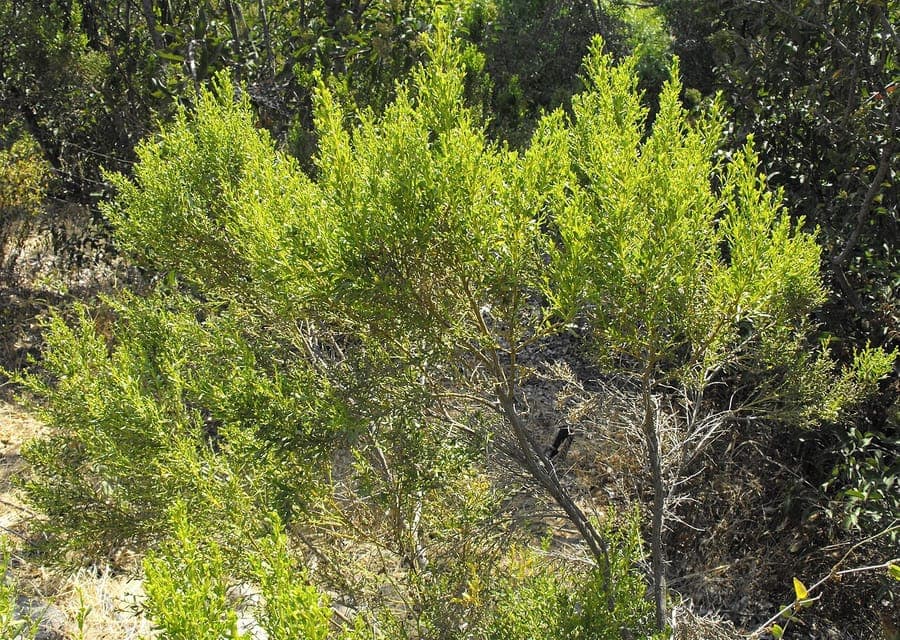
Desert broom is a semi-evergreen to evergreen shrub with a multi-stemmed growth habit. The stems are densely branched, erect, and deep green - even during the driest periods. This gives the plant a lively appearance year-round, even when the leaves have partially dropped. The leaves are small, needle-like to linear, 1 to 4 cm long and only a few millimeters wide, strongly reduced as an adaptation to arid conditions. They release a pleasant, resinous scent when crushed.
The flowers are small, creamy white to pale yellow, and appear in dense clusters at the tips of the many side shoots. The main flowering period falls in autumn, from September through November, sometimes continuing into December in mild conditions. Baccharis sarothroides is dioecious: male and female flowers are borne on separate plants. After flowering, female plants produce conspicuous white seed plumes that are dispersed massively by the wind - one of the most dramatic spectacles of autumn in desert areas. The plumes are so numerous that a mature female plant looks as if it has been dusted with snow.
The plant reaches 1 to 3 meters in height and similar spread. The growth rate is moderate, but once established the plant grows steadily. The deep green, always-present stems provide year-round visual interest outside the flowering season.
Ideal location
Desert broom belongs in full sun and tolerates no shade. In its natural habitat it receives intense sunshine throughout the year without interruption. In the garden, always choose a spot with at least six hours of direct sunlight per day; more is better. The plant is ideal for dry, hot borders, for spots along the sunny side of fences and walls, and for open desert or gravel gardens.
A sheltered position is not required - desert broom is specifically resistant to dry winds and handles most urban conditions well. Avoid low-lying spots with stagnant water, as wet feet are fatal to this plant. Raised borders, sloped terrain, or elevated planting beds suit it best.
In urban gardens, desert broom offers an additional benefit: it attracts large numbers of insects. During its September to October bloom, a well-developed plant can literally hum with life. Gardenworld.app provides extensive inspiration for creating a biodiverse, xeriscape garden design in which desert broom plays a central role.
Soil
Baccharis sarothroides is extremely tolerant of poor, infertile soils. In the wild it grows on granite rubble, sandy river deposits, and compacted limestone. For the garden, a well-drained, slightly sandy to loamy soil with a pH of 7.0 to 8.5 is ideal. The plant performs best on alkaline to neutral ground and is one of the few ornamental shrubs that thrives effortlessly on calcareous soils where other shrubs discolour and decline.
Heavy clay is problematic due to the risk of waterlogging. Improve such soils with generous additions of coarse sand, grit, or perlite. On light, impoverished sandy soils, little intervention is needed; the plant is accustomed to lean conditions. Fertilizing is unnecessary and can be counterproductive: excess nutrients promote loose, floppy growth rather than the compact, robust habit for which the plant is known.
A layer of grit or pebbles as a surface mulch around the plant is ideal: it keeps the roots cool, limits evaporation, and maintains the dry conditions the plant is used to. Organic mulch is less suitable because it retains too much moisture.
Watering
Once established, Baccharis sarothroides is one of the most drought-tolerant shrubs you can plant in a garden. In its Sonoran Desert homeland it survives on less than 250 mm of annual rainfall. In cultivation outside its native range, it needs somewhat more water to perform at its best, but restraint is still the guiding principle.
In the first year after planting, water two to three times a week to allow roots to establish. Gradually reduce watering in the second year to once a week during warm months and less or not at all during cool months. Mature plants three years or older need no supplemental watering in most of western Europe, except during exceptionally dry and hot summers with four or more weeks without rain. In such cases, one thorough watering every two weeks is adequate.
Overwatering is by far the most common mistake when growing Baccharis sarothroides. Persistently wet soil, especially in cool temperatures, leads rapidly to root rot. Always check that the top 5 to 10 cm of soil is completely dry before watering again. Drip irrigation, which delivers water slowly and precisely to the root zone, is the best method for this species.
Free design
Want to see Desert broom: complete guide in your garden? Make a free design now.
Pruning
Desert broom needs little pruning and maintains a handsome, rounded to cushion-shaped form on its own. Unnecessary cutting disturbs the compact, characteristic habit. That said, there are situations where pruning is worthwhile. After the bloom and seed plume production in late autumn or early winter, you can remove aged, dead, or damaged side shoots. Also remove branches that restrict airflow through the centre of the plant to prevent fungal disease.
If the plant has grown too large for the available space over the years, a cautious rejuvenation trim in early spring before bud break is appropriate. Remove no more than one-third of the total volume. Hard pruning is inadvisable: desert broom recovers more slowly from drastic cutting than species adapted to humid climates. Always use sharp, disinfected pruning tools and make clean, angled cuts to prevent dieback.
In areas where female plants cause problems through excessive self-sowing, deliberately select male plants or remove the seed plumes before they disperse. Your local garden centre can advise on the sex of available plants when purchasing.
Maintenance calendar
January and February: Full winter dormancy in cooler regions. No pruning, no watering, no fertilizing. Check for frost damage on stems. In mild coastal areas the plant may grow slowly through winter.
March: Start of the new growing season. Remove any frost-damaged branches. A cautious rejuvenation trim is best carried out now if needed. No fertilizer required.
April and May: The plant grows steadily. Water only during prolonged drought. Check for aphid colonies on young shoots.
June and July: Summer heat. The plant handles this period well. Water once every two weeks if rain is completely absent. Appreciate the always-green stems.
August: Preparation for flowering. Young flower buds become visible. No more pruning this season. Minimal watering.
September and October: Peak of flowering. The plant buzzes with insect activity. Enjoy the spectacle. Female plants form seed plumes.
November and December: Seed plumes in full glory. Remove promptly if unwanted dispersal is a concern. The plant gradually enters dormancy.
Winter hardiness
Baccharis sarothroides is moderately cold-hardy. The species is rated for USDA zones 8 to 11, tolerating temperatures down to approximately -9 degrees Celsius. In mild, dry coastal areas and regions of southwestern Europe, desert broom overwinters successfully in most years. In regions with wet, cold winters - common in much of continental western Europe - the species is less reliable and frost damage may occur.
The combination of cold and moisture is more dangerous than cold alone. A plant growing dry on well-drained soil survives temperatures to -9 degrees Celsius far better than one in wet, compacted ground. In at-risk climates, give desert broom a sheltered position against a south-facing wall, generous grit mulch around the root zone, and protect the stems with horticultural fleece when frost below -6 degrees Celsius is forecast.
Young plants are more vulnerable than established specimens. Provide extra protection during the first two winters. In regions with USDA zone 7 or colder, desert broom can be grown in a large container and brought into a cool, frost-free space with good light during the cold months.
Companion plants
Desert broom thrives alongside plants with similar requirements for soil, water, and light. In a xeriscape or gravel garden, excellent companions include Larrea tridentata (creosote bush), Encelia farinosa (brittlebush), various Agave and Yucca species, Fouquieria splendens (ocotillo), Penstemon parryi, and Echinocereus cacti. These combinations evoke the authentic Sonoran Desert landscape while remaining virtually maintenance-free.
In European gardens, you can approach the desert atmosphere with combinations of Lavandula stoechas (French lavender), Rosmarinus officinalis (rosemary), Cistus (sun rose), Convolvulus cneorum, and various Salvia species. These plants share the same requirements for dry, alkaline soils and full sun. At gardenworld.app you can plan a bespoke dry garden in which desert broom serves as the anchor plant, combined with other drought-tolerant species for a colourful, ecologically rich planting throughout the year. Local garden centres can advise on suitable companion plants available in your region.
Closing
Baccharis sarothroides, the desert broom, is an impressive, virtually maintenance-free shrub for gardeners who want to let nature do the work. Its ever-green stems provide year-round structure, its autumn flowering in September and October attracts enormous numbers of insects, and its seed plumes are a unique botanical spectacle. In the right dry, sunny position it demands almost no attention and rewards with reliable flowering and vitality year after year.
Whether you want to create an authentic desert garden, plant up a dry corner, or simply find a robust, ecologically valuable shrub for a neglected spot - desert broom is an outstanding choice. Visit gardenworld.app for professional guidance in designing your drought garden and let yourself be inspired by the beautiful palette of xeriscape plants.
Want to see Desert broom: complete guide in your garden? Make a free design now.
Upload a photo, pick a style, and get a photorealistic design with plant list in under a minute.
10,000+ gardens designed already
No credit card required


Similar plants
Calendula stellata: complete guide
Calendula stellata
Complete guide to Calendula stellata, the star-flowered marigold from Sicily: location, soil, watering and companion planting tips.
Korean chrysanthemum: complete guide
Chrysanthemum x rubellum
Chrysanthemum x rubellum is a hardy autumn perennial with single pink to copper flowers from August to November. Care and combinations.
Helianthus divaricatus: complete guide
Helianthus divaricatus
Helianthus divaricatus is a North American woodland sunflower with yellow summer blooms, ideal for naturalistic borders and shady edges.