
Wikimedia Commons / Public domain, via Wikimedia Commons
Sea purslane: complete guide
Atriplex portulacoides
Want to see Sea purslane: complete guide in your garden?
1 minute, no credit card
Overview
Sea purslane, scientifically known as Atriplex portulacoides, is a remarkable coastal shrub from the Amaranthaceae family. Native to Mediterranean and western European coasts from France through North Africa, this plant is celebrated for its ability to thrive in challenging coastal conditions.
The plant is renowned for its ability to tolerate salt-rich and windy climates. This makes it an ideal choice for gardens near coasts or situations where salt intrusion presents a challenge.
Appearance and bloom
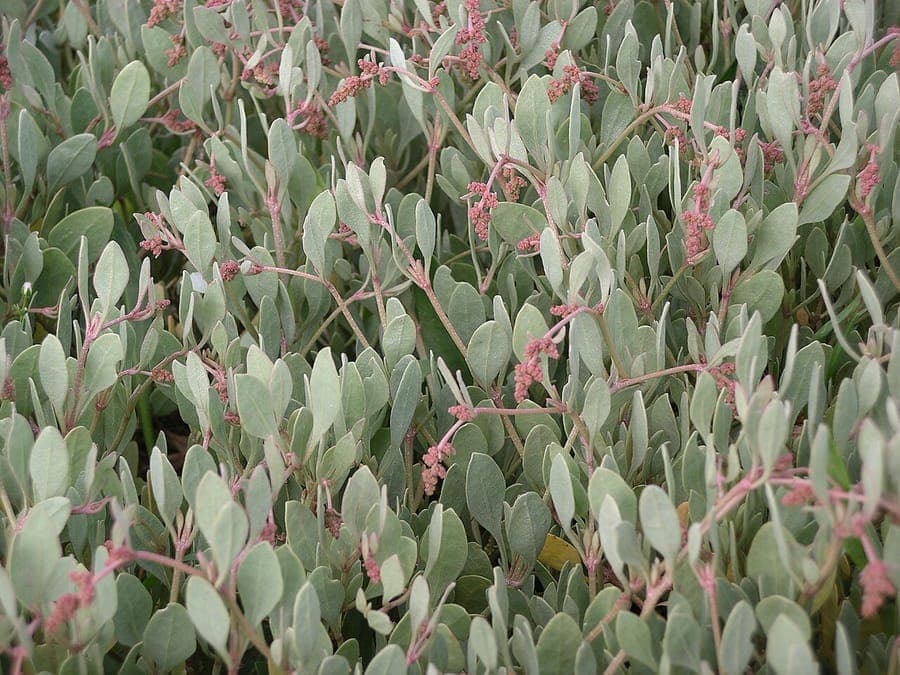
Sea purslane grows as a compact-growing shrub reaching approximately 50-100 centimeters in height and spread. The plant features characteristic succulent, gray-green to silvery foliage. These leaves are adaptations to salty environments. The flowers are small and inconspicuous, growing in leaf axils and displaying greenish to yellowish coloring.
The plant retains its foliage year-round in mild climates, making it a valuable structural plant for winter interest.
Ideal location
Sea purslane thrives best in locations with full sun. The plant can tolerate partial shade, though this may cause less compact growth. The plant tolerates strong wind well and can be used in windy coastal climates.
Soil
Sea purslane prefers sandy, well-draining soils. The plant is extremely tolerant of salt-rich soils and can even grow in boggy grounds. This makes it ideal for salt mitigation or areas prone to salt intrusion. The plant tolerates various pH levels well. Ensure good drainage to avoid waterlogging.
Free design
Want to see Sea purslane: complete guide in your garden? Make a free design now.
Watering
Once established, sea purslane is very drought-tolerant. Young plants require regular water until well-rooted. Mature plants require minimal supplemental water except during prolonged drought. In coastal areas with regular rainfall, supplemental watering is rarely necessary. Excessive watering must be avoided.
Pruning
Sea purslane requires minimal pruning. The plant naturally grows compact. In spring, remove damaged branches and lightly prune if desired to maintain shape. Pruning is particularly useful if you wish to use the plant as a hedge.
Maintenance calendar
Jan-Mar: Light pruning, shape maintenance Apr-May: Stimulate growth with water Jun-Jul: Regular maintenance Aug-Sep: Reduce watering Oct-Dec: Rest period, form inspection
Winter hardiness
Sea purslane is hardy to approximately -5 to -10 degrees Celsius. In milder coastal regions, the plant can retain foliage year-round. In colder climates, lower portions may be damaged but the plant will regenerate in spring. Mulch can help protect roots in very cold areas.
Companion plants
Sea purslane pairs well with:
- Erica (Heather)
- Fuchsia
- Pittosporum
- Genista (Broom)
- Other coastal plants
These combinations create interesting coastal-like landscapes.
Conclusion
Sea purslane is an excellent structural plant for coastal gardens and windy climates. With its salt resistance and low maintenance requirements, it is a perfect choice for challenging locations. Visit gardenworld.app/en for more garden designs featuring hardy, resilient plants.
Want to see Sea purslane: complete guide in your garden? Make a free design now.
Upload a photo, pick a style, and get a photorealistic design with plant list in under a minute.
No credit card required


Similar plants
Bassia laniflora (woolly summer-cypress): complete guide
Bassia laniflora
Full guide to Bassia laniflora: origin, appearance, ideal location, soil, watering and care for this drought-tolerant annual.
Suaeda spicata: complete guide
Suaeda spicata
Everything about Suaeda spicata (spiked seablite): a rare salt-tolerant coastal succulent from the western Mediterranean and Macaronesia.
California amaranth: complete guide
Amaranthus californicus
Full guide to California amaranth (Amaranthus californicus): growing tips, ideal location, soil needs, watering, and garden design ideas.